Warming the teaware and rinsing the leaf 温壶烫杯
Warming raises the temperature of the first infusion by several degrees, and a rinse helps dense leaf open. They are two separate steps, and not every tea needs both.
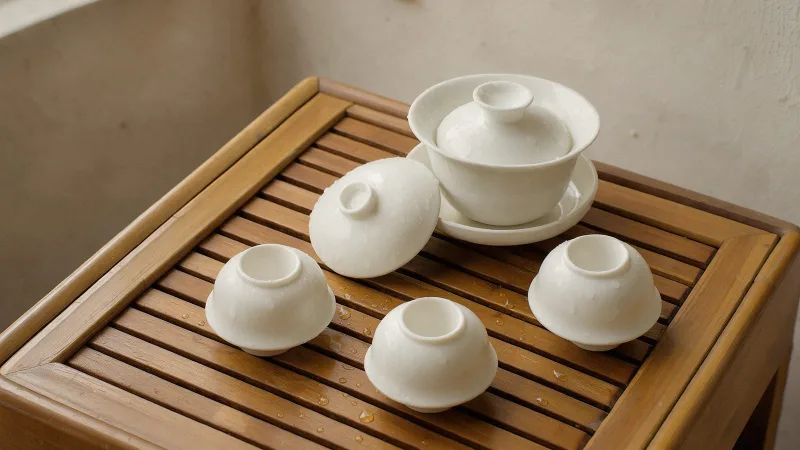
- Warming:
- boiling water into the empty vessel, then pour out
- Rinse:
- a pour of up to 10 s, straight to the waste
- Warming adds:
- +5 °C in the first minute (small porcelain)
- Rinsed:
- pu-erh, dark tea, pressed white tea
- Not rinsed:
- green, yellow, young white, black
- Flavor loss:
- 0–11% of five compounds with a 5–30 s rinse
Pour boiling water into an empty pot, wait a few seconds, and pour it out. That is warming. Then add the leaf, cover it with water and pour that off at once. That is rinsing. The two steps usually run back to back and often get lumped together, but they do different jobs. Warming is for the vessel, rinsing is for the leaf, and many teas need no rinse at all.
What warming does
A cold vessel pulls heat out of water you have just boiled. The smaller the vessel and the thinner its walls, the bigger the loss. The measurements come from hobbyists with thermometers, and no laboratory study of warming exists, so treat the numbers as orders of magnitude.
In 2026, TeaDB poured water into a 75 ml porcelain vessel. Unwarmed, it read 90.6 °C right away, 85 °C after a minute and 76.7 °C after five. Warmed, it read 96.1, 90.6 and 79.4 °C. That is about 5.5 °C more in the first minute, and by minute five the gap shrinks to 3 °C. Akira Hojo tested clay pots: a minute after the boiling water went in, a 100 ml pot had dropped to 79 °C and a 300 ml pot to 85 °C. A small pot loses heat faster, and one warming is not enough for it. After one 10-second warming the reading was 81.5 °C, after two it was 89 °C.
Three conclusions follow:
- Warm, then brew right away. After five minutes the advantage is almost gone.
- The smaller the vessel, the more warming matters, and for a 100 ml pot it is not optional.
- Never fill a vessel halfway. In TeaDB's tests it cooled faster than a cold full one: 57 °C against 77 °C after five minutes.
Material matters less than you would think. In tests by Stéphane Erler of Tea Masters, an unwarmed glazed 218 g gaiwan lost more heat than a silver pot and a fairly thick-walled clay pot. In the TeaDB experiment, warmed porcelain, Yixing clay and a large pot behaved almost the same. Nothing in the measurements supports a clear rule that clay holds heat better.
A common gongfu cha rule of thumb says a cold gaiwan takes 10–15 degrees off the first infusion. The measurements spread wider: about 5 °C for small porcelain and about 20 °C for a 100 ml clay pot. Plan on 5–20 degrees, depending on volume.
How to warm
In gongfu cha, warming is part of the sequence:
- Pour boiling water into the gaiwan or pot and put the lid on.
- Pour the water into the fairness pitcher (chahai), then into the cups. They warm along the way, and the water cools to a drinkable temperature.
- Pour it out onto the tea tray (cha pan).
- Add the leaf to the hot, wet vessel, close the lid for 10–20 seconds and smell it. Warm dry leaf releases its aroma.
A small pot gets warmed twice. Chaozhou masters go further and pour boiling water over the outside of the closed pot so the walls stay hot. Weng Huidong wrote in 1957: "hot cup and hot pot, only then does the aroma rise"1. Aim the stream at the center when scalding cups, because thin porcelain can crack if the water hits the rim.
Warming is older than rinsing. In the 11th century Cai Xiang told drinkers to warm the bowl before whisking powdered tea, since foam would not hold in a cold one. Rinsing whole leaf shows up in Ming texts. In 1541 Gu Yuanqing said to wash the leaf with hot water to remove dust and "cold qi", and around 1642 Feng Kebin asked for water that was hot but not at a full boil, which in his words would wash all the flavor away. Lu Yu does not mention rinsing at all, so do not credit him with condemning it.
What rinsing does
In a pressed cake, a brick or a rolled oolong ball, the water at first reaches only the outer layer of leaf. The first pour from such tea comes out empty while the leaf swells and loosens. A rinse helps it open sooner. With aged and heavily fermented tea it also carries off the warehouse smell that clings to the surface.
Chinese sources separate three actions. The first is warming the vessel (温壶). The second is rinsing, xi cha (洗茶), a pour that is thrown away. For oolong it is called wen run paowen run paoWarm moistening infusion (温润泡): water goes over the leaf and is poured off quickly so the leaf softens. The usual Chinese and Japanese word for rinsing oolong.. The third is "awakening" (醒茶), which comes in two kinds. Wet awakening is the same as a rinse. Dry awakeningdry awakeningBroken-up pressed tea is kept in a clean, ventilated jar for several days to two weeks so the storage smell airs out. works differently: broken-up pressed tea sits in a clean, ventilated jar for several days, even up to two weeks. Russian-language articles also call a rinse a "zero infusionzero infusionThe Russian name for a rinse: a pour before the real brew starts, poured off without tasting." or a "technical infusion", meaning the pour before real brewing starts.
A rinse has a cost. Amino acids, which carry sweetness and umami, dissolve faster than catechins. In a sencha experiment almost half of the free amino acids came out in the first infusion, while catechins reached only a little over half by the third. So a short pour-off costs more sweetness than bitterness, and pouring delicate tea down the drain is a waste. In a 2019 study by Gao and coauthors, a 5–30 s rinse cut five functional compounds (EGCG and caffeine among them) by 0–11% in the following infusion2.
Which teas need a rinse
The table runs from teas that need a rinse to teas that do not. The seconds and the number of rinses are guidelines from individual sources, not a standard.
| Tea | Warming | Rinse | Time | Rinses |
|---|---|---|---|---|
| Sheng and shou pu-erh | yes | yes | up to 3–10 s | 1 for sheng, 2 for shou |
| Aged, dense "warehouse" tea | yes | yes, longer | up to 1–2 min for very dense pressing | 2 or more |
| Pressed white | yes | yes | up to 10 s | 1–2 |
| Rolled oolong | yes | disputed | up to 10 s | 0–1 |
| Rock oolong | yes | often skipped | – | 0–1 |
| Black, yellow, young loose white | yes | no | – | 0 |
| Delicate green | yes, water cooled in the pitcher | no | – | 0 |
Tieguanyin balls are dense, so many people do one short pour of 3–5 seconds. Rock teas such as Da Hong Pao often go unrinsed: according to white2tea, the rinse is "too tasty". Black teas like Jin Jun Mei and green teas are not rinsed, because their first pour is the most aromatic. In Japanese service the teaware is warmed to cool the water and measure the volume, and sencha and gyokuro are not rinsed.
7 g per 110 ml, as on the pu-erh page, water at 95–100 °C (203–212 °F). Warm the gaiwan and cups, add the leaf, pour water over it and pour it off within 3–10 seconds. Let the leaf rest 10–20 seconds in the hot vessel, then start the first infusion. Rinse tightly pressed tea twice, or leave it under the lid so the residual heat steams the leaf open.
Where masters disagree
There is no consensus on rinsing oolong. White2tea and the Shanghai Center for Disease Control suggest a quick pour of up to 10 s. Erler does not rinse oolong: the first taste is the lightest and most valuable, and after fixation the leaf is no longer a raw product. He warms the vessel thoroughly instead. Red Blossom Tea does a long first infusion for rolled, lightly oxidized oolongs, until the leaf has opened to two thirds. Erler also points out that many people rinse the leaf when what they really need is to warm the pot.
Timing is disputed too. The Shanghai center recommends up to 3 s for pu-erh, up to 10 s for oolong and about 3 s for delicate green. White2tea says up to 10 s, and over a minute for very dense pressing. One Russian magazine allows even green tea a rinse of 1–2 s at 75–85 °C, but most sources do not rinse green. The practical answer is to brew the same tea twice, with and without a rinse, and compare. Your own taste is more reliable than someone else's table.
What rinsing does not do
Rinsing is often justified as a way to wash out pesticides and caffeine. Hojo and Chinese authors note that residues mostly sit inside the leaf, and water does not flush them out. In Gao's experiment, 0.2–24% of pesticides moved into the rinse water in 5–30 s. According to Hicks, Hsieh and Bell, caffeine splits across three infusions as 69, 23 and 8%. Nigel Melican used their data to estimate a loss of about 9% in 30 s, but that is a calculation, not a measurement.
If safety is the concern, a rinse is weak protection. What helps is tested tea from clean raw material. Boiling water and a dry pour change little here.
Common questions
Do you have to rinse tea?
Pu-erh, dark tea and pressed white tea benefit from it: dense leaf gives up little in the first pour, and a rinse helps it open. Green, yellow, young white and most black teas are not rinsed. Oolong is disputed: some masters do one quick pour, others skip it.
Does a rinse wash out pesticides and caffeine?
Very little. In a 2019 experiment, 0.2 to 24% of pesticides moved into the water in 5–30 s, depending on the compound. About 9% of the caffeine goes in 30 s, and that figure is a calculation, not a direct measurement. Most of it stays in the leaf.
What if the pot is small?
Warm it twice. In one set of measurements, a 100 ml clay pot read 81.5 °C a minute after filling when warmed once for 10 seconds, and 89 °C when warmed twice. And do not fill a vessel halfway: it cools faster than a cold full one.
-
Weng Huidong, "Chaozhou Tea Classic: Gongfu Cha", 1957. In 2008 the procedure was entered into China's national intangible heritage list as "Chaozhou gongfu tea art" (X-107): https://www.ihchina.cn/project_details/15247/ ↩
-
Gao W. et al., "Rinsing Tea before Brewing Decreases Pesticide Residues in Tea Infusion", Journal of Agricultural and Food Chemistry, 2019, 67(19): 5384–5393: https://pubs.acs.org/doi/10.1021/acs.jafc.8b04908 ↩