Teaware 茶具
A Chinese tea set is built around the vessel where the leaf opens up. Everything else is there to decant the liquor, serve it and drink it hot.

Brewing tea the Chinese way takes only a few things, and each has its place. The leaf steeps in a gaiwan or a small teapot, then the whole infusion goes into a fair cup, which stops the steeping. From there it is poured into small cups of two or three sips each, while the water used to warm the teaware drains into the basin of a tea tray. Together these are the brewing vessels, and the spout, filter and lid of a pot decide whether it pours in a clean stream or dribbles down the side.
What goes in a set
Utensils surround the vessel: a kettle with temperature control, a scoop and scale for the leaf, tongs for hot cups, a strainer for fine leaf, a caddy for dry leaf. The minimum set for gongfu cha is a gaiwan or teapot of 100–200 ml, a fair cup slightly larger than the vessel, two to four cups of 30–50 ml, a strainer, and a kettle or thermometer. A tea tray and tongs can wait until the habit sticks. For Western-style brewing, a teapot with a strainer and a large cup are enough.
Porcelain, clay, glass, metal
The material determines how much heat the leaf gets and whether the smell of earlier teas lingers in the vessel.
Porcelain is dense and glazed. It absorbs nothing and washes perfectly clean, so you can brew green tea in a gaiwan in the morning and pu-erh in the same one that evening. China's main porcelain centers are Jingdezhen in Jiangxi and Dehua in Fujian.
Teapot clay is fired without glaze and stays porous. The walls are thicker than porcelain and hold heat longer, and over time a film of tea builds up inside. That is why a Yixing pot of zisha clay is kept for a single type of tea, usually oolongs or dark teas that want boiling water. Besides Yixing, potters dig their own teapot clay in Chaozhou, Jianshui, Qinzhou and Rongchang.
Glass is as neutral as porcelain and transparent too, which is why fair cups are often made of it. It holds heat worst of all, and with delicate green and yellow tea that does more good than harm. On the tea table, metal mostly means boiling water: the cast-iron tetsubin, silver and copper kettles.
Teaware of other countries
Japan, Korea, Europe and Russia each made teaware for their own way of drinking tea. In Japan, loose green tea is brewed in a kyusu with a side handle, and matcha is whisked in a wide chawan bowl. In Korea, the water for green tea is cooled in a separate sukwu bowl. Europeans first shipped teapots from China, began copying Yixing pots in Delft around 1678–1680, and made their own porcelain in 1708. In Russia, tea water was heated in a samovar.
Care and collecting
Care and collecting start simply. Porcelain and glass wash like any dishes, but unglazed clay gets plain water only, because it soaks up the smell of detergent as readily as tea. Old and signed pieces are harder. A mark on the base proves nothing, and age is read from the body, glaze and foot. With a new painted cup, it is worth checking that no lead or cadmium leaches from the glaze into the tea.
Where to start
Start with a white porcelain gaiwan of 120–150 ml. It handles any type of tea, the white bowl shows off the color of the liquor, and a broken one is cheap to replace. Add a fair cup and a couple of cups next. A Yixing teapot can wait until you know which tea you drink most, since its clay, shape and volume are matched to that tea.
-
 Brewing vessels
 for gongfu cha: the gaiwan, Yixing teapot, fair cup, cups and tea tray. Typical volumes, materials, and how the spout, lid and filter work.
Gaiwan · Yixing teapot · Teapot anatomy: spout, lid, handle and filter · Fair cup (chahai) · Tea cups · Tea tray (cha pan)
-
 Utensils
The tea utensils around the brewing vessel: kettle, heat source, scale and thermometer, tongs and scoop, strainer, caddy. What to buy first, what later.
Water kettles · Tea tools: the six gentlemen, pu-erh knife, tea pets · Strainers, infusers and tea bags · Heat sources for tea · Scales, thermometers and timers · Tea caddies: tin, ceramic and metal
-
 Materials
Chinese pottery and porcelain from Chaozhou to Dehua, heat-proof glass, cast iron, silver, tin and copper. How each one behaves in use.
Chinese ceramics and porcelain · Glass teaware · Metal teaware: tetsubin, silver, tin and copper
-
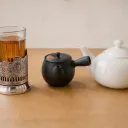 By region
Teaware of Japan, Korea, Europe and Russia: kyusu and chawan, dagwan and sukwu, Delft copies of Yixing pots, Meissen porcelain and the samovar.
-
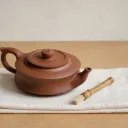 Care and collecting
Teaware care and yang hu, marks and fakes, what sets the price of old pieces, lead and cadmium in glazes, dyed zisha, and Chinese and EU limits.
Caring for teaware and seasoning a teapot (yang hu) · Collecting and authenticating teaware · Is your teaware safe? Lead, adulterated clay and standards