Cold brew and iced tea 冷泡茶
Pour cold water over the leaf and leave it in the fridge for hours, or pile ice on top and let it melt. The tea comes out softer and sweeter, but without hot water nothing kills the bacteria on the leaf, so timing matters.
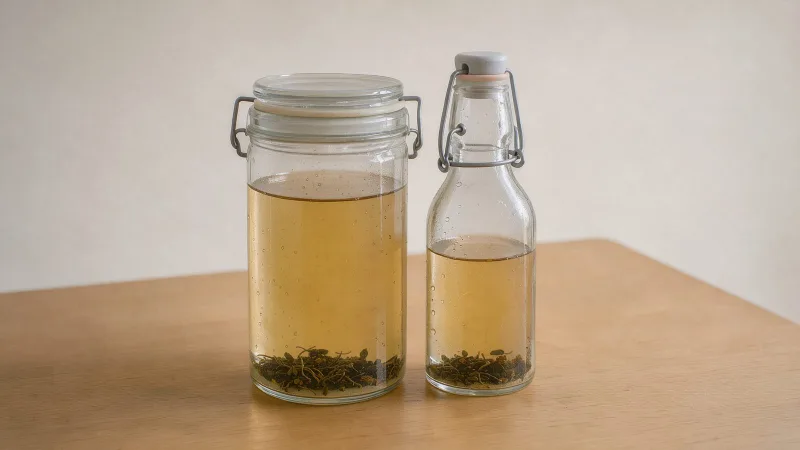
- Leaf to water:
- 1:50, or 20 g per liter
- Temperature:
- 4 °C, fridge
- Time:
- 4–10 hours, by tea type
- Keeps:
- 1–3 days in the fridge
- Not suited to:
- ripe pu-erh and other dark teas
Cold brew is more than a summer drink. Hot water pulls everything out of the leaf at once, while cold water is selective. The same tea steeped overnight in the fridge comes out sweet and round, without the bitterness that creeps into a hot cup by the third minute.
There are three methods, and they have little in common beyond the result. You can leave the leaf in cold water for hours or bury it under melting ice. Or you can brew a strong hot infusion in a couple of minutes and pour it straight over ice.
What happens in the water
At 4–10 °C, theanine and epigallocatechin (EGC) extract readily. Epigallocatechin gallate (EGCG) and caffeine come out noticeably less readily: according to Japan's NARO research institute, at 10 °C EGCG reaches about a fifth of its hot-brew level, and caffeine about half.
Theanine accounts for sweetness and umami, EGCG and caffeine for bitterness and astringency. The taste is softer because the cup holds a different mix of compounds. Taiwanese researchers compared green tea steeped cold for 4 hours with a 5-minute hot infusion. The cold one had about 30 % of the hot one's caffeine.
That softness comes at a single cost. In ordinary hot brewing the water also sanitizes the leaf, while in cold brewing the bacteria from the dry tea stay in the liquor. Remember this above all else.
Cold brew in the fridge
This is the simplest and most predictable method. In Japan it is called 水出し (mizudashi), in Taiwan 冷泡茶 (lěng pào chá).
Weigh the leaf, cover it with cold water, close the container and put it in the fridge. Taiwan's tea stations work from 1:50, or 20 g per liter, at 4 °C. In Japan people use 10–15 g per liter and wait 8–10 hours. The gap comes down to dose: the more leaf, the less time it needs. For sencha, NARO gives 3 g per 100 ml and "from one hour".
Leaf shape matters too. Oolong rolled into balls unfurls slowly, while thin twisted leaf opens fast.
| Tea | Time at 1:50 and 4 °C |
|---|---|
| Green | 4 h, longer turns astringent |
| Baozhong (light oolong) | 6 h |
| Dong Ding, Tie Guan Yin | 6 h |
| High-mountain oolong | 8 h |
| Red oolong, black tea | 10 h |
Use soft water. The Taiwanese recommendation is pH 6–6.5 and hardness below 120 mg/l. In Japan, tap water is boiled and cooled to get rid of the chlorine smell. The guide to water for tea covers what else can get in the way.
20 g of leaf, 1 liter of cold boiled or bottled water, fridge (4 °C, 39 °F), 4–10 hours depending on the tea. Before serving, swirl the bottle without shaking it: the liquor settles to the bottom. Take the leaf out and drink the tea within a day.
No fridge, and you want tea in two hours? The Taiwanese institute suggests 8–10 g per 600 ml of bottled water at room temperature. Pick twisted leaf (baozhong, black tea), which opens faster than balls, and drink the tea right away.
Ice brewing
Japanese 氷出し (koori-dashikoori-dashiThe Japanese method 氷出し: ice is piled on the leaf and the liquor collects drop by drop as it melts.) is a method for the patient. Ice goes on top of the leaf, and the liquor collects drop by drop from the meltwater.
A Kyoto tea house gives the classic version: 10 g of gyokuro and 50 g of ice, steeped for about two hours. The ice may not melt completely, and that is fine. You get only a little liquor, but it is thick, enough for a sip rather than a glass. For a second infusion, add cold water.
There are mixed versions too, and the same house lists five. Ice plus water: 10 g of gyokuro, 100 g of ice and 200 ml of water, the same two hours. Cold water with no ice: 10 g in 300 ml, about 30 minutes. The hot version, 熱湯氷出し: 100 ml of boiling water on the leaf, then about 200 g of ice right away. The boiling water opens up the aroma, and the instant chill tames the bitterness.
Ice brewing is worth the effort for good tea. Gyokuro and first-flush sencha are rich in amino acids and show at their best in the cold.
Hot concentrate over ice
If you want a glass by lunch, the hot method is faster and safer. Brew strong, take out the leaf and pour the liquor straight over ice.
An Italian study on sencha, Tung Ting oolong and black tea used 30 g of leaf per 600 ml of water at 80 °C for 3–5 minutes, then added 400 g of ice. The green and black teas had nearly twice the EGCG of a regular hot brew at 12 g per liter, and matched a 12-hour cold brew in antioxidant activity.
The American food-service method is designed for black tea: water at 195 °F (about 90.5 °C) for 3–5 minutes, then cooling.1 That is how classic iced tea is made, and Southern sweet tea as well. For sweet tea, the sugar goes into the strong base while it is still hot, and only then is the tea diluted with water or ice. In cold tea the sugar will not dissolve properly.
If tea turns cloudy as it cools, blame the dose of leaf, not the cooling method. In America's Test Kitchen trials, tea made with 6 g of black tea per cup clouded, 4 g barely did and 2 g stayed clear. The haze goes away if you warm the tea slightly or dilute it with ice water.
Which teas to use
Japanese greens and Taiwanese oolongs do best in the cold. The Taiwanese stations consider them all suitable, so you only need to adjust the time. Baozhong is less fragrant cold, and the tight balls of Dong Ding and Tie Guan Yin need longer. Black tea works too: in Taiwan it steeps for 10 hours, and in America it is the usual base for iced tea.
Ripe pu-erh and other dark teas are not cold brewed; Taiwanese specialists advise boiling them for 1–2 minutes. The reason is their microbial load, not flavor.
Strongly flavored blends with flowers and fruit are also better made as a hot concentrate. In a Japanese study nearly all of them were heavily contaminated by microorganisms from the non-tea ingredients.
The sources give no verified parameters for white or yellow tea. Start with the general 1:50 ratio and allow extra time.
Buy certified tea for cold brewing. The leaf sits in water for a long time, and traces of water-soluble pesticides pass into the liquor in proportion to steeping time.
How long it keeps
Cold brewing does not kill the bacteria on dry leaf. A 2016 Japanese study tested dry teas and cold infusions: almost all teas carried bacteria and fungi, green tea more than oolong.2 At 35 °C, the most contaminated sample passed 10⁷ CFU/ml in 12 hours, and within a day every sample neared 10⁸. At 20 °C there was almost no growth for the first six hours. At 5 °C the count did not rise over 24–48 hours.
So keep the tea cold at all times, take out the leaf or bag, and drink from a glass rather than from the bottle. Carry it in a cooler bag when you go out, and wash and dry the bottle after each use.
Sources give different limits:
- 1 day for ice brewing (NARO);
- no more than 24 hours (Taiwan Tea Research and Extension Station);
- 2–3 days (the Japanese trade body JETRO);
- up to 3 days in the fridge (Iowa State University);
- no more than 8 hours at room temperature.
Go with the conservative limit. If the liquor thickens, turns stringy or smells sour, pour it out.
Skip sun tea, where a jar sits in the sun for six hours. The water gets no hotter than 54 °C, which is not enough to kill bacteria, and warm water is exactly what they like. The US CDC considers this method to carry a higher theoretical risk.
One myth and some history
Iced tea is often said to have been invented at the 1904 World's Fair in St. Louis. Historians disagree: iced tea was advertised in Richmond in 1856, and cookbooks were printing recipes for it in the 1870s and 1880s. Early recipes used green tea, and black tea took over after 1900 with cheap imports from India and Ceylon.
None of this matters to the ritual of cold brewing. What matters is that you can get the flavor without fire and without hurry, as long as you have a fridge and an evening.
Common questions
How much tea do I need per liter of cold water?
The Taiwanese guideline is 20 g per liter, or 1:50. Japanese sources give 10–15 g per liter and 8–10 hours. With less leaf, steep longer; with more, steep shorter. A 750 ml filter bottle is designed for 15 g of leaf and 3–6 hours.
How long does cold-brewed tea keep?
One to three days in the fridge, depending on the source. The Taiwan Tea Research and Extension Station advises against drinking it after 24 hours, while the Japanese trade body JETRO allows 2–3 days. At room temperature bacteria multiply fast, so keep it cold.
Why isn't cold-brewed tea bitter?
Catechins and caffeine, the source of bitterness and astringency, dissolve poorly in cold water. Amino acids, theanine among them, extract almost as well as they do in hot water, so the tea tastes sweet and soft.
-
CDC, memo on bacterial contamination of iced tea, 1996, as summarized by Food Safety News. The memo itself was not available to the author. ↩
-
K. Okazaki, "Preservability of cold-brewed tea made by mizudashi" (水出しで作る冷茶の保存性), Report of Tea Research No. 122, 2016: J-STAGE. ↩