Leaf size and leaf grades
The smaller the particle, the faster the tea infuses: for CTCCTCShort for crush, tear, curl. A machine with two grooved rollers turns the leaf into granules. fractions the extraction rate constant at 60 °C climbs from 0.257 to 0.685 min⁻¹. On short steeps size decides almost everything; by five minutes the gap has closed.
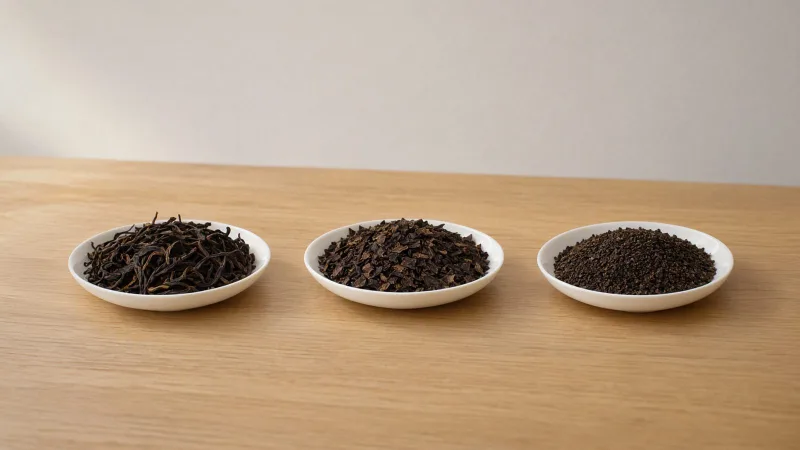
- Orthodox black tea groups:
- whole leaf, broken leaf, fannings, dust
- CTC:
- no whole leaf, only broken leaf, fannings and dust
- Extraction rate, 60 °C:
- 0.257 → 0.685 min⁻¹, coarse to fine fraction
- ISO 3103:
- 2 g per 100 ml; 6, 5 and 3 minutes
- Matcha:
- 2–15 µm stone-ground, 15–25 µm mill-ground
Open two tins of black tea. One holds dark twisted strands the length of a fingernail, the other black grit like sand. The leaves may have grown on the same bush, yet they have to be brewed differently. After drying, tea is sorted by particle size, and that sorting decides its price, its use and how many seconds the leaf can sit in the water.
Four groups of orthodox tea
Orthodox black tea (rolled, not run through a CTCCTCShort for crush, tear, curl. A machine with two grooved rollers turns the leaf into granules. machine) falls into four groups: whole leaf, broken leaf, fanningsfanningsSmall tea particles, larger than dust but smaller than broken leaf. A sorting by-product, mostly used in tea bags. and dust1.
| Group | Typical grades | What it is |
|---|---|---|
| Whole leaf | OP, FOP, GFOP, TGFOP, FTGFOP | Whole rolled leaf; extra letters describe the share of tips (buds) |
| Broken leaf | BOP, FBOP, GBOP, BPS | Pieces of leaf, "B" stands for broken |
| Fannings | BOPF, FOF, GOF | Small particles slightly coarser than dust |
| Dust | OPD, BOPD, FD, D1 | The smallest particles |
The Sri Lanka Tea Exporters Association describes BOP as small or broken pieces of leaf, and BOPF as finer than BOP but a little coarser than dust. In the same list OPA is a large, slightly open leaf, and OP1 is wirier than OP. The letters describe how the dry leaf looks; tasters judge flavor and price separately.
That deflates the most famous grade of all. Orange Pekoe is a leaf size and has nothing to do with oranges or top quality. The word pekoe comes from the Chinese 白毫 (white down), the name for young, downy shoots. No document backs the story that "Orange" nods to the House of Orange. In practice many tins with that label hold ordinary BOP.
CTC: the sieve sets the size
CTC tea has no whole leaf at all, only broken leaf, fannings and dust. The Tea Board of India standardized CTC grades in those three categories on 1 March 2011: BOP, BOPL and BP for broken leaf, OF, PF and BOPF for fannings, and PD, D, FD and others for dust. Orthodox sorting also takes shape and specific weight into account; in CTC, size alone decides.
The machine has two stainless steel rollers with spiral grooves that turn toward each other at a speed ratio of 1:10. A single pass crushes, tears and curls the leaf. Sir William McKercher invented it in Assam in the early 1930s2. For about twenty years the method failed to catch on, because early users did not shorten fermentation and got poor tea. Commercial production took off in the 1950s, and ten years later more than two thirds of Indian tea was made by CTC. It grew alongside the tea bag, which needs exactly this kind of small granule.
The practical difference shows in yield. A kilogram of CTC makes about 550 cups of 114 ml, against about 275 from orthodox tea. That works out to roughly 1.8 g of CTC per cup against 3.6 g of orthodox tea.
Traders have their own notes on the grades. In one Assam trader's experience, large BOPL brews a light liquor, BP a strong one, and dust the darkest and fastest, which is why dust ends up at tea stalls. Secondary grades with a "1" on the end (BP1, OF1) are the same size, but the particles are browner and lighter and the liquor is weaker. Watch for that digit on a label. For how people drink this tea where it is grown, see South Asia.
What size does in the cup
The smaller the particle, the shorter the path from its core to the surface. In one experiment with CTC fractions at 60 °C, the extraction rate constant rose from 0.257 min⁻¹ for the coarse fraction to 0.685 min⁻¹ for the fine one. At 80 °C, 0.33 mm granules steeped at 98% of their dissolution rate, while 1.99 mm granules managed only 68%, because in a large particle diffusion from the interior slows everything down. This fits the general physics of extraction: compounds on the surface dissolve first, and those deeper inside follow more slowly.
One caveat matters in practice. In another experiment concentration rose most steeply in the first minute, and by minute five the difference between fractions from 1.21 to 0.41 mm had shrunk to a minimum for most compounds. So size matters most when steeps are short. In gongfu cha or a kyusu, where a steep lasts a few dozen seconds, fine leaf releases far more than coarse. In a Western pot over four minutes the difference evens out.
The bag material itself slows extraction: the rate constant for caffeine is 29% lower than for the same leaf brewed loose. See strainers, infusers and tea bags for how they are built.
ISO 3103 accounts for size directly. Every tea gets 2 g per 100 ml of boiling water, but steeping times differ: 6 minutes for black, 5 for leaf green, 3 for green fannings. It is a method for comparative tasting, not a recipe for the cup at home. At home, dose and time are set together.
Grinding has its limits. When black tea was milled to 10 to 50 µm in one experiment, the equilibrium yield of polyphenols, caffeine and sugars came out the same as for millimeter-sized particles. Small particles reached equilibrium faster, but all of them got there within 45 minutes. So "finer means healthier" holds only for speed.
Deep-steamed sencha is finer than regular sencha because of the long steaming. In a test with 5 g of leaf and 150 ml of water at 80 °C it needed 40 seconds instead of 60, and the second infusion yielded more pectin, with 34% extracted over two infusions against 16%.
Whole leaf, crumbs and pressed tea
Leaf in one pot is often a mix of sizes, and Chaozhou gongfu turns that into a technique. Under the T/CTSS 5-2019 regulation, part of the rolled leaf goes to the bottom and toward the spout, the fine crumbs go in as a middle layer, and the rest of the leaf goes on top, so the leaf fills about 80% of the pot. Whole leaf at the spout acts as a filter. James at Tea DB gives similar advice for cheap, heavily roasted oolong: dust at the bottom, where the whole leaves will strain it.
Pressed tea is brittle, and the size of the pieces shapes the whole session. Use a pick rather than a knife: a pick separates the layers, while a blade cuts through leaf and makes crumbs. Start at the edge of the cake or at the dimple on the back, where the pressing is looser. Aim for flakes of a few leaves stuck together, not a solid lump or a handful of crumbs. A thumb-sized lump opens slowly, peaks late and can still be dry inside after three infusions. Crumbs release nearly everything at once and dominate the first two infusions. With both lump and crumbs in the pot, two extractions run at the same time, and by the third infusion the flavor comes apart. Breaking a cake calls for the right tea tools.
If a pack is full of fragments, shorten the steep. TeaHQ estimates that a broken batch may need only half the time of whole leaf.
China, Russia, Japan
In China, broken black tea (红碎茶) falls under GB/T 13738.1-2017, which is based on ISO 3720:2011. The standard reduced flat fragments (片茶) and crumbs (末茶) to one specification each and added requirements for moisture and dust content. Dust content is measured under GB/T 8311-2013 with sieves whose openings run from 0.18 to 0.63 mm, depending on leaf shape.
Russia's GOST 1938-90 divided packaged black tea by particle size into three kinds: large (leaf), granulated and small. Large could not be blended with small, but small could be blended with granulated. Fannings and crumbs were allowed only in single-serve, bagged tea. In 2015 the standard was replaced by GOST 32573-2013.
In Japan, after primary processing, the leaf is split into finished tea (本茶) and by-products (出物). By-products make up about 20% of the raw material: stem tea kukicha, bud tea meicha and konacha, the fine sievings of sencha and gyokuro. Konacha is served in sushi bars and brews a strong cup quickly. Do not confuse it with powdered tea 粉末茶, which is made by milling.
Matcha: size in microns
With matcha, particle size shapes the drink itself. The powder is not strained but drunk in suspension, so fineness determines color, texture and foam. The argument about grinding is older than the teapot. Lu Yu, writing in the eighth century, told readers to grind lightly dried tea so that "the best powder is like fine rice, the worst like fragments of water chestnut." That is grit, not flour. The Song treatise Da guan cha lun called for a fine sieve and double sifting, since only then does the powder float easily in boiling water and form a glossy foam.
Today stone grinding reaches 2 to 15 µm at about 40 g an hour per millstone, while a mill reaches 15 to 25 µm at 10 to 15 kg an hour. Stone-ground particles are uneven and angular, which, according to a Kyoto producer, makes for excellent foam; mill-ground powder gives only average foam. But "the finer the better" does not hold: a powder that is too fine looks whitish, picks up static and clumps in the bowl. For how to prepare it, see matcha.
The Chinese standard GB/T 34778-2017 sets an upper limit on particle size: D60 of no more than 18 µm by laser diffraction, and the "Zhejiang Made" group standard for beverages asks for 15 µm. In reference tables, 800 mesh (openings per inch of sieve) equals 18 µm and 1000 mesh equals 13 µm. The standards set no lower limit.
Common questions
What does Orange Pekoe on the label mean?
It is a leaf-size grade, not a flavor or a mark of top quality. Pekoe goes back to the Chinese 白毫 (white down), the name for young, downy shoots. The idea that it tastes of orange is wrong, and no document supports a link between "Orange" and the Dutch House of Orange. Many tins marked this way hold plain BOP, which is broken leaf.
Is whole leaf always better than small leaf?
No, they do different jobs. Whole leaf suits many short infusions, while small leaf brews a strong cup fast, which is what tea bags, milk tea and mugs need. Grade letters describe the look of the dry leaf, not the taste.
What do I do with the crumbs at the bottom of a pu-erh or oolong pack?
Put them at the bottom of the pot under whole leaf, which strains them. If a batch is full of fragments, shorten the steep: broken tea may need only half the time of whole leaf.
-
Indian Tea Association, orthodox grade list: https://www.indiatea.org/orthodox. CTC grade standard of 1 March 2011: https://www.indiatea.org/ctc_tea_grade ↩
-
Sources disagree: 1930 (KKHSOU), 1931 (National Geographic, Goodricke), 1932 (CDS paper), hence "early 1930s". See https://www.goodricke.com/tea-garden/assam/amgoorie and https://www.nationalgeographic.com/culture/article/tools-6-things-to-know-about-tea-bags ↩