How a Yixing teapot is made: shaping, marks, classic shapes 紫砂壶成型
A Yixing teapot is not thrown on a wheel: a round body is beaten into shape with a wooden paddle, and a faceted one is joined from slabs. The method affects price and authenticity, not how the tea tastes.
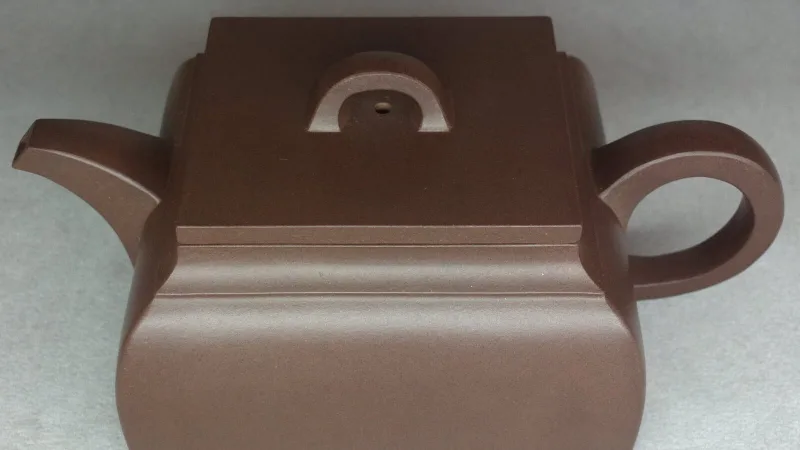

- Base method:
- clay slabs, not a potter’s wheel
- Round body:
- paddled out (打身筒)
- Faceted body:
- joined from slabs (镶身筒)
- Timing:
- 1–3 days to build, 2–5 to dry
- Firing:
- 1100–1200 °C
- Heritage:
- Ⅷ-1, first PRC national list, 2006
You can turn a Yixing teapot in your hands for a minute and still not guess how it was made. Outside there is a smooth reddish wall, and inside there is nothing extra. Yet the craft behind it went onto China’s first national list of intangible heritage in 2006, as item Ⅷ-1.1 To understand what you are holding, you need to know how a pot is built, how handmade, half-handmade and cast work differ, which shapes count as classic and what the marks mean. The Yixing clays and the history of Yixing teapots have their own pages.
How the body is built
Yixing potters barely use the wheel. They roll the clay into strips and slabs and assemble the vessel from those. The heritage register sums up the canon: beat out a slab, paddle out the body of a round vessel or join the body of a faceted one, then polish the surface and, if wanted, carve an inscription.1
For a round body, the potter uses a compass cutter to slice a band, a base disc and a support ring from the slab. The ring goes at the center of a turntable, the band is wrapped around it and the seam glued, and then the potter beats the outside with a thin wooden paddle, supporting the wall from inside with the left hand. A faceted body is cut from a slab using templates and joined with a fat clay paste. The glue comes from the same aged clay, so after firing the seam is almost invisible.
The clay keeps drying, so an unfinished pot stays under a damp cloth or plastic film. Most pots take one to three days to build, and the raw piece then dries for two to five days before firing.2 Spout, handle and knob are rolled separately and fixed on with slipslipClay thinned with water to a liquid. Potters use it to glue parts together or pour it into plaster moulds.. Each step has its own name in the Yixing dialect: “setting the neck”, “piercing the spout”, “closing the joint”. One of them is “push the wall, scrape the base”, where the clay is pressed from inside to close small cracks.
Potters make their own tools, and they number in the hundreds. The register says “more than a hundred”; one craftsman from a family of potters counted about 120 for a single pot of the duozhi shape. The essentials:
- the paddle, rosewood, about 28 cm long and 10 cm wide, for beating out the body;
- the mallet, beech or jujube, for flattening slabs, which takes about three months to learn;
- the compass cutter, bamboo with an iron pin, for cutting round parts;
- profile scrapers, bamboo, for shaping the curve of shoulder and base, with a separate set for each shape;
- the mingzhenmingzhenA strip of ox horn (明针) kept in water, used at the end to compact and polish the surface., for compacting and polishing the surface at the end.
The base mark goes on with a small wooden mallet while the base is supported from inside, at the point when the blank is neither soft nor dry.
Fully handmade, half-handmade, cast
The market sorts pots into four groups by how they are made. The grouping says nothing about quality.
| Method | How it is made | How to recognize it |
|---|---|---|
| Fully handmade (全手工) | Body paddled out or joined from slabs, without a model to set the shape | Vertical seam inside, slight asymmetry, lid fits best in one position |
| Half-handmade (半手工) | A slab or rough body is pressed into a plaster mould and finished by hand | Paired mould lines, very even wall, scraped base |
| Slip-cast (灌浆) | Slip is poured into plaster and removed after 1–2 minutes | Light, thin even walls, smooth surface without grain |
| Wheel-thrown (手拉坯) | Thrown on a wheel, spout and handle often cast separately | Concentric rings inside |
This is where the disagreements start. Some Yixing makers reject the split into “handmade” and “half-handmade” altogether, since even a fully handmade pot is often finished in a mould and the only difference is how much of the work the mould does. The American author Jason Cohen calls a pot fully handmade only if no mould or template was used.2 Wheel-throwing is disputed too. One Yixing author writes that real zisha cannot be thrown without adding kaolin. Another reference treats wheel-thrown Chaozhou pots such as the shoula as a legitimate tradition of their own.
None of this changes the basics. There is no mechanism by which a fully handmade pot would brew better. What handwork buys you is craftsmanship and resale value. A half-handmade pot is fine for daily brewing, and most good working pots are made this way. Yixing authors hold that a cast pot cannot be made from real grainy zisha, so they class cast pots as “not real zisha”.
If a seller calls a pot “fully handmade” and prices it like a factory mug, do not believe it: a master’s day of work does not come that cheap. You cannot tell the method from a photo of the outside, since the evidence is inside the body and under the lid. Other signs of a fake are on the main Yixing teapot page.
Firing
Pots go into the kiln raw and unglazed. Until the mid-20th century they were fired in dragon kilns, long sloping tunnels about 40 m long that ran up a hillside and burned wood and brushwood. The kiln was held at 1100–1200 °C for 40–42 hours and then took another 15–24 hours to cool.
Zhou Gaoqi, writing around 1640, already describes sealing teapots five or six at a time in a ceramic box to keep them from cracking. An overfired piece is “old” and ugly, an underfired one is “young” and smells of earth.
Today 99% of output is fired in electric and gas kilns. But the Ming-era Qianshu dragon kiln, 43.4 m long, is still in use. It holds about 8,000 pieces, has been a nationally protected monument since 2006 and is lit six to eight times a year. According to its kiln master, zhuni is fired at 1150 °C and duanni at 1200 °C. Any hotter and the surface blisters and sinters almost to porcelain.
Classic shapes
The register divides wares into plain (round and faceted), ribbed, and “floral” shapes that imitate natural forms. These are the shapes you see most often. Most attributions rest on tradition rather than documents.
- Xishi (西施). Round body, short thick spout, handle like an inverted ear. Attributed to Xu Youquan.
- Shipiao (石瓢). Pyramid-shaped body, short straight spout, low center of gravity. One of the “Mansheng 18 shapes”.
- Shuiping (水平). A small light pot whose spout, rim and top of the handle sit on one line. The name means it “stands level”.
- Dezhong (德钟). A bell. Attributed to Shao Daheng; the era is given as Jiaqing to Daoguang, while the Hong Kong Museum of Tea Ware says Daoguang to Xianfeng.
- Hanwa (汉瓦). A cylinder widening toward the top, with a flat lid and a bridge knob. Modeled on a Han roof tile.
- Duoqiu (掇球). Three spheres: body, lid, knob. Cheng Shouzhen’s version is the accepted benchmark.
- Panhu (潘壶). A pear. Named for the client, salt merchant Pan Shicheng, with the mark on the lid rim rather than the base.
- Dongpo tiliang (东坡提梁). A pot with a tall bail handle over the lid.
The last one comes with a popular misconception. Su Shi did not invent it; he boiled tea in a stone pot called a “tiao”. The shape with this name dates from 1932. Wang Shijie, director of the Yixing school, gave it the name, and Wang Baogen made the first one for an exhibition in Chicago.
For brewing, shape matters as much as looks. A low wide shipiao suits a bigger measure of leaf, and a small shuiping is meant for gongfu. How the spout, handle and lid affect the pour is covered under teapot anatomy.
How to read the marks
Marks go on the base, under the lid and under the handle. They identify the maker, the workshop or the client.
- A square four-character base seal usually reads top right, bottom right, top left, bottom left. That gives three characters of the name and 制 “made”.
- Small paired seals under the lid usually carry the potter’s family and given name. The same may appear under the handle, or, on pots from Republican-era workshops (1911–1949), the shop name.
- On “Mansheng” pots the seal of Chen Hongshou’s studio, “阿曼陀室”, sits on the base and Yang Pengnian’s “彭年” under the handle, and the body carries poems and Mansheng’s signature. The Hong Kong museum’s own descriptions disagree on where “阿曼陀室” goes: on the base or under the lid.
- A “中国宜兴” mark with no name is the typical stamp of Factory F1 from 1966 to about 1975, when personal marks were banned.
A mark is the least reliable sign of authenticity. Famous masters were already being copied in the late Ming, and during the Republic the future masters Gu Jingzhou and Wang Yinchun learned by faking old pieces. The generic mark “荆溪惠孟臣制” is stamped on countless pieces, and in Chaozhou “Mengchen” is simply the word for a Yixing brewing pot. So read the mark together with the shape, the seam, the weight and the fit of the parts.
What to check in hand
Function comes first, beauty second. The lid should sit flush and turn without catching, the spout should pour without drips and cut the stream cleanly, and a full pot should feel balanced when you hold it by the handle. There is also the “three peaks” test (三山齐). Set the pot upside down without its lid on a flat table, and spout, rim and handle should land in one plane.
Under the Chinese standard GB/T 10816 for zisha ware, whose latest edition has applied since July 1, 2025, water absorption of a teapot may not exceed 6.0%, and a filled pot must not leak within 24 hours.3 How to prepare and look after a new pot is covered under caring for teaware, and the pot is most at home in gongfu cha.
Common questions
Is a fully handmade pot better than a half-handmade one?
Not for the tea. Taste depends on the clay, the firing and the volume, not on whether the blank was pressed into a plaster mould. Handwork raises the price and the value to collectors. Half-handmade is a legitimate method. The fraud starts when such a pot is sold as fully handmade.
Does the mark on the base prove who made the pot?
No. Marks get copied, and generic ones such as “荆溪惠孟臣制” appear on thousands of pieces. Judge the shape, the seam inside and the fit of lid and spout, and treat the mark as a hint.
How can I tell whether a pot is slip-cast?
Not from a single photo of the outside. Ask for pictures of the inside of the body and under the lid, and ask for the method in Chinese: 全手工 or 半手工. A cast pot is light, with thin even walls and a surface without grain.
-
Yixing zisha pottery craft (宜兴紫砂陶制作技艺), Ⅷ-1, no. 351, first list of 2006. China Intangible Cultural Heritage register. ↩ ↩
-
Jason M. Cohen, Making a Yixing Teapot, Tea Technique, 2024; The Chinese Tea Handbook, Handmade, Half-Handmade or Slip-Cast, 2026. ↩ ↩
-
GB/T 10816-2024 “Zisha ceramic ware”, approved Dec 31, 2024. Standard record. ↩