Jin Jun Mei 金骏眉
Black tea made only from the spring buds of bushes in Tongmu village, in the Wuyi Mountains. It was first made in 2005, and within a few years it became one of the most expensive black teas in China.

- Province:
- Fujian, Wuyi Mountains, Tongmu village
- Made since:
- 2005
- Raw material:
- a single bud, no leaf
- Processing:
- no pine smoke
- Dry leaf:
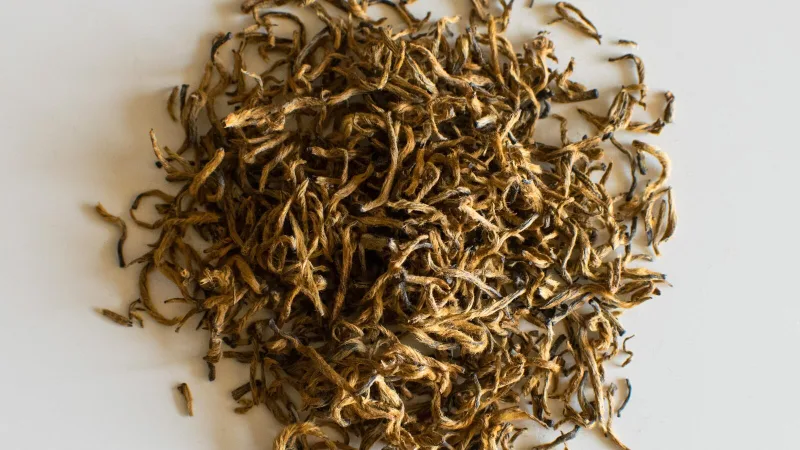
- small, thin, black with gold
- Liquor:
- honey, flowers, baked sweet potato
Jin Jun Mei (金骏眉) is a black tea made only from buds in the village of Tongmu in the Wuyi Mountains, the home of Zheng Shan Xiao Zhong. It is a little over twenty years old, which for a Chinese tea is almost nothing.
The name translates as "golden eyebrows of a steed", and each word has its own explanation. Jin, "gold", refers to the color of the buds and the liquor, and to the price as well. Mei, "eyebrow", is an old comparison of a thin curved bud to an eyebrow. The syllable jun has several interpretations.
How it began
Until 2005 Tongmu made only Zheng Shan Xiao Zhong, from a bud with several leaves. Nobody made black tea from buds alone: they are hard to pick and easy to spoil.
In the summer of 2005, in June or July (sources differ), tea merchants from Beijing suggested that one of the Tongmu factories try a black tea of pure buds. The makers picked the buds, withered them, rolled them by hand on glass so they would not break, then oxidized and dried them. By the factory's account, the batch came to three liang of dry tea, about 150 grams. The technique was refined in 2006, and the first batches went on sale in 2006–2007. A ladder of grades took shape at the same time: Jin Jun Mei from buds, Yin Jun Mei ("silver") from a bud with one leaf, Tong Jun Mei ("copper") from a bud with two leaves.
Then came a dispute over who invented it. The factory that made the first batch claims the tea as its own, while other Tongmu producers say it belongs to the whole village. Both sides filed trademark applications in 2007. In 2013 the Beijing Higher People's Court ruled that "Jin Jun Mei" had become the generic name of a kind of black tea, and a generic name cannot be a trademark1.
The name is just as disputed. One version says the syllable jun comes from Liang Junde, the master who made the first batch. Another says "jun" appeared in the names of three masters at once and also sounds like the word for "steep", a nod to the mountains where the bushes grow. The steed is explained as a wish for quick success.
Buds of local bushes
The raw material is the buds of cai chacai cha菜茶: the local Wuyi bushes grown from seed. Small-leaved, each one slightly different, growing singly in the forest., local bushes grown from seed. These are small-leaf Chinese bushes, and each plant differs a little from its neighbor. They grow singly on steep slopes among forest and bamboo, and their buds do not all wake at the same time.
Pickers take only the bud, no leaf. According to the Wuyishan authorities, 500 g of tea takes 50,000–60,000 buds2. An experienced picker gathers about two thousand a day, so half a kilo of finished tea takes more than twenty working days.
Without smoke
The technique grew out of Zheng Shan Xiao Zhong, but it uses no pine smoke. Makers first wither the buds on bamboo trays at room temperature for 6–8 hours, then for about two hours at 35–40 °C. They roll them until the sap comes out, oxidize them under cloth for 6–8 hours at 25–30 °C until they turn red-brown, and dry them at 80–90 °C. Finally they sort the buds, sift out stems, fragments and down, and dry them again if needed.
The dry tea is small, tight and slightly curved, black with golden-yellow streaks. The liquor is golden-orange and clear. The aroma is honey, flowers and fruit; the flavor has a sweetness that Chinese tasters compare to baked sweet potato. The buds hold up through many infusions, and the sweetness carries through to the final ones.
Fakes and comparisons
Since the name is generic, anyone can call their tea Jin Jun Mei. It is made all over Fujian and beyond, from the buds of other cultivars. Such buds are often larger, fuzzier and solid gold: they look richer and taste simpler. Genuine Tongmu tea is rare and expensive, so a cheap one almost always comes from somewhere else.
A useful comparison is Jin Ya, the all-bud Dian Hong from Yunnan. Its buds come from the large-leaf variety: thick, covered in dense golden down, and they brew a full liquor of honey and malt. Cai cha buds are noticeably smaller, with a lighter liquor that leans more floral and sweet. Anhui's Qimen, made from a bud with leaves, is a third point of reference: less sweetness, more perfume.
How to brew
The buds are delicate and infuse quickly, so boiling water is too harsh for them: the sweetness goes first, then bitterness comes through. A 100 ml porcelain gaiwan works best, along with a fair cup to decant each infusion completely. Use soft water: in hard water the buds lose their sweetness.
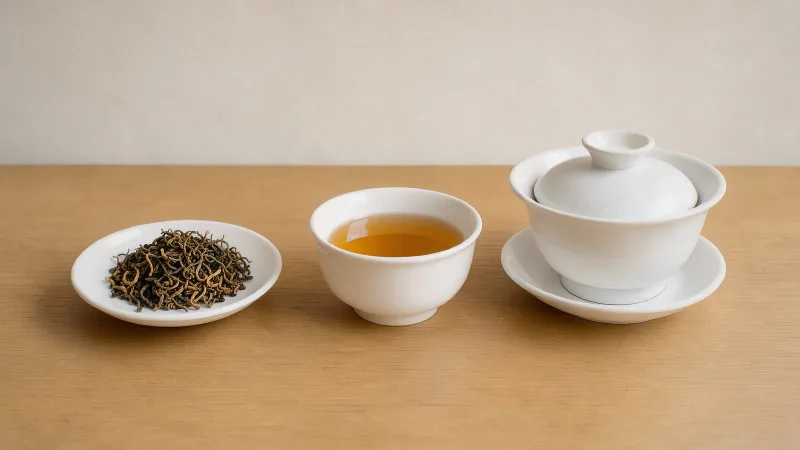
4 g of buds per 100 ml, water 90 °C (194 °F), 85 °C for very fresh tea. First infusion 5–10 seconds, each one after that 5 seconds longer. Good leaf lasts 6–8 infusions. In a teapot, 3 g per 250 ml for 2–3 minutes is enough.
Jin Jun Mei needs no rinse: the first infusion is the most aromatic. If the liquor comes out thin, add leaf rather than time.
Common questions
Why is Jin Jun Mei so expensive?
It takes 50,000–60,000 buds to make 500 g of dry tea. An experienced picker gathers about two thousand a day, so half a kilo of tea means more than twenty days of hand-picking on the steep slopes of Tongmu.
How can you tell Jin Jun Mei from Tongmu?
Its dry leaf is black with golden-yellow streaks, not solid gold. The buds are small and thin. Large, fuzzy, bright gold buds usually point to a different cultivar. The surest way is to ask the seller where the leaf comes from and compare it with a sample from Tongmu.
Is Jin Jun Mei smoked?
No. It follows the Zheng Shan Xiao Zhong technique, but without pine smoke. If you taste smoke in the liquor, it is a different tea or a blend.
-
Judgment of the Beijing Higher People's Court (2013) Gao Xing Zhong Zi No. 1767 in the trademark case over "金骏眉", 12 December 2013. ↩
-
Petition of the Wuyishan People's Government for protection of "Wuyishan black tea" as a geographical indication product, 2010; cited in the court judgment (see above). ↩