Furicha: Japan's folk whisked teas 振り茶
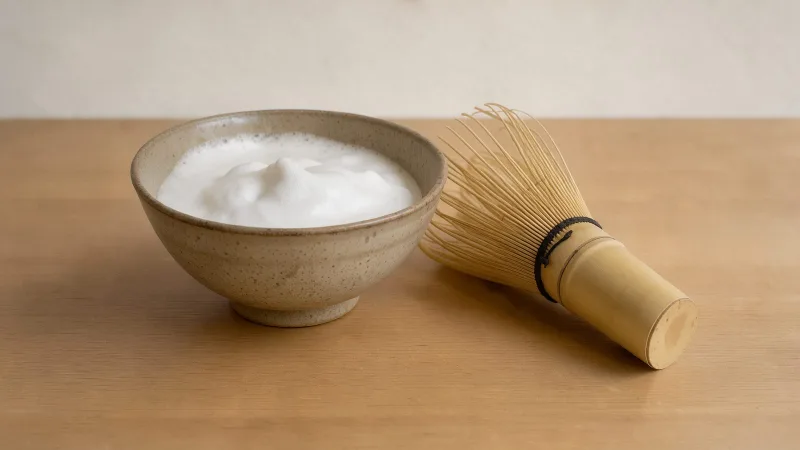
Furicha is a method, not a tea: coarse tea is boiled for a long time, then beaten with a large bamboo whisk. The custom survives in a few places from Toyama to Okinawa, and people there often eat the foam with rice and beans instead of drinking it.
- Name:
- 振り茶, "tea that is shaken"
- Leaf:
- bancha, kurocha, jasmine sanpin-cha, genmaicha
- Tool:
- a bamboo whisk larger than a matcha chasen
- Where it survives:
- Toyama, Okinawa, Shimane, Ehime, Tokunoshima, Aichi
- Time:
- boiling from 15 minutes to several hours
- Status:
- buku-buku-cha: "100-year food" (2024)
Japan has two ways to put foam on tea. The first is known worldwide: matcha and water are beaten together with a bamboo whisk, and the chanoyu ceremony grew out of it. The second never acquired schools, masters or a place in textbooks. This is furicha, with no powder and no etiquette.
Until the 18th century, customs like this were common across Japan. Today they survive in only a few places, nearly always at gatherings of women and neighbors, and they made it through the 20th-century decline thanks to a revival between the 1980s and the 2010s. Uruma Motomi brought the field studies together in Customs of Furicha (Agency for Cultural Affairs, 1982), which covers Niigata, Toyama, Aichi, Nara, Shimane, Ehime, Kagoshima and Okinawa.
How it differs from matcha
Furicha calls for cheap late-season banchabanchaCoarse Japanese green tea from late leaves and twigs. Cheap and everyday., usually with twigs and sometimes picked by the household itself. The tea boils for anything from 15 minutes to several hours, then goes into a bowl, tub or wooden basin to be whisked, sometimes with salt.
Since the whisk makes foam rather than dispersing powder, it is larger than a chanoyu chasen. Edo-period merchants kept the two apart: a 1678 Kyoto guide divides whisk shops into "for chanoyu" and "ordinary", and a Fukuyama domain report of 1815 to 1816 lists a "furicha whisk" as a separate item.
Its origin is disputed. Some see it as commoners imitating chanoyu, others as a forerunner of the ceremony, and others still as a remnant of Japanese tea drinking older than the Classic of Tea. It was certainly written about early. Engelbert Kaempfer, traveling in 1691 to 1692, described roadside women whisking boiled tea from old leaves in a cup. The Wakan sansai zue (1712) notes that whisked sencha has big, coarse bubbles.
Batabata-cha: Birudan, Toyama
The best-known tradition belongs to Birudan, in Asahi, Toyama Prefecture. The leaf there is unusual: kurochakurochaJapan's black tea: leaf and twigs fermented in chambers with live microflora, like the post-fermented teas of China., a post-fermented tea of leaf and twigs, made on a single production line run by the Asahi Chamber of Commerce. The leaf is cut in late July, chopped, steamed and packed into a fermentation chamber (muro). It ferments there for about 35 days at roughly 60 °C, turned every 2 to 3 days, and is sun-dried in early September. In 2023, 1,000 kg of fresh leaf yielded about 200 kg of finished tea.1 The principle is the same as in Chinese dark teas: post-fermentation in a pile with living microflora.
The tea sits in a bag in a large kettle on the hearth for hours, and the water is topped up all day. Everyone whisks their own bowl with their own whisk. The gorohachi bowl is cylindrical, about 10 cm across and 7 cm tall. The whisk is doubled: two whisks of three-year-old bamboo, 15 to 17 cm long, joined by two pins. Held upright, it is rocked left and right so that it knocks against the rim, hence "batabata". According to the Chamber of Commerce, the word describes the whisk's busy movement; the researcher Homma Nobuo adds the knock on the rim.
In Birudan the gatherings were for women. In 1979 the village had about 600 residents in 118 households, all parishioners of the Higashi Honganji branch. Of the 15 participants the researcher Nakagawa observed in 1978, 12 were married women. They met on the 20th and 25th of the month; people came and went as they pleased, and the hostess only topped up the water. The tea came with simmered vegetables, pickles and sweets. Foam was for festive occasions; on ordinary days people drank the same tea without it. Salt used to go in but now usually doesn't, since people drink many bowls at one sitting.
Buku-buku-cha: Naha, Okinawa
Okinawa does it differently. The base is jasmine sanpin-cha, sometimes with bancha or seimei-cha, and the foam comes from a broth of roasted rice made with hard local water. The rice is roasted to dark brown, boiled for about 20 minutes and strained. Broth and tea go into a wooden bukubuku-zara bowl, 25 cm across and 13 cm deep, and are whisked for about 10 minutes (15 in some accounts) with a whisk 22 to 25 cm long. The foam holds well; the preservation society says that after long whisking it stands for up to an hour.
A pinch of sekihansekihanRice steamed with red beans, a celebratory dish. goes in the bottom of the bowl, then a third of a bowl of tea, then a heap of foam topped with crushed peanuts. It is eaten without chopsticks or a spoon.
The earliest written account comes from the Chinese envoy Xu Baoguang in 1721: tea powder is mixed with a little fine flour, half a bowl of boiling water is added, and the mixture is whisked with a small bamboo brush several dozen times until foam covers the surface.2 A record of 1757 says elderly Ryukyuan women "whisk sencha as in a Japanese village", and an early Meiji dictionary calls buku-buku-cha foamy tea, once common, now rare.
The custom disappeared after the war, along with the utensils lost in the fighting. One set survived: its owner, Shinkaki Kimi, had given it to the historian Higaonna before the war, and around 1958 it came back to her. Niijima Masako made copies of it in 1984. In 1992 a reconstructed recipe was published, and two preservation societies were founded. In 2024 the Agency for Cultural Affairs added buku-buku-cha to its list of "100-year food".
A popular story makes it the tea of the Ryukyu court. The expert Ashitomi Junko disagrees: the picture in Xu Baoguang's record shows a lidded bowl without lush foam, the word "bukubuku" never appears, there is no other evidence from the court, and whisking splashes expensive clothes. The Akesino society defends the court story.
Bote-bote-cha and its kin
In Matsue, Shimane, furicha is called bote-bote-cha; the older name, oke-cha, means "tub tea". Autumn bancha with twigs and dried tea flowers is boiled for about 15 minutes, then whisked in a tall bowl with a long whisk, about 20 cm. Salt goes on the tip of the whisk, and then the filling is added to the foam: sekihan, rice, black beans, takuan, takana, tofu, mushrooms. A tap on the bottom of the bowl shifts the filling, and everything goes down in one gulp. The foaming additions are no accident: Homma noted that outside Toyama every tradition has either tea flowers or beans.
Bo-cha in Matsuyama, Ehime, is much the same. Bancha or goji leaf simmers with soybeans for two hours, and the bowl gets rice with black beans plus finely chopped lotus root, butterbur and kamaboko. Here, though, people eat it with chopsticks before the foam settles.
In Inabu, Aichi, on the "salt road" between Oku-Mikawa and southern Nagano, oke-cha was drunk from a tub. The Furuhashi family's set, a tub of nine staves with bamboo hoops, has been protected as city cultural property since 2017. Tokunoshima has its own furi-cha: genmaicha steeps for 10 to 15 minutes in a kyusu and is whisked in a tub to a fine foam. Each morning the elders first place a bowl by the hearth, to ward off fire, and one at the altar. Taira Yoko, who keeps the custom alive, calls it "friendship tea" rather than etiquette-bound hospitality.
There are plenty of myths, from a lord named Fumai inventing bote-bote-cha to "Japan's only post-fermented tea" in advertising. O-CHA NET treats the lordly tales as the usual legends that give simple food a noble origin.
How it is brewed, place by place
There is no single standard: the sources record each place's method as people there remember it.
- Birudan, home method: tea in a stock bag, boiling water in a kettle or pot, at least 30 minutes of simmering, water topped up all day. Unwhisked, the same brew is drunk as ordinary bancha, chilled in summer.
- Itoigawa (Niigata): about 7 dried tea flowers to 0.5 l of water, then a generous pinch of bancha, then straight off the heat. The host salts to the guest's taste, whisks, and rinses the bowl with hot water after each guest.
- Matsue, Shimane recipe of 1985: bancha for 4 cups of water and tea flowers in a cotton bag, 15 minutes of boiling, salt on the tip of the whisk, whisk fast. The filling goes in afterward.
- Matsuyama, for 4 people: 20 g of soybeans and a handful of bancha to 15 cups of water, 2 hours at a low heat in earthenware. The bowl is filled a third full, with a pinch of salt on the whisk or in the tea.
- Tokunoshima: genmaicha 10 to 15 minutes in a kyusu with hard local water, foamed in the tub and poured by rocking it.
The whisking itself is much alike. In Birudan the whisk moves only left and right, touching the rim of the bowl. In Matsue, as Tani Akira described in 2011, it is held between thumb and forefinger and also knocked against the rim.
Where the foam comes from
Bancha is low in saponins, which stabilize foam. An ordinary infusion has 5.9 mg per 100 ml, against 21 to 32 in sencha and 58 to 86 in gyokuro.3 Long boiling may change these numbers, but there are no direct measurements. This is probably why furicha recipes add things that foam: tea flowers, beans, rice broth. In Birudan, though, kurocha is whisked plain, and nobody has compared its foaming with bancha.
Salt matters too. In an experiment with matcha, 0.5% NaCl in the water increased foaming, while higher concentrations reduced it. Nobody has run the test with bancha and long boiling. Salt is also there simply for flavor: in Birudan it went in "for softness of taste".
There is no single furicha recipe. Each region has its own, and the local records do not reduce to one scheme.
Common questions
How is furicha different from matcha?
Matcha is a fine powder whisked into foam. Furicha starts from a brew or decoction of coarse bancha. The whisk, which is larger, only beats the liquid, and the foam comes from leaf saponins and from additions such as tea flowers, beans and rice broth.
Can I try furicha outside Japan?
Batabata-cha is the easiest: boil tea in a stock bag for at least 30 minutes and whisk it in a bowl, holding the whisk upright and rocking it left and right. There is no standard recipe; every region has its own.
Why is the foam sometimes eaten?
In Shimane and Ehime the bowl holds rice, beans and pickles, and the tea acts as a dressing. In Naha a pinch of sekihan goes in first, the foam is piled on top, and the whole thing is eaten without chopsticks or a spoon.
-
Asahi Tourism Association, "Batabata-cha", 2023: https://www.asahi-tabi.com/sanpo/2023/11/21/2312/. Other sources give different turning temperatures: 60 to 70 °C, cooled to 35 °C, at the Global Japanese Tea Association. ↩
-
Xu Baoguang, Zhongshan chuanxin lu (1721), juan 6: https://zh.wikisource.org/wiki/%E4%B8%AD%E5%B1%B1%E5%82%B3%E4%BF%A1%E9%8C%84/%E5%8D%B7%E5%85%AD. ↩
-
Shimada Kazuko, analysis of saponins in green tea infusions, Journal of Home Economics of Japan 54(11), 2003: https://dl.ndl.go.jp/view/prepareDownload?contentNo=1&itemId=info%3Andljp%2Fpid%2F10583233. ↩