The Chemistry of Water for Tea: Hardness, Alkalinity, Chlorine
What changes the cup is not "minerals" in general but calcium and magnesium, bicarbonate and chlorine. In Chinese trials the best water was low in mineral content, hardness and alkalinityalkalinityThe ability of water to neutralize acid, mostly due to bicarbonate. The higher it is, the harder it is for the tea to acidify the water.. Boiling removes only part of the hardness and none of the chloraminechloramineChlorine bound to ammonia, which some water utilities use to disinfect the supply. Unlike free chlorine, it does not leave the water on standing or boiling..
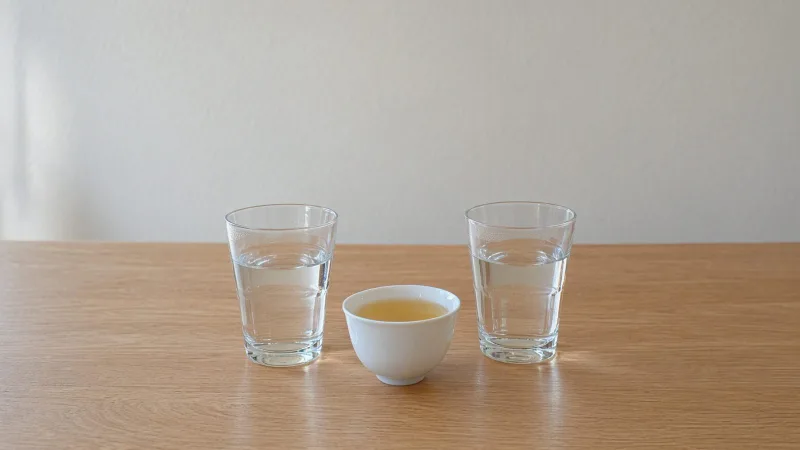
- Biggest troublemakers:
- calcium, magnesium, bicarbonate, chlorine
- Hardness in mg/L CaCO₃:
- Ca × 2.497 + Mg × 4.118
- Scum on tea:
- needs calcium (or magnesium) and bicarbonate
- Boiling:
- removes temporary hardness, not chloramine
- Most sensitive:
- green tea; dark tea is the most tolerant
"Use soft water" is easy advice to follow and hard to understand. What does hard water actually do to tea? The numbers on a label tell you more than the word "soft" does. Which water to buy, how hot to heat it and whether re-boiling matters are practical questions, covered under water for brewing. This page is about the chemistry of what happens in the cup.
In Chinese trials with 34 types of water, the best infusion came from water that was low in mineral content, low in hardness and low in alkalinityalkalinityThe ability of water to neutralize acid, mostly due to bicarbonate. The higher it is, the harder it is for the tea to acidify the water..1 Each of those "lows" matters for its own reason.
Calcium and magnesium: hardness
Hardness is the sum of calcium and magnesium in the water. Labels list both in mg/L; to get hardness in mg/L as CaCO₃, multiply calcium by 2.497, magnesium by 4.118 and add the two. For Vittel (Ca 94, Mg 20 mg/L) that comes to about 317 against a declared 315. Russian practice uses mg-eq/L, where one degree is about 50 mg/L CaCO₃. In Germany one °dH is about 17.8 mg/L.
A Japanese trial showed what hardness does to green tea. The harder the water, the fewer catechins end up in the cup, especially EGC and EGCG, and the more white sediment forms. The liquor turns darker and yellower, and at 200 mg/L hardness and above, vitamin C almost vanishes. Even at 84 mg/L there was significantly more sediment than with distilled water. Yet tasters in the same trial preferred tea brewed with hard water (225.6 mg/L) to tea brewed with distilled water: less astringency and bitterness, more sweetness. So hardness hurts the look and the composition of the liquor but can help the taste. Which water is better depends on what you want from the cup.
Magnesium has been tested on its own. With 16 mg/L of magnesium, black tea lost sweetness and umami and gained astringency; it did best at 4 mg/L. Tap water in Hangzhou had 3.6 mg/L in that study, natural mineral waters 31 on average. One trial on one tea, but the direction is clear.
Aroma suffers too: calcium and magnesium suppress 17 characteristic aroma compounds of Longjing, including linalool and geraniol.
Bicarbonate and pH: alkalinity
Alkalinity in water almost always comes from bicarbonate. It keeps the liquor mildly alkaline, and in that range polyphenols oxidize faster, so green tea darkens and loses antioxidant activity. A Beijing study using tap water found that calcium, magnesium and sodium on their own actually lighten the liquor, and that bicarbonate is what darkens it. A Japanese study links the darkening to hardness. Most likely calcium and bicarbonate go together in bottled hard waters, and the trials did not separate their effects.
pH has its own thresholds. In Chinese research, a dull, stewed note (熟闷, shúmèn) appears once the water is above pH 6.5, and aroma weakens below pH 4.5 and spoils above 7.0. According to Japanese sources, alkaline water makes the liquor red-black and bitter. So "alkaline water is healthy" does not apply to tea.
Tea itself acidifies the water, too. The more leaf, the lower the pH and the weaker the effect of alkalinity, so a weak brew on hard water suffers more than a strong one.
Scum on the liquor and cloudiness on cooling
Scum is the most visible sign of hard water. Michael Spiro and Deogratius Jaganyi described it in 1993 and 1994 at Imperial College London as an organic mass of oxidized soluble tea compounds with islands of calcium carbonate.2 Their experiments add up to a few simple rules.
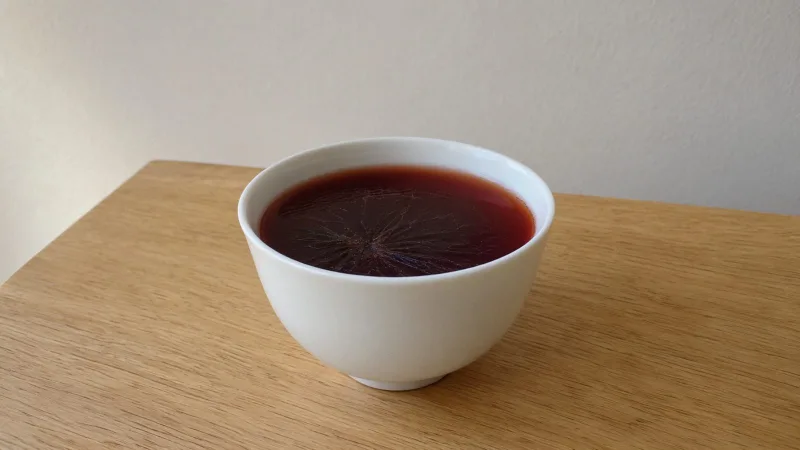
- Calcium (or magnesium) and bicarbonate are both required. Take away either one and there is no scum.
- Binding the calcium (with EDTA) or acidifying the water gets rid of the film. That is why tea with lemon has none: the pH is low and citrate binds calcium.
- Oxygen is required. Under nitrogen there is far less scum.
- It grows with the surface area of the liquor, not its volume. A wide cup shows more than a narrow mug.
- Milk increases it sharply. What else milk, lemon and sugar do to tea is a separate topic.
Boiling the water reduces scum but does not remove it. It is not wax from the leaf: there is no film with distilled water, so it comes from the water. Green Chun Mee forms about 80 % as much scum as black tea.
Cloudiness on cooling is a different process. Chinese literature calls it 冷后浑 (lěng hòu hún); in English it is tea cream. As the liquor cools, caffeine and flavanols precipitate together and turn it cloudy, and calcium and magnesium make that precipitate heavier. Caffeine and polyphenols each have a page of their own.
Chlorine and chloramine
Water utilities add chlorine so the water reaches the tap clean. In tea it is an impurity you pick up by smell. According to the WHO, some people notice chlorine from 0.3 mg/L, and a Japanese tea producer puts the point where the smell gets in the way of tea at 0.5 mg/L. The trials disagree: in Murugesan's experiment chlorine had no effect on black tea up to 3 mg/L, and the tea only got worse at 5 and 10. That is one trial on one tea, so do not count on 3 mg/L being safe.
Free chlorine is easy to get rid of: let the water stand uncovered for a few days. Boiling works inconsistently, but Japanese sources still advise boiling tap water and then letting it cool.
Chloramine, if your supply uses it, is another matter. It is chlorine bound to ammonia. The US EPA writes that boiling, standing at room temperature and reverse osmosis do not remove monochloramine. The San Francisco utility reports that a short boil "for tea" removes about 30 %, that 20 minutes of gentle boiling removes all of it, and that tea itself neutralizes chloraminechloramineChlorine bound to ammonia, which some water utilities use to disinfect the supply. Unlike free chlorine, it does not leave the water on standing or boiling. almost instantly. The sources differ in detail but agree on the main point: a short boil does not take out chloramine.
Activated carbon works, given enough contact time: chloramine drops from 1–2 to under 0.1 mg/L. To find out which disinfectant your utility uses, check its analysis report or ask the utility.
What boiling, filters and osmosis remove
Boiling breaks down temporary hardnesstemporary hardnessCalcium and magnesium paired with bicarbonate. Boiling drops them out as limescale. Permanent hardness (calcium and magnesium sulfates and chlorides) stays in the water.: Ca(HCO₃)₂ decomposes into CaCO₃, carbon dioxide and water. The carbon dioxide leaves with the steam, the equilibrium shifts, and the carbonate settles as limescale on the walls of the kettle. Boiling leaves permanent hardness in place.
What each method does:
- Jug with carbon and ion-exchange resin. The carbon takes out chlorine and its compounds; the resin takes out temporary hardness, copper and lead. Permanent hardness stays. This is partial demineralization, not distillation. A carbon-only disc filter removes chlorine but lets calcium and magnesium through.
- Household water softener. Swaps calcium and magnesium for sodium, so you need a separate tap of unsoftened water for drinking.
- Reverse osmosis. Removes 92–99 % of minerals, including 94–98 % of calcium and magnesium. The membrane does nothing to chloramine. To keep the water from tasting flat, some systems add a remineralizer, which dissolves calcium carbonate with CO₂ and puts calcium and bicarbonate back.
- Magnetic "softeners". They change the shape of limescale crystals in constant-flow systems. They do not soften the water.
You can also mix your own water from distilled water and a few salts. The "Truth Serum" recipe by the hobbyist Arby calls for five salts per gallon of distilled water, weighed on milligram scales. The result is Ca 10, Mg 3, Na 16 and bicarbonate 32 mg/L. It is an enthusiasts' experiment, not a recommendation. It meets the Chinese standard T/CTSS 32-2021 for calcium and magnesium, but not for sodium (16 mg/L versus 12).
How many minerals count as normal
There is no single figure. The Tea Research Institute of the Chinese Academy of Agricultural Sciences treats total dissolved solids below 50 mg/L as the norm. The Chinese standard for packaged "tea water" sets electrical conductivity at 10–100 µS/cm at 25 °C, Ca at no more than 12, Mg at no more than 8 and Na at no more than 12 mg/L. The US Tea Association's recommendation, as relayed by Barista Hustle, is 50–150 ppm, though the primary source for those numbers could not be traced.
A pocket TDS meter does not measure minerals, it estimates them: it reads electrical conductivity and multiplies by a factor, usually 0.55–0.70. The error runs up to 15 %, and non-ionic substances do not register at all. The meter is fine for checking the order of magnitude, not for exact composition; for that, use an analysis report. Drinking-water limits are further from what tea needs than you might think: the Russian sanitary limit of 7 mg-eq/L is four times the hardness at which Japanese researchers already saw sediment in green tea.
Putting it to use
The less oxidized the tea, the more galloylated catechins it contains and the more the water matters. In a Cornell trial, green tea brewed with bottled or deionized water had about twice as much EGCG as green tea brewed with tap water, while in black tea the EGCG content did not depend on the water. Dark tea proved the most tolerant of water composition, green the most sensitive. For white and yellow tea there are no scientific data, so any conclusion about water there is drawn by analogy.
Start by finding out the hardness and composition from the utility report or the label. If your supply has chloramine, you need a carbon filter. For delicate greens, use the water with the lowest mineral content. If scum and limescale in the kettle are obvious, filter the water. To compare teas on different waters, follow the ISO 3103 tasting method, which calls for water similar to the local drinking water.
Common questions
Why does a film form on tea made with hard water?
It needs calcium (or magnesium) and bicarbonate at the same time. With distilled water, or water with the calcium or bicarbonate taken out, there is no film. It is an organic mass of oxidized tea compounds with islands of calcium carbonate, not wax from the leaf. Boiling the water reduces the film but does not get rid of it.
Does boiling remove chlorine from water?
Free chlorine leaves standing water within a few days; in San Francisco utility tests boiling worked inconsistently. According to the US EPA, boiling, standing and reverse osmosis do not remove chloramine. Activated carbon does, given enough contact time.
Does tea need water with no minerals at all?
Not necessarily. The WHO describes fully demineralized water as flat and insipid, and ISO 3103 allows distilled water only as an exception. Some Chinese experts, on the other hand, accept purified water. There is no consensus, and the safe choice is water with low but nonzero mineral content.
-
Chen Zongmao and Yin Junfeng (Tea Research Institute of CAAS), interview in China Science Daily, 2017: caas.cn. A separate trial by the same institute with four types of water: Xu Y.-Q. et al., Food Chemistry, 2017. ↩
-
Spiro M., Jaganyi D. What causes scum on tea? Nature 364, 581 (1993); follow-up in Food Chemistry 49(4), 1994. ↩