Chanoyu: the Japanese way of tea 茶の湯
Chanoyu is the making and drinking of matcha in a dedicated room, in a set order. The monk Eisai brought the powdered method from Song China, and Juko, Joo and Sen no Rikyu gave it its present shape.
- Name:
- 茶の湯, "hot water for tea"; schools also say chado, the Way of Tea
- Tea:
- matcha only: thick koicha and thin usucha
- Full gathering:
- chaji, about 4 hours, about 5 guests
- Short gathering:
- chakai, no meal, usually just usucha
- Main schools:
- the three Sen houses: Omotesenke, Urasenke, Mushakojisenke
- Seasons:
- ro (sunken hearth) November to April, furo (brazier) May to October
When people say "Japanese tea ceremony" they usually mean chanoyu (茶の湯). The word means "hot water for tea," and there is nothing solemn about it. The solemnity came later, out of a fixed order: the host prepares tea, the guests drink it, and all of it happens in a room built for a single evening.
What the guests drink is matcha, powdered green tea. The rite around it came from China and took several centuries in Japan to reach its present form.
The road from China
Tea reached the Japanese court in the early ninth century: an entry dated April 22, 815 records the monk Eichu serving it to Emperor Saga.1 The story that Kukai and Saicho brought tea over is a tradition with no documents behind it. Until the 12th century tea was drunk at court and in Buddhist temples, and it was brick tea.
Powdered tea in a bowl came later. The monk Eisai went to Song China twice, in 1168 and in 1187–1191, and brought back a method known there as diancha. In 1211 (a second version followed in 1214) he wrote the Kissa yojoki and presented it to the shogun Minamoto no Sanetomo. In 1227 Dogen came back from China with utensils and wrote tea rites into the rules of Eihei-ji. Chinese historians go further and trace the Japanese matcha schools to the Jingshan tea banquet, while the Japanese schools see wabi teawabi teaTea of simplicity and lack: a small dark room, clay instead of gold, objects without shine. Its beginnings are linked to Murata Juko, its completion to Sen no Rikyu. as their own reworking.
Two or three centuries later, tea had become a pastime of nobles and warriors. Gatherings of the 14th and 15th centuries were loud affairs: guests guessed varieties, composed renga, drank sake and showed off Chinese utensils (karamono).
From Juko to Rikyu
The turning point is credited to three men. Murata Juko studied Zen under Ikkyu Sojun in 1474–1481 and wrote the Kokoro no fumi ("Letter of the Heart"), the first text to ask about the spirit of tea. Omotesenke treats it as the beginning of wabi tea. Juko put Japanese objects on a level with Chinese ones and preferred the moon behind clouds to a full one. His dates vary between sources (Shuko, 1422–1503 at Urasenke; 1422–1502 in Kumakura), so treat them as approximate.
Takeno Joo, heir of a merchant house in the port of Sakai, studied renga poetry and carried its taste for the cold and the withered into tea. In his time the tea room acquired earthen walls instead of papered ones, bamboo, and a narrow alcove framed in rough wood.
Sen no Rikyu (1522–1591) was born to a Sakai merchant family named Tanaka. From the age of 19 he studied under Joo, then served as tea master to Oda Nobunaga and later to Toyotomi Hideyoshi. The historian Kumakura Isao lists five of his achievements: tea-room architecture, his own utensils, formalized temae (procedures), the reform of kaiseki and the philosophy of wabi tea. He introduced the tiny two-mat room, raku bowls, bamboo vases and scoops, and found new uses for everyday objects. According to Omotesenke, he wanted to take the game out of tea and leave a charged exchange between people.
In 1585 Rikyu helped Hideyoshi host Emperor Ogimachi and received the name Rikyu koji. In 1587 a tea gathering open to everyone was announced at Kitano: warriors' servants, townspeople and farmers were all invited to come with a kettle, a bowl and their own tea. Planned for ten days, it ended after one, for reasons that remain unclear. On the 28th day of the second month of 1591 Rikyu took his own life at Jurakudai on Hideyoshi's order. He was 70 by Japanese reckoning, 69 by Western.
Legend clings to Rikyu. The Nanboroku, source of the "tea saint" image, was compiled and edited by Tachibana Jissan in 1686–1690, a century after his death. The one near-contemporary treatise by a student, the Yamanoue Soji ki, mentions few innovations beyond a room of one and a half mats. The phrase "ichigo ichie" ("one lifetime, one meeting") is often credited to Rikyu, but in that form it appears in Ii Naosuke's Chanoyu ichie shu, written at the end of the Edo period.
Schools and the iemoto
Rikyu's grandson Sotan lived in the wabi spirit and refused to serve lords. His three sons divided the house: Koshin Sosa took the front of the estate (Omotesenke), the younger Senso Soshitsu the back (Urasenke), and Ichio Soshu settled on Mushakoji street (Mushakojisenke). Together they are the three Sen houses, the sansenke. Urasenke is now the largest school in Japan and the world: in 2021 its Tankokai association had 111 branches in 37 countries and regions.
There are also the samurai lines, buke cha. Furuta Oribe, Hosokawa Tadaoki, Kobori Enshu and Katagiri Sekishu studied under Rikyu or his students and kept warrior customs. Nearly thirty schools are on record, and about half survive. They differ in the details of temae, but all of them practice chaji.
The system rests on the iemotoiemotoThe hereditary head of a school. Grants students licenses for procedures and teaching ranks, and passes the house to a single heir.: a hereditary head passes the house to one heir, and the other sons take different family names. The word came into use in the 18th century, when Joshinsai, the seventh head of Omotesenke, fixed succession through a single son. The iemoto grants licenses to study procedures and teaching ranks.
Chanoyu has no national standard, and the schools set their own norms. The 2001 law on culture and the arts does, however, list chado first among the "everyday culture" the state must support. Few Japanese actually practice it: in a survey by the Agency for Cultural Affairs nearly 70% had never tried it, and of those who had, about 90% no longer do.
Chaji and chakai
The full gathering is the chaji (茶事). It opens with a written invitation and closes with the guest's thank-you letter, runs about four hours and has about five guests. The most formal version is the midday chaji of the ro season.
The sequence:
- Guests gather on the waiting bench and are served hot water.
- The host bows silently to the guests at the middle gate of the garden. Guests rinse their hands and mouths at the stone basin (tsukubai) and enter the tea room.
- They look at the scroll in the alcove (tokonoma), the hearth and the kettle. The host lays the first charcoal (shozumi).
- Kaiseki, then the main sweet (omogashi).
- A break of about 15 minutes, nakadachi, when guests step out into the garden.
- Koicha, then the second charcoal (gozumi) and usucha with dry sweets.
Sources disagree on one point. Omotesenke and the Washington and Lee tea room place shozumi before the meal, while for the furo season the practitioners' Chado-wiki puts it after. Schools vary, and that is normal.
Kaiseki (懐石) is written with the characters for "bosom" and "stone." Zen monks tucked a warmed stone inside their robes during meditation to stave off hunger, so the word came to mean just enough food to keep you from being distracted. The base is ichiju sansai, "one soup and three dishes." Rice, soup and mukozuke come first on the tray; the host serves the rice freshly cooked and barely done, to show he could not wait for his guests. At the end the guests set their chopsticks down on the trays together with a clack, and the host knows the meal is over. Kaiseki is never a lavish banquet.
The two teas play different parts. Koicha (濃茶) takes three scoops of powder per person, and four or five guests share one bowl. It is kneaded to the consistency of kudzu starch broth rather than whisked. Usucha (薄茶) takes one and a half scoops per bowl, each guest gets their own, and this time the powder is whisked to a froth. Grams vary by source: about 1.5 g in 70 ml at Marukyu Koyamaen, about 2 g from the Kyoto Prefectural Tea Industry Chamber, 5 bu (about 1.8 g) at Urasenke. For koicha Urasenke gives 1 momme, about 3.75 g.
A chakai (茶会) is the shortened version. Today the word usually means a large gathering with sweets and usucha, sometimes koicha.
Before tea, say "osaki ni" to your neighbor. Cut the sweet on a sheet of kaishi paper and eat it before the tea arrives. Take the bowl in your right hand, move it to your left palm, turn it twice so you do not drink from the front, and drink in a few sips. Wipe the spot your lips touched with thumb and forefinger, then wipe your fingers on the kaishi. Turn the bowl back and return it to the host with the front facing him. Procedures differ between schools, so follow whoever leads.
Room, garden and utensils
The way to the tea room runs through the roji garden, "dewy ground." A waiting bench stands in the outer part, a stone basin in the inner. The host puts fresh damp leaves in the pit (chirian) as a sign that the garden has been swept clean.
The room is built like a hermit's hut and holds four or five people. Taian, at the Myoki-an temple in Oyamazaki near Kyoto, is a two-mat room. Omotesenke considers it the only room that is undoubtedly Rikyu's and dates it to 1582 "by tradition." It is a national treasure. Inside are an alcove with rounded corners, clay walls and a nijiriguchinijiriguchiThe low crawl-in entrance to the tea room. Guests creep through it, and rank counts for nothing at the threshold.: Rikyu made the entrance so that everyone, whatever their rank, had to crawl in. The square sunken hearth, the ro, measures 42 cm. From May to October a portable brazier, the furo, takes its place, which splits the year into two seasons.
The tea new year comes around Ritto, November 7 or 8. Hosts open the hearth and, in the rite of kuchikiri, break open the jar of new-harvest tea. They also replace the tatami and shoji paper and renew the green bamboo of the fence.
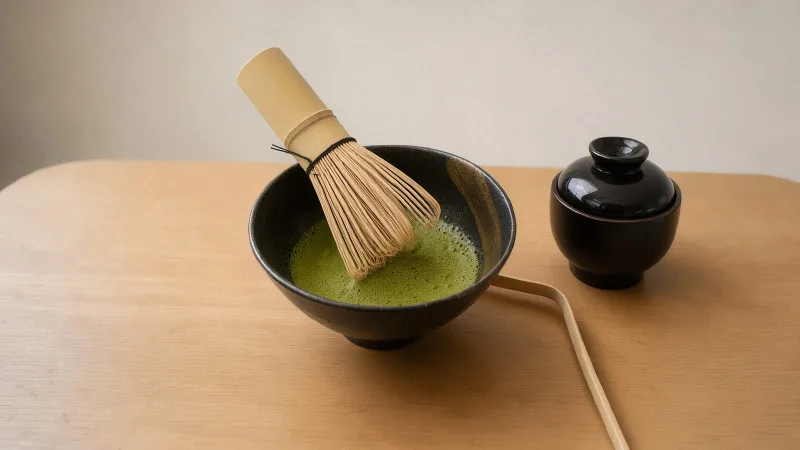
A guest sees three utensils: the bowl (chawan), the scoop (chashaku) and the bamboo whisk (chasen). In chanoyu, connoisseurs decide what an object is worth: masters picked single vessels out of many Shigaraki and Bizen pieces, and every famous owner added to an object's pedigree. The pedigree is written on the box as the hakogaki inscription: the maker's name, the object's name, the chain of owners.
Tea at a table, on chairs, is called ryurei. Gengensai, the 11th Urasenke head, devised it in 1872 for the Kyoto Exhibition, and every school uses it now.
Common questions
How is a chaji different from a chakai?
A chaji is the full gathering for a few guests: a kaiseki meal, thick tea and thin tea over about four hours. A chakai today usually means a larger event with sweets and usucha, sometimes koicha, and no meal.
Do I need to know etiquette to attend a tea gathering?
No. A newcomer does well in the middle of the row: the main guest talks with the host, and the last guest has duties of their own. Before tea, say "osaki ni" ("pardon me for going before you") to your neighbor, take the bowl in your right hand, set it on your left palm and turn it twice so you do not drink from the front. Procedures differ between schools, so follow the person leading.
Why is only matcha used in chanoyu?
The practice grew out of the powdered Song tea that Eisai brought back. Japan has leaf tea traditions too, but they stand apart: in the Agency for Cultural Affairs report, senchado is not part of the concept of chado.
-
Omotesenke Fushin'an, The tradition of chanoyu: Introduction of tea into Japan. The historian W. W. Farris reaches the same conclusion in The Prehistory of Japan's Tea Industry, 750–1300. Urasenke holds that Kukai brought tea to the court. ↩