Gongfu cha 工夫茶
A lot of leaf in a small vessel, hot water for a few seconds, every drop poured off into the fair cup, and the whole thing repeated ten times. Each infusion tastes different, so one load of leaf gives you a whole series.
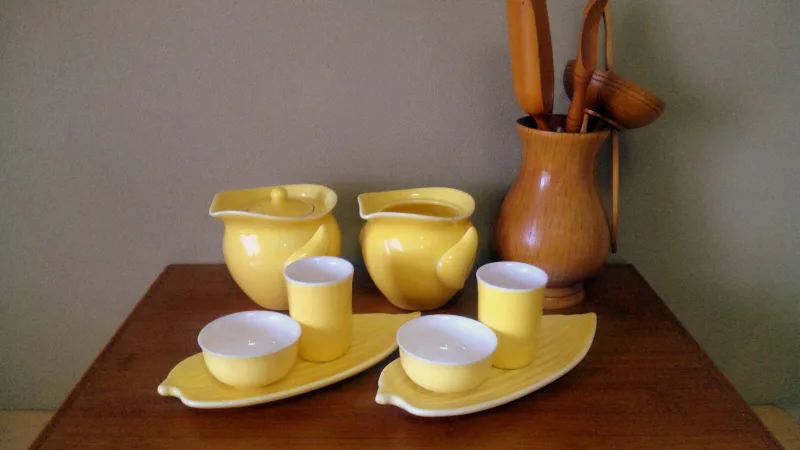

- Origin:
- Chaozhou (Guangdong) and southern Fujian
- Vessel:
- gaiwan or teapot, 90–150 ml
- Leaf:
- 1:7–1:22 by weight to volume
- Infusion:
- 10 to 40 seconds at the start
- Cup:
- 25–35 ml, three sips
Gongfu cha (工夫茶) is a way of brewing with a lot of leaf in a small vessel: hot water goes on for a few seconds, every drop is poured off, and the same leaf is steeped again and again. The name translates as "tea that takes time and skill". The method comes from Fujian and from the Chaozhou–Shantou area in eastern Guangdong. It is used mainly for oolong, and in Chaozhou above all for Feng Huang Dan Cong.
The resemblance to the martial art is only in the sound. The word 功夫 came to mean "kung fu" only in the 20th century, and Qing texts mostly write 工夫茶, tea that costs time and effort.1
Where the method comes from
Yuan Mei left the earliest description of small cups and pots in southern Fujian. In the autumn of 1786, on Mount Wuyi, monks served him tea in cups "the size of a walnut" from pots "the size of a citron", poured less than one liang into each, and the leaf held up for three brews. As the name of a brewing method, "gongfu cha" first appears in Yu Jiao's writing, in a collection compiled around 1801, along with the kit: a white clay stove, a flat-bellied Yixing pot, as many cups as guests. Before that, "gongfu" was the name of a grade of Wuyi tea.
Weng Huidong recorded the Chaozhou sequence in 1957, in the "Chaozhou Tea Classic": prepare the teaware, load the leaf, heat the water, pour, skim the foam, pour over the pot, warm the cups, serve. He advised filling seven or eight tenths of the vessel with leaf.
The familiar modern setup of gaiwan, fair cup and strainer took shape later, in Taiwan in the late 1970s and 1980s, and from there made its way back to the mainland. Cai Rongzhang founded the Lu Yu Tea Culture center in Taipei in 1980 and, starting the following year, codified the "small pot method" as 24 rules. Chaozhou gongfu cha was added to China's national intangible heritage list in 2008, and in 2022 it became part of the UNESCO element on traditional tea processing techniques in China.
What you need
You are working with three variables: how much leaf, how hot the water and how long the leaf steeps. Your teaware and the way you pour affect each of them.
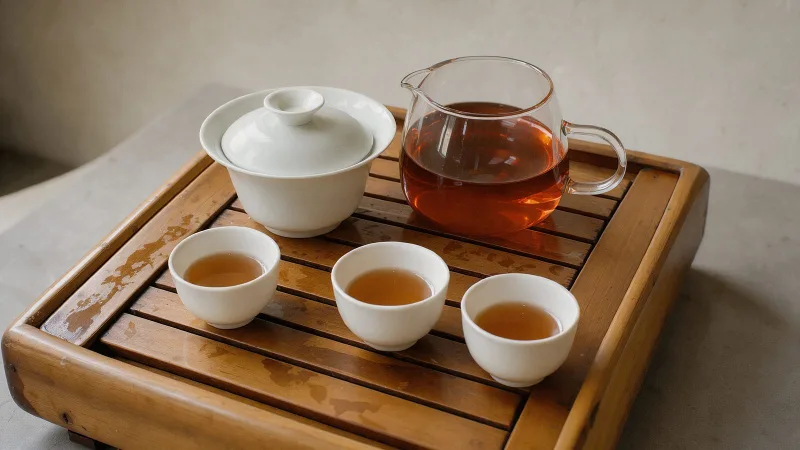
- Vessel. A gaiwan or a Yixing teapot. The 2019 Chaozhou regulation gives 90–150 ml and recommends 120; the Wuyi standard allows 100–150 ml. Thin porcelain adds nothing to the flavor, while thick clay holds heat longer.
- Cups. In Chaozhou, 25–35 ml and traditionally three of them; in the Wuyi set, 35 ml. You drink each one hot, in two or three sips.
- Fair cup (chahai). The Chaozhou setup does without one. In Taiwan the whole infusion goes into it, so every cup gets the same share. In the Wuyi set it holds 200 ml.
- Tea tray (cha pancha panTea tray: a board with a drip basin that catches the water from warming the teaware and rinsing the leaf.) or a pot stand, so the spent water has somewhere to go, plus a waste bowl. To begin with, a deep plate will do.
- Kettle. In Chaozhou this is a clay "shadiao" of 300–500 ml set over a charcoal stove; at home any kettle works.
Step by step
- Bring the water to a boil. In the Chaozhou and Taiwanese traditions it is boiled rather than heated to a set temperature.
- Warm the vessel, fair cup and cups with boiling water and pour it off.
- Put the leaf in the warm vessel and smell it. It should cover the bottom evenly. Break pressed tea apart in layers, snapping as little as you can: broken leaf makes the tea bitter.
- Rinse the leaf if you think it needs it (xi chaxi chaRinse: an infusion poured off right away, not drunk. Not every tea needs one, and even experts disagree about it., 洗茶). Opinions on rinsing differ.
- Pour. Give tightly rolled oolongs a strong stream in a circle and green teas a stream down the wall, away from the leaf; baizhong and pu-erh can take water straight onto the leaf. In Chaozhou the stream runs along the rim and never hits the center, so as not to "break the tea bubble".
- Drain every last drop. Weng Huidong wrote "余沥全尽", leave nothing behind. The Chaozhou rules for serving come down to four words: low, fast, even, to the end.
- Serve. With a fair cup, every cup comes out the same strength; without one, fill the cups in several passes, for example half, half, full, half, half. The last drops from the vessel are more concentrated than the first.
- Make each following infusion longer. Between them, lift the lid a little so the leaf does not stew.
- Stop when even a long infusion tastes empty.
The Wuyi standard sets the rule "pour high, serve lowpour high, serve lowThe pouring rule: water goes into the vessel from a height, and the liquor is served from close to the cups so it stays hot and does not splash.": water poured from a height moves through the leaf with more force, and liquor served close to the cups stays hot.
Leaf: 4–8 g. Water: see the table below (boiling is 100 °C, or 212 °F). First infusion: 10–40 seconds, then 3–10 seconds longer with each round. Pour off completely. Change only one variable per session.
Leaf, water and time by type
These are starting points per 100 ml, drawn from several sources, with each row taken from a single reference. Experts and standards disagree on the parameters by a factor of two or three, so a range is more honest than a single number.2
| Type | Leaf | Water | First infusion | Then |
|---|---|---|---|---|
| Green | 3–6 g | 80–85 °C | 10–15 s | +3 s, about 5 infusions |
| White | 3.5–6 g | 85 °C | 20 s | +10 s, about 5 |
| Rolled oolong | 4–6.5 g | 95–99 °C | 25 s | +5 s, about 9 |
| Strip-style oolong, Wuyi | 4.5–5 g | 99 °C | 20 s | +5 s, about 9 |
| Dancong | 3–8 g | boiling | 10–38 s | longer, 10–30 |
| Black | 4–4.5 g | 90–95 °C | 10–15 s | +5 s, about 8 |
| Sheng pu-erh | 5–6 g | 95–100 °C | 10 s | +3 s, about 15 |
| Shou pu-erh | 5–6 g | 95–100 °C | 10 s | +5 s, about 20 |
For comparison, the Chaozhou regulation calls for 8 g per 100 ml, 38 seconds for the first infusion, then 22–35 seconds (the "strong" version); the "mild" version uses 7 g per 120 ml and 15–30 seconds. The Wuyi standard allows 5 to 15 g per 110 ml. A retailer's guide for old-tree dancong goes the other way: 3 g, the first four infusions at 10–15 seconds, 10 to 30 infusions in all.
How to count the seconds
The Wuyi standard does not count the time spent pouring in and out; the Guizhou standard starts the clock when the pour begins. If a vessel takes 24 seconds to drain, even an "instant" infusion brews for all 24 seconds, not 6. Follow the same table with a fast-draining gaiwan and a slow pot, and you get two different liquors.
Water in the vessel is cooler than in the kettle, because a high stream cools it. Brew rolled oolong and dense pressed tea stronger in the first infusions, then cut the time. You can also add or remove leaf mid-session to correct the strength.
Schools
- Chaozhou "strong". A zhuni Yixing or Chaozhou pot, or a gaiwan, three cups, no fair cup. 8 g per 100 ml, boiling water, the pour circles the rim, the foam is skimmed off with the lid, the cups are filled in a circle, and the last drops are shared out one by one.
- Wuyi. A gaiwan or pot of 100–150 ml, a fair cup optional. Foam is skimmed only in the first infusion, and each cup is filled to seven tenths.
- Taiwanese "small pot method". A pot, a fair cup, sometimes a pair of cups with a wenxiangbei, the aroma cup. Water goes in to nine tenths, and the pot is not doused on the outside. Brewing is either "wet", on a tray with a reservoir, or "dry", on a flat stand.
- Guizhou. Boiling water, plenty of leaf, a fast pour-off, the liquor separated from the leaf, no rinse.
- The "European" school of Tea Masters. A gaiwan without a fair cup, the liquor served straight into the cups; only old teas and shou get a rinse.
Myths and mistakes
Many people assume the fair cup belongs to traditional Chaozhou gongfu. In the Chaozhou setup the liquor goes from the vessel straight into the cups, and the fair cup arrived from Taiwan in the 1980s. Even its origin is disputed: by one account Taiwanese tea people invented it in the mid-1980s, while Cai Rongzhang's chronicle has his pitcher made in July 1981.
"The first infusion is always the strongest." Not always. In a lab test on tea bags of ground leaf (8 infusions of 30 seconds), at 85 and 100 °C most of the caffeine and catechins came out in the first infusion, and at 70 °C in the second. In a Japanese taste study the first oolong infusion was the most intense, but panelists preferred the second.
"Set the pot in hot water and it will brew better." Cai Rongzhang checked this with a thermometer: soaking the pot in hot water does not raise the temperature inside.
The four most common ways to spoil the tea:
- Leaving water in the vessel between infusions. It keeps brewing the leaf, and the next infusion comes out more bitter.
- Aiming the stream at the center of the leaf. Chaozhou authors link this to bitterness and astringency.
- Leaving the leaf pressed against one wall after pouring off. It opens unevenly, and the liquor ends up with both under-extracted and over-brewed notes.
- Filling the vessel to the brim. Tight buds expand a lot, the water cannot get in and the taste turns bitter, which is why Weng Huidong capped the load at seven or eight tenths.
For laboratory evaluation under GB/T 23776-2018, oolong is brewed in a 110 ml bowl: 5 g, boiling water, three infusions of 2, 3 and 5 minutes. It is a way to compare samples, not a way to drink tea.
Care of the teaware
Cai Rongzhang considers rinsing cups inside a tea boat unhygienic, since the cups rub against each other, and advises warming them separately. He calls trays with a drain hose a compromise for tea rooms that brew all day; at home a small waste bowl is enough. The Chaozhou regulation suggests setting the pot on a loofah pad, which adds no foreign smell. A porous clay pot is usually kept for one type of tea, with separate pots for shou and sheng.
Common questions
How much leaf goes into 100 ml?
From 3 to 8 g, depending on the tea and the school. Retail guides suggest 3–6.5 g per 100 ml (less for green, more for rolled oolong), and the Chaozhou regulation calls for 8 g with dancong. Start in the middle of the range and adjust the strength with steep time.
Do you have to rinse the tea?
No. Some shops rinse sheng pu-erh once and shou twice, others rinse nothing except old teas and shou. The Guizhou standard says outright not to rinse. Decide tea by tea: pressed and aged leaf gets rinsed more often.
Do you need a fair cup for gongfu cha?
Not for flavor, but yes for even strength. The classical Chaozhou setup has none: the liquor goes from the vessel straight into the cups. The fair cup came into use in Taiwan in the 1980s and evens out strength between cups, but every extra pour costs a little heat and aroma.
-
Victor Mair, "Kung-fu (Gongfu) Tea", Language Log, 2011: languagelog.ldc.upenn.edu. ↩
-
Mei Leaf, "Tea Brewing Guide" (2016), gongfu table by type: meileaf.com. Dancong and Wuyi yancha follow regulation T/CTSS 5-2019 and standard DB35/T 1545-2015. ↩