Oolong 乌龙茶
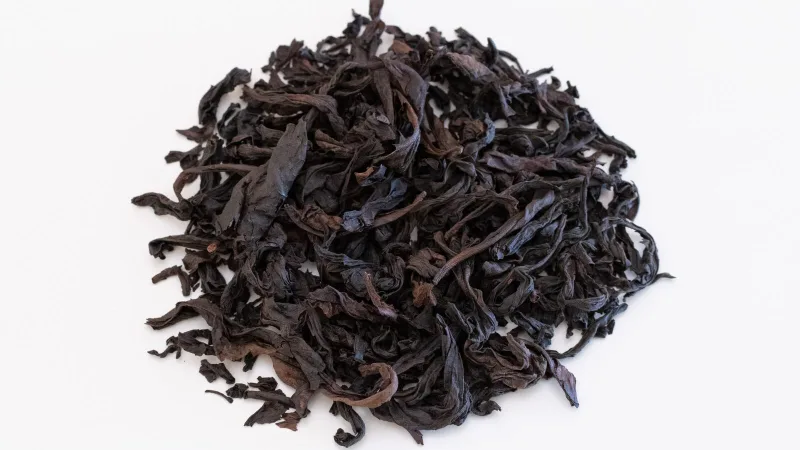
The leaf is only partly oxidized: light oolongs sit close to green tea, heavy ones close to black. The tea maker chooses how far to take oxidation and roasting.

- Oxidation:
- partial, light to heavy
- Key step:
- shaking (yao qing), then fixation
- Regions:
- Fujian (Anxi, Wuyishan), Guangdong (Fenghuang), Taiwan
- Leaf shape:
- tight balls or long twisted leaves
- Liquor color:
- golden green to orange amber
- Roasting:
- light to heavy
Oolong sits between green and black tea (in China black tea is hong cha, “red tea”, after the color of its liquor). The leaf is oxidized only in part, and fixation stops the process when the tea maker decides it has gone far enough. In the Chinese classification this type is 青茶 (qing cha), “blue-green tea”. The word oolong (乌龙) means “black dragon”, and there are several stories about where the name came from.
Shaking
Producers first wither the fresh leaf in the sun or indoors, then shake it by hand in wide bamboo trays or in rotating drums. This step is yao qingyao qingShaking: the fresh leaf is tossed in bamboo trays or tumbled in drums. The leaf edges bruise and oxidize while the center stays green. (摇青). The leaves rub against each other, cells along the edges break, and that is where oxidation begins. The shaking is repeated several times with rests in between, and by morning the leaf has its classic look: a green center with a reddish rim. Then the leaf is fixed, rolled and dried.
Lightly oxidized oolongs smell of flowers and fresh greenery. Heavily oxidized ones come closer to black tea, with honey and fruit tones.
Four schools
Oolongs are usually grouped by origin:
- Northern Fujian, the Wuyi Mountains: rock teas (yan cha, 岩茶) with long twisted leaves and a heavy roast, among them Da Hong Pao and Rou Gui;
- Southern Fujian, Anxi County: the leaf is rolled into tight balls, and the best-known tea is Tie Guan Yin;
- Guangdong, Fenghuang Mountain: dan cong (单丛) teas with a bright floral and fruity aroma;
- Taiwan: from light mountain oolongs to heavily oxidized ones; the best-known roasted oolong here is Dong Ding.
Roasting
After drying, many oolongs also get a roast, called bei huobei huoRoasting: slow, long drying of finished oolong over charcoal or in an oven. It gives warm, toasty notes. (焙火). The tea spends hours over charcoal or in an electric oven. A light roast keeps the floral aroma, a heavy one brings notes of roasted nuts, caramel and cocoa. Wuyi rock teas go through several rounds of roasting, then rest for a few months until the sharp “fire” taste fades.
How to brew
Oolongs open up best in gongfu cha: plenty of leaf, a small vessel, water near boiling, short infusions. The Anxi balls unfurl gradually, and a good oolong lasts six to eight infusions. Heavily roasted teas go into a Yixing teapot; light floral ones are easier to brew in a gaiwan.
A 100 ml gaiwan, 7 g of tea, water at 95–100 °C (203–212 °F). The first 5-second infusion warms the leaf; you can pour it off. After that, steep 10–15 seconds and add 5 seconds with each infusion.
-
 Tie Guan Yin
铁观音
Tie Guan Yin, an oolong from Anxi County in Fujian rolled into tight balls. How fresh qing xiang differs from roasted, and how to brew it in a gaiwan.
-
 Da Hong Pao
大红袍
Da Hong Pao, the Wuyi Mountains rock oolong: six mother bushes, cuttings and blends sold under the name, charcoal roasting, and brewing in a gaiwan.
-
 Feng Huang Dan Cong
凤凰单丛
Feng Huang Dan Cong, an oolong from Fenghuang Mountain in Guangdong. What “single bush” means, ten aromas from Mi Lan Xiang to Mo Li Xiang, how to brew.
-
 Rou Gui
肉桂
Rou Gui, a Wuyi rock oolong with a spicy cassia-bark aroma. Where the cultivar came from, why Ma Rou and Niu Rou are prized, Rou Gui vs Shui Xian, brewing.
-
 Dong Ding
凍頂烏龍
Dong Ding, a Taiwanese oolong from Lugu Township in Nantou County. How the leaf is rolled into half-balls, why it is roasted, how it differs from gao shan.