Lei cha and you cha: pounded and oil teas 擂茶
Lei cha is ground in a ridged mortar with sesame and peanuts, then topped up with boiling water. You cha is beaten with a mallet in a cast-iron pot with ginger. Both are meals: the Hakka and the Yao eat such tea in place of lunch, and both customs are on China's heritage registers.
- Where:
- Hakka (Jiangxi, Fujian, Guangdong, Taiwan), northern Hunan; Yao and Dong of Guangxi
- Base:
- green tea, sesame, peanuts, ginger, rice
- Lei cha:
- leibo mortar and pestle, the tea is ground
- You cha:
- cast-iron pot and mallet, the tea is fried and beaten
- Earliest mention:
- Meng liang lu, 13th c.: seven-treasure lei cha
- Status:
- PRC registers; Yao you cha on the UNESCO list since 2022
In these two customs tea is not a drink with lunch but the lunch itself. It is ground, fried or beaten, then eaten with a spoon or drunk with puffed rice. The leaf is almost a seasoning, like greens in a soup.
Southern China has two families of such teas. The first is lei cha, the "ground tea" of the Hakka and of Han Chinese in northern Hunan. The second is you cha, the "oil tea" of the Yao and Dong in Guangxi. Tibetan butter tea is made differently: the butter is churned into tea that has already been brewed.
Lei cha: mortar, pestle and tea paste
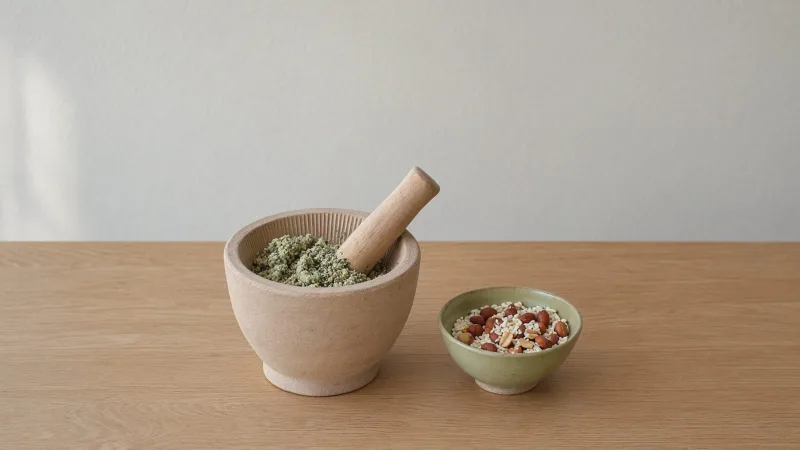
The basic tools are a leiboleiboThe clay mortar 擂钵, with grooves on its inner wall that run to the center. Ingredients are ground against them. mortar and a pestle. The mortar is clay, ridged inside with grooves that converge on the center, and the pestle follows them, "poking and turning". The cook sits with the mortar clamped between the knees. In Gannan (Jiangxi) a bamboo skimmer completes the set, and the three tools are called the "three treasures of lei cha".
Sizes vary. A Gannan mortar is usually about 50 cm across, with a pestle of about 85 cm in hawthorn or oil camellia wood. In Luhe (Guangdong) the pestle is around a meter long; in Jiexi it runs two to four chi, with a ring groove at the top so it can hang from a cord. Taiwanese pestles are short, about 50 cm long and 5 cm thick. There is no standard, and the wood counts as part of the recipe, since the pestle flavors whatever it grinds. Taiwanese cooks use oil camellia, guava, pomelo and olive. In Jiexi they use may chang (Litsea), which is pungent and, locals say, drives out cold. In Taoyuan a pestle of wild "mountain pepper" leaves its aroma and helps the paste keep longer.
Into the mortar go leaf, sesame, peanuts and, depending on the place, beans, rice and herbs. Everything is ground to a dough-like mass that people in Jiangxi and Fujian call tea pastetea pasteThe ground mass of leaf, sesame, peanuts and herbs (茶泥). Pour boiling water over it and you get a thick soup. and in Hunan "lei cha feet". Boiling water is poured over it (in Gannan with a spoonful of mountain camellia oil) and stirred in with the pestle.
Luhe cooks follow a rule: "once for coarse, twice for even, three times for stubborn". The leaf gets a brief grind. Sesame is worked into a paste with steady pressure, without forcing it into the grooves. Once the peanuts go in, the pestle turns heavy, and you can't stop at that point.
How lei cha differs by region
Green tea is the base everywhere, and in Gannan and Luhe it is fresh, unprocessed leaf. Taiwan prefers green or high-mountain tea, and Singapore cooks sometimes add oolong for a stronger taste.
The fillings are where regions part ways. In Luhe people drink a "salty tea" of leaf, sesame and peanuts, and a "raw" one with mugwort, mint, young sweetgum leaves and ginger. In Jiexi cooks add Thai basil and garlic, and people eat lei cha with rice and vegetables from one bowl as lunch. Taoyuan in Hunan makes two kinds: "clear water" with ginger, soybeans, mung beans and salt, and a thick porridge with rice flour. There is a trick to serving it. The paste is first loosened in a cup with cold water and only then covered with boiling water, otherwise you get "grounds on one side, soup on the other".
Hunan has more variants of its own. The "three raw soup" is raw ginger, raw rice and raw leaf; add evodia and mung beans and it becomes "five flavor soup". In Xiangyin ginger is ground in a small mortar and put into a clay pot with roasted soybeans, sesame, tea and a pinch of salt, then covered with boiling water. At a wedding the bride puts 80 peanuts, 80 soybeans and half a cup of sesame into a big pot and pours ten cups so that each holds 8 peanuts and 8 beans. Nobody uses chopsticks: a slap on the rim of the cup sends the beans up toward the mouth.
Overseas, the dish is known as thunder tea rice (擂茶饭). Rice with vegetables, tofu, radish and anchovies comes with a green soup of leaf, mint, basil and mugwort. In Singapore and Malaysia it is associated with the Hepo and Hailufeng clans. Chef Pang Kok Keong's recipe for 10–12 servings: 140 g Thai basil, 60 g mint, 30–60 g mugwort, 30 g cilantro, 60 g roasted peanuts, 40 g roasted sesame, optionally 8 g oolong, 700 ml ice water and 150 g rice per person. Blanch the greens, chill and squeeze them, then blitz everything in a blender.
You cha of the Yao and Dong
Gongcheng in Guangxi was founded in 618 as "Tea City" and renamed in 621. According to the register, the Yao began arriving from Hunan, Guangdong and Jiangxi in the Tang and reshaped the local tea custom. What sets you cha apart from lei cha is the technique: the leaf is not ground but fried in a cast-iron pot in oil with ginger, garlic and peanuts, then beaten with a wooden mallet. The local standard defines the drink as a liquid from tea leaf, fresh ginger, water and edible oil, made by heating and beating the ingredients, boiling them with water and straining.1
The kit is called "you cha of three pieces". First comes a cast-iron pot with a handle and a spout, 18–25 cm across by the standard (a tradition bearer says "one chi", about 33 cm). Its iron is two to three times thicker than a wok's, so it cools slowly and stands up to the pounding. The second piece is a mallet shaped like the numeral 7, cut from an oil camellia trunk, with the long arm as the handle. The third is a woven bamboo strainer.
One meal takes 20–30 g of large-leaf green tea from the spring picking and 15–20 g of ginger. Heat the pot above 150 °C, fry the leaf, ginger, peanuts and garlic, then beat and grind them with the mallet until a yellow-green crust forms on the bottom. Add boiling water (100 °C) and salt. Strain the liquor into cups, top with scallion and cilantro and serve with puffed rice. Top up the grounds with water three more times; the third and fourth rounds are the richest.
Cooks advise soaking the leaf for 5–10 minutes in a little boiling water before frying, to cut the smokiness and bitterness. A saying sums up the four cups: the first is bitter, the second astringent, the third and fourth are real you cha. A good liquor is yellow-green, smells of tea, scallion and cilantro, and is smooth on the palate, with a light sharpness and a sweet aftertaste.
The Dong of Sanjiang do it a little differently. They fry dried glutinous "shade rice" in camellia oil until it puffs, fry the leaf with rice, beat it lightly and boil it. It comes with rice, peanuts, liver, sausages and sour fish. Each of the four cups gets its own filling: an empty one (plain liquor), a square one with cubes of rice cake, a sweet one with ginger and sugar, and a round one with tangyuan, though sources disagree on the order. The word 油茶 means both the drink and the oil camellia, whose seeds are pressed for the oil in Dong you cha.
A Yao guest drinks at least three cups before the hosts cook the main meal. You cha marks every stage of life: a baby's first month, betrothal, wedding, a milestone birthday. The custom entered the national register in 2021, and in 2022 it became part of UNESCO's "Traditional tea processing techniques and associated social practices in China".
Where it comes from
The Tang link is tempting. In the Classic of Tea Lu Yu cites an old custom: leaf pressed into cakes, toasted red, pounded and covered with boiling water, "seasoned with scallion, ginger, tangerine". He himself calls tea with scallion, ginger, jujubes, tangerine peel and mint "gutter water" and adds that "the custom does not stop". So seasoned tea was common under the Tang. Lu Yu boiled his tea with salt, and boiled tea is still made today.
Only one thing is firmly dated: in Southern Song Hangzhou the teahouses sold "seven-treasure lei cha" (七宝擂茶) in winter. Wu Zimu records it in the Meng liang lu, chapter 16, the earliest known use of the word itself. Leibo mortars from the Wumashan kiln in Jianle are dated to the Five Dynasties. Heritage applications trace lei cha back to the congee of Han and Wei and to Song whisking, but no primary source backs this up.
The same goes for you cha. Guangxi's culture department states outright that no documents dating the start of the custom "have been found so far", and the Yao came to the area from the Tang on.
Myths
- Zhang Fei, Ma Yuan or Pan Renmei invented lei cha. Each district claims its own hero. These are legends, and Hakka TV says plainly that they should not be taken as history.
- Lei cha is an ancient, unchanged custom of all Taiwanese Hakka. Until 1999, when the first lei cha shop opened in Beipu,2 most Taiwanese had never heard of it. Settlers from Hepo brought mortars around 1948, and only a few families made it at home. The sweet, thick version with puffed rice was adapted for tourists.
- Emperor Qianlong called you cha "soup that lifts the spirit". Guangxi's agriculture department says the story has yet to be verified.
- You cha is over 1,500 years old. About 1,400 years have passed since the start of the Tang, and no documents date the custom.
Buying and caution
Powders and instant mixes are now mass-market goods: Beipu bags, Gongcheng concentrates and canned you cha. That is a different product, since the custom is about grinding in a mortar and working together. Nearly every version contains peanuts, so anyone with an allergy should ask what's in it first.
Lei cha has no standard: recipes are given "in proportion" and handed down in families. Gongcheng you cha has a local standard, DB45/T 1479-2017, but the csres.com catalog lists it as withdrawn in 2025, while another catalog shows it as valid. The safe wording is that the standard was in force from 2017.
In Jiexi the pestle hangs by a cord in the groove at its top. Yao households keep the tea for you cha above the hearth and take it down for guests and festivals.
Common questions
How is lei cha different from matcha?
The color is similar, but matcha is just powdered leaf whisked with water. Lei cha has grain in it, so it is cloudier and thicker, closer to a soup than to tea as most people know it.
What is "thunder tea"?
The English name is a pun: Hakka "lui", to grind, sounds like Mandarin 雷, thunder. "Ground tea" is the more accurate name.
Can a blender replace the mortar?
You get the taste but not the texture. Singapore chef Pang Kok Keong allows the blender as his one departure from the mortar. Hakka cooks see the grinding as part of the custom: people do it together and slowly, 15 to 20 minutes in Taiwan.
-
DB45/T 1479-2017, "Technical requirements for making Gongcheng you cha" (恭城油茶制作技术要求), Guangxi Bureau of Quality and Technical Supervision. Record of the standard: bzchaxun.com. ↩
-
Master's thesis on lei cha in Beipu (National Chiao Tung University), summarized on the Hakka Affairs Council site: hakka.gov.tw. The English abstract gives 1991, which is a typo. ↩