Chanoyu utensils: chasen, chashaku, natsume, kama 茶道具
Besides the bowl, chanoyu calls for about ten objects: kettle, whisk, scoop, two caddies, water jar, ladle, lid rest. The set changes twice a year, as the sunken hearth (ro) gives way to the portable brazier (furo) and back.
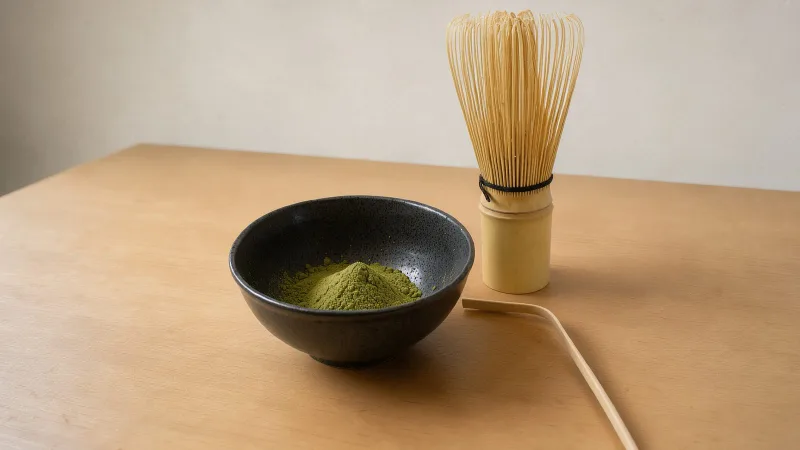
- Name:
- chadogu, "tea tools"
- Whisk:
- about 12 cm, 16 to 120 outer tines
- Scoop:
- 16-21 cm, bowl about 1 x 2 cm
- Sunken hearth (ro):
- November to April, 1 shaku 4 sun (about 42 cm)
- Brazier (furo):
- May to October
- Whisks:
- over 90% of Japanese-made ones come from Takayama
Chanoyu utensils are sorted by room. Whatever the host needs in front of the guests goes in the tea room, and everything else waits in the preparation room, the mizuya. English-language surveys divide the utensils into five groups, from decorative objects to garden items1. This page covers the temae tools used to make tea, apart from the bowl. For the ceremony itself, see chanoyu.
Everything in the set exists to make matcha. Loose-leaf sencha has a separate set in Japan, with a small teapot and five cups.
The whisk: chasen
A chasen (茶筅) is carved from a single piece of bamboo, with the tines cut from the butt end of the culm. The handle stays whole and the rest is split. In Takayama, in the city of Ikoma in Nara Prefecture, makers divide a piece about 12 cm long into 16 strips and split each strip into roughly 10 fibers. The thinner half becomes the outer tines, and the rest are tied into an inner row. Last comes ajikezuriajikezuriLiterally "taste shaving": the last step, when the maker planes the tine tips of a whisk down to about 0.05 mm.: the maker planes the tips of the outer tines down to 0.05 mm so they won't scratch the bowl or tear the foam.
The label gives a tine count, but only the outer tines are counted. A whisk sold as "64" has 128 fibers once you add the inner ones, and the actual number rarely matches the name.
| Outer tines | Name | Use |
|---|---|---|
| 16 | hira-ho | special |
| 32-48 | ara-ho, chu-ara-ho | thick tea |
| 64 | tsune-ho | standard |
| 68-74 | kazu-ho | all-round, thin tea |
| 75-120 | hachijuppon-date and up | thin tea |
Sparse, thick tines are springy and knead koicha to the consistency of liquid starch. Dense, fine tines whip usucha into a froth of tiny bubbles. Schools have their own preferences. Omotesenke uses whisks of smoked bamboo, and Musha-no-koji-senke prefers the straight tines of the Kangyuan shape, which barely foam the tea at all.
Takayama makes more than 90% of Japanese whisks, around 300,000 a year. The figures are approximate and come from a single source; the craft has held official traditional status since May 10, 1975. Japan goes through about a million whisks a year, so cheap imports, mostly Chinese, take roughly 70% of the market. A handmade whisk has tines that thin toward the tip and curl in a smooth line, bamboo of an even pale color, and a box that names the maker. Even the shin shape, a soft curve with no loop, is now made in China, because Takayama makers taught Chinese craftsmen the pattern. So "shin" on a label is no guarantee of origin.
The scoop: chashaku
The chashaku (茶杓) carries powder from the caddy to the bowl. It is usually 16 to 21 cm long, and its bowl (kaisaki) is no more than 1 cm wide and 2 cm long. Two museum pieces attributed to Rikyu and Sotan measure 17.9 and 17.5 cm.
Each part has a name: tsuyu is the tip, kaisaki the bowl, tame the curve, fushi the node, ottori the spot under the thumb. The position of the node defines three forms. A scoop with no node, symmetrical like the ivory prototype, is shin. With a node at the end it is gyo, and with a node in the middle it is so, the most common form. Tradition credits the nodeless bamboo scoop to Murata Juko, the end-node scoop to Takeno Joo, and the middle-node scoop to Sen no Rikyu.
The first scoops were ivory, modeled on apothecary spoons. Sources disagree on when bamboo took over. The JAANUS dictionary says after the mid-17th century, while Japanese Wikipedia and the Metropolitan Museum place the change in the 15th to 16th centuries, the time of Juko and Rikyu.
A scoop is kept in a bamboo tube inscribed with its poetic name. A tube signed by the maker is called a tomozutsu, and a scoop without one loses much of its value.
The caddies: natsume and chaire
There are two caddies, one for thin tea and one for thick.
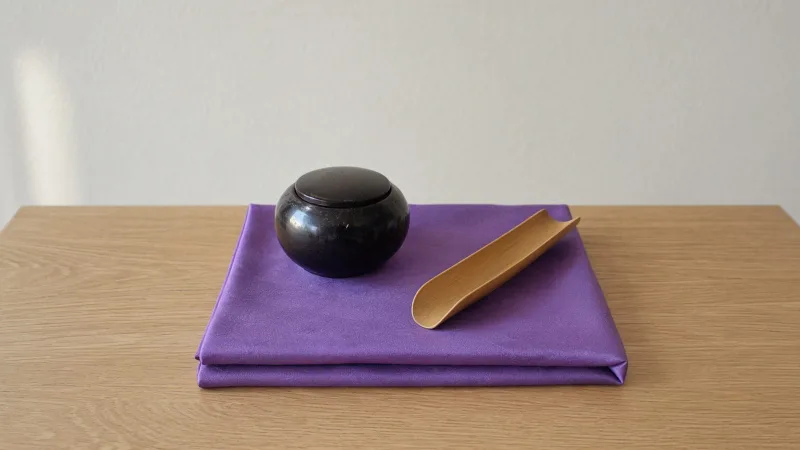
Natsume (棗) is a turned, lacquered wooden caddy for thin tea. The name means jujube, the fruit it resembles in shape. The Rikyu-gata canon has three sizes (o-, chu- and ko-natsume). In the medium size the height equals the diameter, about 6.8 cm, though another reference gives 6.6 cm. The lid makes up the top third. The natsume is usually credited to Haneda Goro of Kyoto in the time of the shogun Ashikaga Yoshimasa, but historians treat this as legend, since the natsume shows up in tea records only after Takeno Joo's death.
Chaire (茶入) is a ceramic jar 3 to 15 cm tall, used for thick tea. Its ivory lid is lined underneath with gold foil, and the jar itself is kept in a silk shifukushifukuThe silk pouch for a ceramic chaire caddy. Valuable caddies come with several, for different occasions.. Chinese jars of the Southern Song and Yuan, known as karamono, arrived in the 13th century and long ranked highest. Japanese kilns started making chaire in the Momoyama period. You can tell the two apart by the spiral the cutting string leaves on the base: it runs "right" on Seto ware and "left" on Chinese pieces, because the wheel turned the other way.
A chaire is valued together with its accessories. The "Zaichuan" jar of Kobori Enshu survives with eight pouches and eight ivory lids. The Fujita Museum calls the idea that the gold darkens from poison nothing more than a belief.
Kettle, hearth and brazier
The kama (釜) is a cast-iron kettle. Copper ones exist but are rare. It has a narrow mouth and two lugs on the shoulders for the rings (kan) used to carry it.
A furo kettle has a flange, the hane, that rests on the rim of the brazier. A ro kettle stands on a trivet, the gotoku, and needs no flange. The ro itself is a square hearth sunk into the floor, 1 shaku 4 sun (about 42.4 cm) on a side. Joo and Rikyu settled on that size; before them, hearths came in all sizes. The furo is a portable brazier of ceramic or metal. The charcoal sits on specially prepared ash, and the ash for ro differs from the ash for furo. For other ways to heat water, see heat sources.
Two casting centers dominate the history of the kettle. Founders in Ashiya (now Fukuoka) cast even, smooth shinnari kettles, while those in Tenmyo (now Tochigi) gave theirs a rough, torn surface. Sixteenth-century tea records mention Tenmyo more often, and the Tokyo National Museum links this to the shift from the lavish shoin style to modest wabi. The same museum calls the legend of a first tea kettle cast for the monk Myoe in 1201 to 1203 unproven. Ii Naosuke, a shogunate minister and tea master, said a single kettle sets the standard for the whole gathering.
For the cast-iron teapot used for everyday tea, see metal teaware.
Water, ladle and cloths
The mizusashi (水指) holds the cold water used to top up the kettle and rinse the bowl and whisk. Most are ceramic; some are lacquer, bent thin wood or bamboo. It is usually set in place before the guests enter. Waste water goes into the kensuikensuiThe waste-water bowl. It comes in last and goes out first, because pouring water away counts as unclean work., a bowl of metal, ceramic or bent wood. It comes in last, goes out first and stays out of the guests' sight.
The hishaku is a bamboo ladle with a cup (go) fitted onto a handle. The schools use around 120 kinds between them, and the most visible difference is seasonal.
| Ladle | Cup | Handle end cut |
|---|---|---|
| for ro | larger | skin side cut |
| for furo | smaller | pith side cut |
| sashidoshi | - | straight, for formal display on a shelf |
These rules follow ladle maker Mihara Keiji; the Enshu school reverses the cuts.
The futaoki is a rest for the kettle lid and the ladle cup, made of bamboo, ceramic or metal. On a bamboo rest the node sits near the top for furo and in the middle for ro. The "seven rests of Rikyu" include an incense burner, a trivet, a turban shell and a crab.
There are two cloths. The fukusa is a double-layer silk cloth about 27 x 29 cm, used to symbolically purify the caddy and scoop. Sources give slightly different sizes for it. The chakin is a white linen cloth about 30 x 15 cm for wiping the bowl.
The seasonal year
The ro is in use from November to April, the furo from May to October. The hearth opens on the Day of the Boar in the lunar calendar, in early November. The rest of the set follows the half-year. In the furo season the incense burner gets chips of aromatic wood; in winter, kneaded incense is burned.
Each half has finer touches of its own. In March the Urasenke school hangs the kettle (tsurigama) from a ceiling hook on a chain, so the spring wind can rock it a little. In summer comes habuta, when the water jar is covered with a mulberry leaf instead of a lid. In the furo season, for thick tea, the host adds a ladle of cold water to the kettle: by May last year's tea has lost some of its aroma, and water at a full boil would drive the rest off.
Choosing and caring
Start with the whisk. It is the easiest piece to buy in person, and you feel the difference right away. The rest depends on your school. Among the honorary "ten crafts of the Sen house," each family has its specialty: Onishi Seiemon casts kettles, Nakamura Sotetsu lacquers caddies, Kuroda Shogen makes bamboo pieces and ladles, and Eiraku Zengoro shapes clay braziers.
Dry the whisk on a shaping stand, a kusenaoshi, in the preparation room and keep it somewhere cool, or the bamboo will crack and mold. Never touch the kettle with bare hands; hold it through a fukusa or paper. Fill it with well or tap water that has no iron taste. In freezing weather, don't pour cold water into it or set it straight over high heat, or the bottom can crack. Don't heat it on gas or briquettes either, because sulfur fumes damage the iron. After use, rinse it, clear out ash and scale, blot it with a soft cloth, finish drying it on the residual heat and leave it in a draft for about two days. Store it bare in its box. Empty the ash from a furo before putting it away, since ash draws moisture.
No government standard covers these utensils. Only Takayama holds traditional craft status.
Common questions
What is the difference between natsume and chaire?
Material and tea. A natsume is a turned, lacquered wooden caddy that holds powder for thin tea (usucha). A chaire is a ceramic jar with an ivory lid, kept in a silk pouch and reserved for thick tea (koicha). A small ko-natsume can also serve for koicha.
Can I replace the chasen with something else?
Real foam takes a bamboo whisk. A blender or a fork leaves big bubbles and lumps. A beginner can start with an 80- to 100-tine whisk, which handles thin tea well. For whisking technique, see the matcha guide.
How do I keep an iron kama from spoiling?
Never handle it with bare hands, since sweat causes rust. Never heat it on gas, because sulfur fumes damage the iron. After use, rinse it, remove the scale, blot it and let it dry on the residual heat, then store it bare in its box.
-
Wikipedia, "Japanese tea ceremony utensils", https://en.wikipedia.org/wiki/Japanese_tea_ceremony_utensils. For the set, schools and craftsmen, see also the Omotesenke glossary, https://www.omotesenke.jp/english/chanoyu/glossary.html. ↩