Bai Hao Yin Zhen 白毫银针
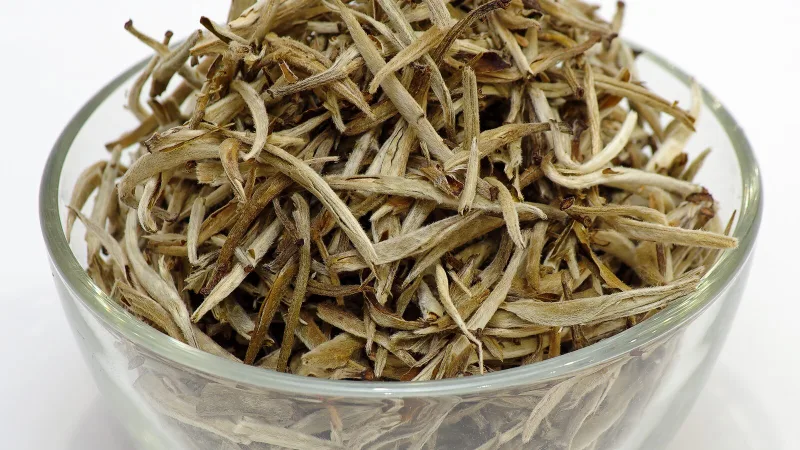
Silvery buds in thick white down, simply withered and dried. The purest example of white tea: fresh, it smells of hay and melon, and with age it moves toward honey and dried fruit.

- Province:
- Fujian, Fuding and Zhenghe counties
- Oxidation:
- light, happens on its own during withering
- Raw material:
- buds only
- Leaf shape:
- whole buds in white down
- Harvest:
- March to early April
- Flavor:
- hay, melon, honey; with age, dried fruit
Bai Hao Yin Zhen (白毫银针, "silver needles with white down") is made only from buds. Each one is covered in thick silvery down, bai haobai haoThe white down on the buds and young leaves of the tea bush. Both this tea and white tea as a type take their name from it., and the dry tea looks like a handful of long, fuzzy needles. It is the flagship of white tea, with the shortest processing of any type: the buds are only withered and dried.
Fuding and Zhenghe
Yin Zhen comes from two counties in northern Fujian. Fuding lies on the coast, on the border with Zhejiang, and Zhenghe sits in the mountains to its west. Each county has its own bushes. Fuding grows the Fuding Da Bai and Fuding Da Hao cultivars, Zhenghe its own Zhenghe Da Bai. All of them are large-bud cultivars with thick, fleshy, downy buds; a smaller bud would not make a "needle".
Fuding Yin Zhen is usually paler and more delicate, with floral notes. Zhenghe buds are larger and give a fuller liquor, with a sweetness closer to herbal.
The buds are picked in early spring, from March to early April, before they open. Nobody picks in rain or morning dew: a wet bud darkens during withering, and the batch drops to a lower grade.
Withering and drying
The buds are spread in a thin layer on bamboo trays. This stage is called wei diaowei diaoWithering: fresh leaf is spread in a thin layer and slowly loses moisture. For white tea it is the main processing step., withering. The trays go out in the sun, in the shade or indoors, and over two to three days the buds lose most of their moisture. Oxidation runs on its own and stays light, because no one shakes or bruises the leaf.
Then the buds are finished over a low fire or in a dryer. Skip this step and the tea picks up damp and goes moldy in storage.
Much depends on the weather and the maker's eye. A dry, sunny spring makes for a sweet, clean tea. In a damp spring withering drags on, the buds darken, and the maker has to lean more on the dryer.
The tea treatise of the Song emperor Huizong (early 12th century) has a chapter on "white tea". It describes a rare bush with pale, almost white leaves, and the tea from it was pressed into cakes. Today's Yin Zhen shares nothing with it but the name: the method behind modern white tea took shape in Fujian many centuries later.
How it changes with age
Fresh Yin Zhen smells of hay, melon and wildflowers. The liquor is pale straw, the taste light and sweet, and the down makes it slightly hazy and velvety.
Over the years the liquor darkens to gold, then to amber. The hay fades, honey and dried fruit take its place, and later come herbal notes and a hint of dried date. Merchants are happy to credit old white tea with healing powers, but that is marketing. Age improves the flavor of a well-made tea stored dry and away from other odors, but it adds no medicinal properties.
Collectors age white tea much like pu-erh: for years, in boxes or pressed cakes, and for cakes they more often use leafy Shou Mei. Yin Zhen needs no fridge: for storage, a dry, dark cupboard and well-sealed packaging are enough.
How to brew
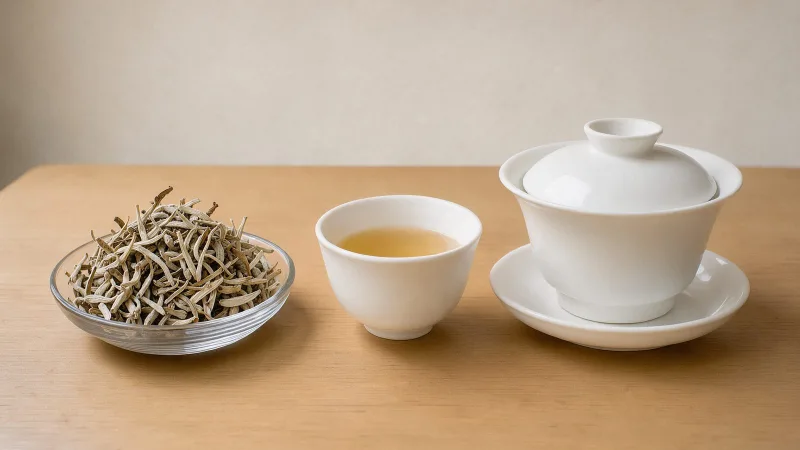
Buds release their flavor slowly, so Yin Zhen forgives mistakes. Brew it gongfu cha style in a gaiwan, with 5 g per 100 ml of water at 85 °C. Give the first infusion 40–60 seconds and each one after it 15–20 seconds more. The tea lasts six to eight infusions, and the middle ones are usually better than the first.
Aged Yin Zhen takes hotter water, up to 95 °C: dense old buds need more heat.
Put 3 g of buds in a 200 ml glass and pour in water at 80 °C (176 °F). After a minute the needles stand upright in the water and slowly begin to sink. Start drinking after 3–4 minutes, and top up with water twice more.
The buds of yellow Jun Shan Yin Zhen stand up in a glass the same way, except that they go through sealed yellowing before drying.
Yin Zhen has a delicate flavor that hard water drowns out, so it pays to choose your water for tea with care. If you came to white tea from green, compare it with Longjing. Both are picked in early spring, but Longjing owes its flavor to fixation in a hot wok, while Yin Zhen owes it to the bud and the sun alone.
Common questions
How is Bai Hao Yin Zhen different from Bai Mu Dan?
The raw material. Yin Zhen is made only from buds, Bai Mu Dan from a bud with one or two leaves. Bai Mu Dan tastes fuller and more herbaceous, Yin Zhen finer and sweeter, and Yin Zhen is the pricier of the two.
Why does the liquor come out watery?
Buds release their flavor slowly, especially in the first infusions. Let the first infusion run up to a minute, or use 6 g per 100 ml. For fresh tea, it is best not to go above 90 °C: the floral aroma is the first thing to go.
How long does Yin Zhen keep?
For years, if the tea is dry and well sealed, away from light and other odors. It is drunk fresh within the first year, or aged after three to five years or more.