Jun Shan Yin Zhen 君山银针
A yellow bud tea from Junshan Island in Dongting Lake. After fixation the buds are wrapped in paper twice and left to yellow for nearly three days. The down stays white; the bud itself turns golden.
- Province:
- Hunan, Junshan Island in Dongting Lake
- Raw leaf:
- buds only, first spring flush
- Harvest:
- 7–10 days around Qingming
- Yellowing:
- twice in paper, about 60–70 hours
- Dry leaf:
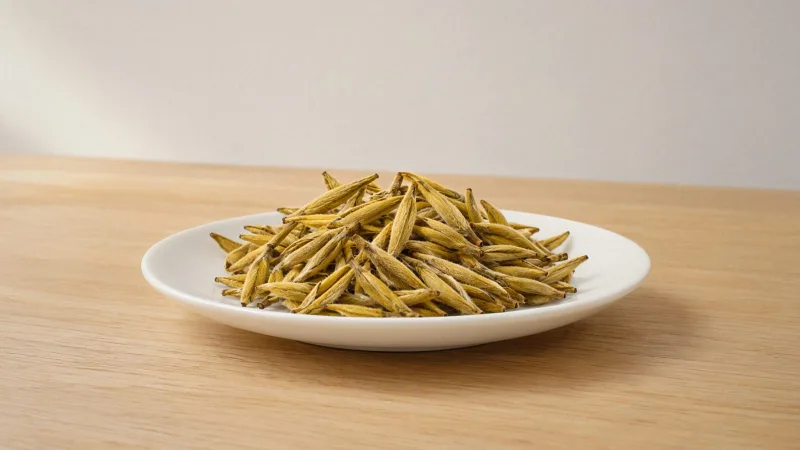
- straight golden buds in white down
- Flavor:
- soft, sweet, not grassy
Jun Shan Yin Zhen (君山银针, "Silver Needles from Mount Jun") grows on an island in Dongting Lake, near the city of Yueyang in northern Hunan. It is the best-known yellow tea and the only yellow one on the list of China's ten famous teas drawn up in 1959. Only buds go into it, and it yellows longer than any other yellow tea: from the wok to the final drying takes about three days.
An island in Dongting Lake
Junshan is tiny: 0.96 square kilometers and 72 low hills. Dongting is China's second-largest freshwater lake. In spring and summer mist hangs over the water, average humidity on the island is about 84%, and forest covers nearly all the land not given over to tea gardens. The soil is sandy and loose. In the summer heat the roots of the bushes reach several meters down for water.
The Tang poet Liu Yuxi, looking from the shore, saw the island as "a green snail on a silver plate". People drank tea from the island long before it had its present name. The Qing gazetteer of Baling County records that Junshan sent 18 jin of tea, about 10 kg, to the court every year1. The name "Jun Shan Yin Zhen" only became fixed in 1957, and in 2021 its processing method was added to China's national list of intangible cultural heritage.
Harvest
Picking lasts 7–10 days around the Qingming festival (April 4–5) and takes only the first flush of spring shoots. The bud has to be plump and straight, about 2.5–3 cm long. Thin, crooked, hollow and insect-bitten buds stay on the bush. There is no picking in rain or while the dew is on: a wet bud darkens during processing.
Pickers snap each bud off at the base with their fingertips, never with a fingernail. A cut, or sweat from the hands, changes how the bud yellows later. A kilogram of finished tea takes about 60,000 buds.
Double yellowing in paper
It starts out like green tea. The buds are fixed in a wok tilted at 20°, in batches of 300 g. The wok begins hot, at 100–120 °C, and ends around 80 °C. The tea maker tosses the buds with open palms and lets them roll down the wall without pressing, or the bud would bend and lose its down. After 4–5 minutes the buds turn soft and lose their grassy smell.
Next the buds are dried over charcoal at 50–60 °C until they have lost half their moisture. This is the first place it can go wrong. An over-dried bud barely yellows afterwards and stays green; an under-dried one darkens and ends up with a dull aroma.
Then comes men huangmen huangSealed yellowing: after fixation the warm, damp leaf is covered and left until it turns yellow., the sealed yellowing. The buds are wrapped in thick paper, 1–1.5 kg to a packet, and laid in a wooden box for 40–48 hours. Inside, the leaf oxidizes slowly, and by the end of the first day the packet reaches about 30 °C. The packets get turned so the buds yellow evenly. Packet size matters too: in a large one the leaf overheats and darkens, in a small one it yellows too slowly. At a room temperature of 20 °C, 40 hours is enough; in cold weather yellowing takes longer.
Once yellow, the buds are dried again, for about an hour at 50 °C, and wrapped again, this time for around 20 hours. The tea maker judges readiness by color and smell: the bud should be golden yellow and smell rich and sweet. The final drying runs at 50–55 °C in half-kilo batches, after which the buds are sorted by hand and only the straight, plump, whole ones are kept.
Jun Shan Yin Zhen yellows slowly and without much heat, and the change happens mostly in the bud beneath the down. Hence the look known in China as jin xiang yujin xiang yu"Gold set in jade": the look of good Jun Shan Yin Zhen, a golden bud under a layer of white down., "gold set in jade": a golden bud under a coat of white down.
What is sold under this name
There is little genuine island tea and plenty of demand for the name. Buds from the shores of Dongting Lake are sold under it, from the same bushes grown in a different climate. Growers on the island and around the lake have also planted bushes brought from elsewhere, including the large-bud Fujian cultivars used for white tea.
Some buds from Junshan itself are made like green tea, without yellowing. That tea is cheaper and is often sold abroad as yellow. Only the leaf and the cup tell them apart. Yellowed tea has a golden bud, an apricot-yellow liquor and a soft, sweet taste with notes of sugarcane and corn silk. The green look-alike smells of grass, has a greenish bud and is slower to stand up in the glass.
How to brew
Brew it in a tall glass, 10–15 cm high, so you can watch the buds rise and sink. Rinse the glass with hot water and wipe it dry, since buds that touch a wet wall soak too early and won't stand up well. Use soft water heated to 80–85 °C.
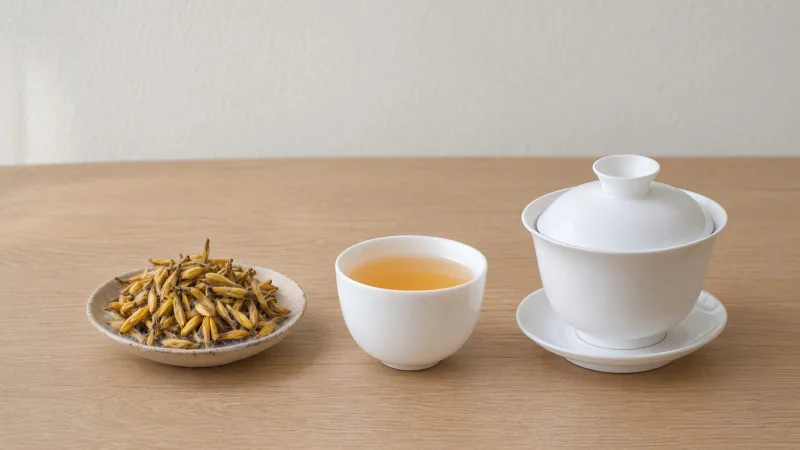
3 g of buds to 150 ml of water at 80–85 °C (176–185 °F). Fill the glass halfway, wait half a minute, then top it up to 150 ml and cover it with a saucer. After 3–5 minutes lift the saucer: the buds stand upright and sink to the bottom one by one. Drink it down to the last third, then top up with hot water. The buds hold up for three refills.
The buds also do well in a gaiwan, though you lose the dance. Store the tea like green tea, tightly sealed, in the fridge. On the island it used to be kept in boxes on a layer of calcined gypsum, the packets wrapped in mulberry paper, since gypsum draws moisture.
At a glance Jun Shan Yin Zhen is easy to confuse with Bai Hao Yin Zhen, which is also made of downy buds. White tea is only withered and dried; its bud is silvery and its flavor leans toward hay and melon. The other two famous yellow teas are yellowed differently: Meng Ding Huang Ya hot, in short rounds between wok firings, and Huo Shan Huang Ya after it has already been partly dried.
Common questions
Why do the buds stand upright in the glass?
A dry bud is light and floats at first. Its base takes up water faster than its tip, so the bud stands on end, and once it is soaked through it sinks to the bottom. Sometimes it rises and sinks several times; in China this is called "three rises, three falls". You see it best in a tall, straight-sided glass.
How do I tell yellow Jun Shan Yin Zhen from one made like green tea?
By color and smell. Yellowed tea has a golden bud under white down, an apricot-yellow liquor and a soft, sweet taste. A bud made the green way stays greenish, smells of fresh grass and gives a pale liquor with a green tinge.
Why is it so expensive?
The island covers less than one square kilometer, only buds are picked, for just 7–10 days a year, and a kilogram of tea takes about 60,000 buds. Processing means about three days of handwork, and one mistake in yellowing ruins the whole batch.
-
Gazetteer of Baling County (巴陵县志), as cited in the Baidu Baike article on Jun Shan Yin Zhen. A Qing jin is about 600 g. ↩