Tea traditions 茶文化
Tea left China by land and by sea, and almost everywhere it went people found their own way with it: whisking it, diluting it with boiling water, simmering it with milk, or eating it.
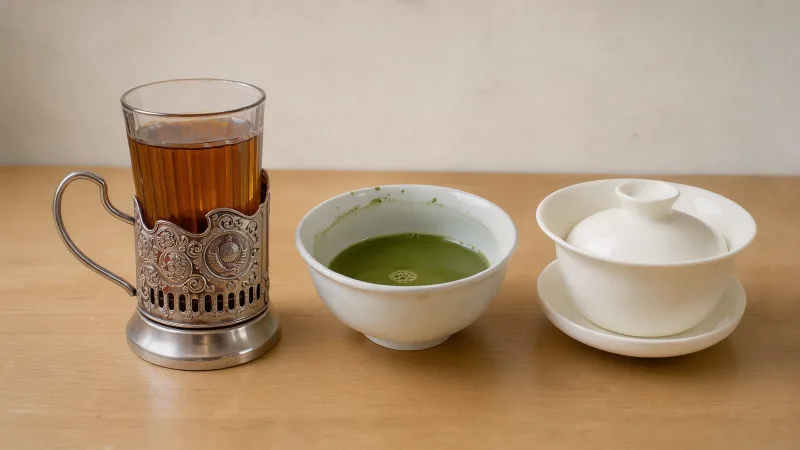
Over more than a thousand years, China boiled its tea with salt, whisked it to a froth and steeped the whole leaf. Each era left behind its own teaware, from the Tang brazier to the Yixing teapot, and its own methods, down to Chaozhou gongfu. Japan preserved the whisked tea of the Song and built the chanoyu ceremony around it. Korea's darye, a rite centered on loose-leaf green tea, took shape between the 1960s and the 1980s.
The Dutch brought the first cargo of tea to Europe in 1610, Britain first tasted it in the London coffeehouses of the 1650s, and Russia got it from Mongolia between 1616 and 1638. Across the Middle East and Central Asia, people dilute strong black tea with boiling water right in the glass, the Maghreb takes green tea with mint, chaikhanas serve tea in bowls, and on the steppe brick tea simmers in a cauldron with milk and salt. In South and Southeast Asia people boil tea with milk and spices. Tibetans churn it with butter, the Vietnamese drink it over ice, and in Myanmar the leaf is fermented and eaten.
-
 China
中国
Chinese tea past and present: Tang boiled tea, Song whisking, Ming loose leaf, water in the classics, then gongfu, chayi, teahouses, Yunnan and lei cha.
-
 Japan and Korea
茶の湯
The chanoyu ceremony with matcha, senchado with leaf tea, the folk whisked furicha, and the Korean darye rite.
Chanoyu: the Japanese way of tea · Senchadō: the way of leaf tea · Furicha: Japan's folk whisked teas · Darye: the Korean way of tea
-
 Europe and Russia
How Europe and Russia drink tea: the samovar and diluted zavarka, British tea with milk, East Frisian cream and rock candy, and the Dutch cargo of 1610.
Russian tea drinking: zavarka, glass and sugar in the teeth · Tea in Britain and Ireland · Tea in continental Europe
-
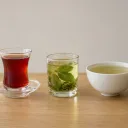 Middle East and Central Asia
The Turkish çaydanlık, the Iranian guri, sweet Arab tea, mint atai, the chaikhana piala and salted steppe tea.
Tea in Turkey and Azerbaijan: the çaydanlık and the armudu · Tea in Iran and Afghanistan · Tea in the Arab world: the glass, the sugar, the qouri and karak · Atai: mint green tea of the Maghreb · Chaikhana and piala: tea in Central Asia · Steppe milk tea: cauldron, brick, salt and butter
-
 South and Southeast Asia
Masala chai and pink noon chai, milk teas from Hong Kong to bubble tea, Tibetan butter tea, Vietnamese lotus and laphet.
Tea in South Asia: masala chai and its neighbors · Asian milk teas: from Hong Kong to bubble tea · Tibetan butter tea: po cha, the dongmo churn and tsampa · Tea in Vietnam: chuyên trà, lotus and trà đá · Tea you eat: laphet and miang