Yixing teapot 宜兴紫砂壶
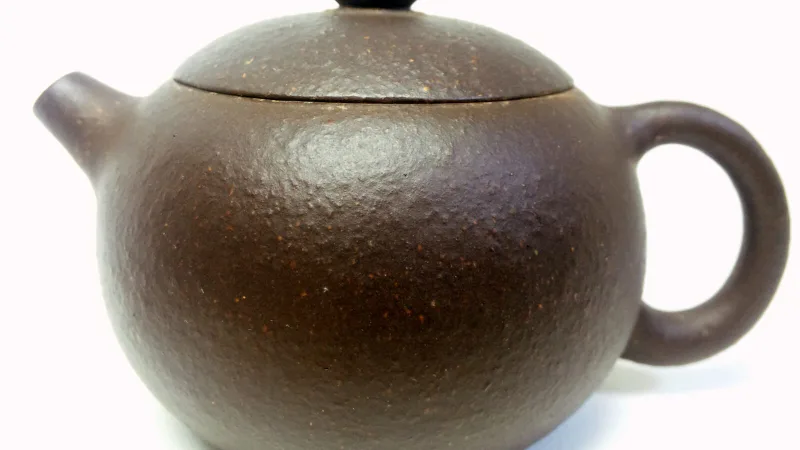
An unglazed teapot of zishazishaYixing clay, literally “purple sand”. Fired without glaze, it keeps fine pores. clay, mined near the city of Yixing in Jiangsu province. Its porous walls hold heat, and a film of tea slowly builds up inside, so each pot is kept for one type of tea.

- Province:
- Jiangsu, city of Yixing
- Clay:
- zisha: zini, zhuni, duanni
- Glaze:
- none, porous walls
- Made since:
- 16th century, Ming dynasty
- Size for gongfu cha:
- 100–200 ml
- Teas:
- oolong, black and dark tea
Yixing (宜兴) lies in Jiangsu province, on the western shore of Lake Tai. The hills around it yield zisha clay (紫砂, “purple sand”), and teapots have been made from it since the 16th century, under the Ming dynasty. The zishazishaYixing clay, literally “purple sand”. Fired without glaze, it keeps fine pores. teapot arrived with the habit of steeping whole leaf: under the Ming, powdered tea fell out of use, and people needed a vessel the leaf could open up in. Over five centuries the Yixing teapot became China's main clay brewing vessel, and the word “Yixing” turned into a label stamped on almost anything.
Zisha clay
Zisha is the name for several clays from the same deposits. Three turn up most often:
- zini (紫泥), purple-brown, the most widespread;
- zhunizhuni“Cinnabar clay”: a red, iron-rich variety of zisha. It shrinks a lot in the kiln. (朱泥), red and rich in iron: it shrinks a lot in firing, and the walls come out thin and dense;
- duanni (段泥), pale, from golden to gray-green, often speckled.
Potters fire the teapots unglazed at 1100–1200 °C, which leaves the body dense enough to hold water but with fine pores. The walls give up heat slowly, and the oils and aromatic compounds of the liquor gradually settle into the clay. Brew the same tea side by side in a gaiwan and in a seasoned Yixing pot: the liquor from the pot usually comes out softer, its sharp notes muted.
Thin-walled zhuni heats up faster and absorbs less, and it is a favorite for aromatic oolongs. Zini is thicker and more porous; it suits teas that need sustained heat, such as dark Liu Bao.
One pot, one type of tea
Clay soaks up the scent of everything brewed in it, and after a year of daily sessions even plain boiling water poured into the empty pot smells of tea. Hence the main rule: each pot gets its own type of tea, ideally a single tea. Brew floral Tie Guan Yin in a pot that has spent a year with Da Hong Pao, and its aroma drowns in roasted notes. Smoky Zheng Shan Xiao Zhong leaves a pine scent that lingers in the clay for a long time, so it gets a pot of its own.
People keep Yixing pots for roasted oolongs, black tea and pu-erh, with separate pots for sheng and shu. Green and white teas rarely go into clay: thick walls hold heat for a long time and stew the tender leaf, so these teas are brewed in a gaiwan or glass.
Care
Before its first session a new pot is prepared, a step called kai hukai hu“Opening the pot”: preparing a new teapot before its first session.. The simplest way is to rinse the pot inside and out with hot water, fill it with boiling water, let it cool, and repeat two or three times. After that, brew the tea the pot is meant for and pour away the first infusions.
After each session, take the leaf out with a bamboo scoop, rinse the pot with boiling water and let it dry with the lid off. Wipe the outside with a soft cloth; many people also pour hot water over it during the session. Over the years the clay takes on an even matte sheen, called baojiang (包浆) in Chinese. With hard water, pouring leaves a mineral ring on the lid (more on this in teaware care).
Detergent, baking soda and the dishwasher: porous clay soaks up the chemicals and releases them into the liquor. Wet leaf forgotten inside: within a couple of days you get mold and a musty smell that is hard to get rid of. Sudden temperature changes, especially in winter: a cold pot can crack under boiling water.
How to choose
For gongfu cha, you want a 100–200 ml pot; 80–120 ml is enough for one person. Then test the pot in use rather than judging the clay alone.
The lid should sit tight, with no play. Fill the pot with water and tilt it while covering the hole in the lid with a finger: with a well-fitted lid the stream stops. The spout should pour an even stream that does not break up or splash, and the pot should not drip afterwards. The empty pot sits comfortably in the hand, and the handle does not outweigh the spout.
Fakes
Genuine zisha is scarce, demand for Yixing teapots is huge, and the market is full of teaware that has nothing to do with Yixing. You will come across pots of ordinary clay tinted with dyes, blends with a small share of zisha, and slip-cast pots made from liquefied clay.
Warning signs:
- a factory-mug price on a “handmade” pot;
- gloss on a new pot: fresh zisha is matte, real shine takes years, and shine on a pot in a shop comes from wax or polish;
- a chemical, varnish or paint smell after boiling water;
- a loud, bright color unnatural for clay;
- glaze inside, which zisha never has;
- water that turns colored when the pot is held in boiling water.
No single sign proves anything on its own. It is safer to buy from a seller who names the clay and the method: fully handmade (全手工), half-handmade in a mold (半手工) or slip-cast. And who lets you test the pot with boiling water before you pay.
-
 Yixing clays
紫砂泥
Yixing clays: zini, hongni, zhuni, duanni and lüni. Where the ore comes from, how they differ after firing, and which clay suits oolong or ripe pu-erh.
-
 How a pot is made
紫砂壶成型
How a Yixing teapot is made: paddling and slab-building, fully handmade vs mould-assisted vs slip-cast, firing, classic shapes and how to read base marks.
-
 History and masters
宜兴紫砂壶史
From a eunuch’s tomb to 1950s cooperatives: how the Yixing pot changed, what Shi Dabin, Chen Mansheng and Gu Jingzhou did, and why a mark is not a maker.
Common questions
Can I brew different teas in one Yixing teapot?
You can, but the flavors will mix. A film of oils and aromas builds up on the inner wall, and after a few months the pot smells of whatever tea was brewed in it most often. That is why each pot is kept for one type of tea, and raw (sheng) and ripe (shu) pu-erh usually get separate pots.
What should I wash a Yixing teapot with?
Hot water only. Detergent and baking soda soak into the porous clay and later come out in the liquor. After a session, take out the leaf, rinse the pot with boiling water and let it dry with the lid off.
How can I tell a teapot is real zisha?
You can only be sure from its provenance and an honest seller. Be wary of a price on par with a souvenir mug, gloss on a new pot, a chemical smell after boiling water, and water that turns colored when the pot is held in boiling water.