Taiwanese tea arts: chayi and wuwo 茶藝
The chayi movement took shape in Taiwan in the late 1970s. It gave the world the fair cup, the aroma cuparoma cupA tall, narrow cup (聞香杯): the liquor is poured into it, tipped into a low tasting cup, and the empty aroma cup is sniffed. and schools of brewing, and Cai Rongzhang devised wuwo, a gathering with no host and no guests.
- Place:
- Taiwan, Taipei
- The word “chayi”:
- 1977, Lou Zikuang’s circle
- Lu Yu Tea Art Center:
- 1980, Taipei
- Key figure:
- Cai Rongzhang (蔡榮章)
- Innovations:
- fair cup, aroma cup, master’s exam
- First wuwo gathering:
- June 23, 1990
In Taiwan tea is drunk the Chinese way, but what the world calls the “Chinese tea ceremony” (a set with a fair cup, a sniffed empty cup, a certificate for brewing masters) took this form on the island around 1980. The movement is called chayi (茶藝), “tea art”. It grew out of Chaozhou gongfu and went back to the mainland as a ready-made standard.
Where chayi came from
In 1971 Taiwan left the United Nations, then lost diplomatic relations with the United States and Japan, the buyers of its tea. Meanwhile mainland China returned to the world market, and Taiwan’s exports dropped sharply. The industry turned to the domestic market. The research station and the agricultural authorities bet on oolong, and the new tea culture rested on old gongfu cha, under the banner of the Chinese cultural renaissance campaign announced in 1966.
The name was settled in 1977 in the circle of the folklorist Lou Zikuang. “Chadao” sounded too lofty and already belonged to Japan. The term itself is older: in 1940 Hu Haochuan used it in an agronomic sense, but no one had applied it to tea drinking before.
Then events moved fast.
- 1974. Li Youran opened the “Chinese Tea House” in Taipei, serving Dong Ding brewed in Yixing pots.
- 1977. The “Chinese Gongfu Tea House” opened (August 14). Cai Rongzhang ran it from November 1977 to May 1979.
- 1979. Guan Shouling received a license for the first house with a 茶藝館 sign: a gallery of paintings and ceramics that served tea.
- 1980. The Lu Yu Tea Art Center began work in Taipei. Sources give different dates (October 1 or December 25), so only the year is certain. Starting in December 1980, the Center published the magazine Chayi, 307 issues in all until 2007.
- 1981. Zhou Yu opened Zi Teng Lu, “Wistaria”: a salon-style tea house named for three old wisteria vines in its courtyard.
- December 23, 1983. The first Lu Yu brewing master exam. By 2020 it had been held 61 times.
By 1983 Taipei had about 80 tea houses, and by 1987 the whole island had about 500.
What chayi added to gongfu
Chayi kept the small pot and small cups of the Chaozhou set for short infusions and added two items the set never had. The Yingge Ceramics Museum states plainly that the fair cup and the aroma cuparoma cupA tall, narrow cup (聞香杯): the liquor is poured into it, tipped into a low tasting cup, and the empty aroma cup is sniffed. were not used in gongfu cha and are Taiwanese innovations.1
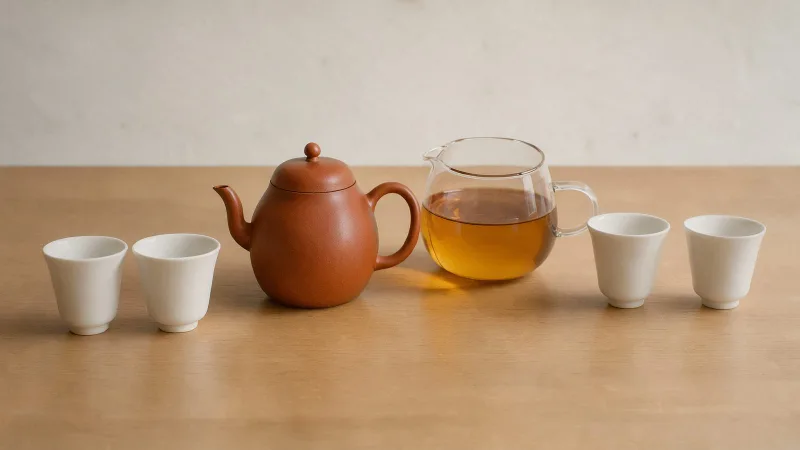
The fair cup (chahai) evens out the strength: you decant the whole infusion into this pitcher and pour from there. Lu Yu’s models changed fast. In 1981 the chahai had a lid and no handle, and in 1986 its spout gained a removable strainer.
The aroma cup (聞香杯) appeared in the 1980s. In the “two-cup method” the liquor goes into it, the guest tips it into a low tasting cup, sniffs the empty aroma cup, and only then drinks. In the demonstration version the aroma cup is set upside down over the tasting cup and the pair is flipped 180° together. No document shows who invented it. Cai does not claim it, and web legends crediting him or the founder of Chun Shui Tang are not backed by primary sources.
The Lu Yu Center also designed gear for drinking tea away from home: an electric kettle and a tea trolley (1980), a chahe for showing the dry leaf (1981), and from January 1988 covers for the pot and cups and a folding cushion. The full 1982 set already included a pot, a chahai, a boat-shaped stand much like a tea tray, six cups with saucers and a chahe.
The Taiwanese school describes the practice in three parts: chaxi (setting the table), chaxu (the order of brewing, serving and drinking) and the infusion itself, the result of the work of the charen, or “tea person”.
The small pot method according to Cai Rongzhang
At the heart of the Lu Yu school is the small pot methodsmall pot methodThe Lu Yu method: leaf is measured as a share of the pot’s volume, from a sixth to a quarter, and steeped in 5–6 short infusions.. It began with 24 rules and by 2017 had 30. Not all of them are obvious, and some run against the usual logic.
- Leaf is measured as a share of the pot’s volume, not in grams. For a ball-rolled oolong like Dong Ding, a sixth of the volume gives two infusions and a quarter gives five or six. The same volume weighs different amounts: a 5 × 3 cm cup holds 13 g of high-mountain oolong, 11 g of Dong Ding, 5 g of Baozhong and 3 g of white peony.
- Use five to six times more leaf than for a single steeping. The single-steep norm is 2 percent of the water’s volume for 5 minutes. The first infusion runs about a minute, with 5–6 in all.
- Each infusion is drained dry, down to slow drops, fewer than one per second.
- The rinse can be skipped so as not to lose soluble matter. In Lu Yu terminology it is optional.
If an infusion came out too strong, steep the next one longer than usual, not shorter. The leaf has already released more, and the next portion would otherwise run weak. That is Cai’s advice, the opposite of what beginners usually hear.
By the fifth infusion there is less liquor, down to 20 percent of the first, so each portion is poured a little smaller than the one before. Without a chahai the cups are filled by “leveling”: for four cups, on the first pass 1/4, 2/4, 3/4 and full, then topped up on the way back.
Tea for this teaware
The set was built for local oolong. The rolled shape is no whim. The 1976 Lugu competition rules called for a half-ball leaf, so Taiwanese oolong was rolled into half-balls, and from 1983, once a lump-forming machine arrived, into full balls. The competition rules grew into a quality system, with 104 samples in the first year and 3,687 by 1986. A grower submits 22 jin (600 g each); one goes to judging and one is bought by the association. Tasting is strict: 3 g in 150 ml of water at about 100°C for 6 minutes.
Taste changed too. From 1976 to 1985 the Lugu chief judge Wu Zhendao demanded a golden color and a fresh aroma (清香) in place of the reddish, roasted liquor “in the Tieguanyin manner”. That style carried over into high-mountain oolongs: over 40 years gaoshan tea has become greener and more floral, with oxidation around 20 percent and little roast or none.
So the set does not suit every tea. A Japanese author in People’s China noted that the method fits Dong Ding and Tieguanyin but suits Wuyi rock oolongs and Phoenix dancong less well: they are not rolled into balls, and the long leaf breaks in a spoon.
Wuwo: a gathering with no host
In 1989 Cai Rongzhang devised a format he called wuwo (無我茶會), “the tea gathering without self”. On May 26, 1990, he presented the draft at the Lu Yu teacher training course. A trial gathering took place on June 2 in the Buddhist Miaohui hall: nine people by Cai’s own recollection, 12 in the chronicle. The first public one came on June 23, 1990, at the graduation of the 13th class of masters, with 70 people.2 The first international one was on December 18, 1990, in Taipei, with more than 70 participants from China, Japan and Korea.
The rules are short:
- seats are drawn by lot, with no places of honor;
- everyone brings their own teaware, tea and water, any type of tea;
- usually four cups: three are served to neighbors in one direction, the fourth is for oneself;
- the first infusion is served in the cups, later ones are topped up from the chahai; the number of infusions is announced in advance;
- there is no leader, everything follows the schedule in the notice;
- once brewing begins, everyone is silent;
- at the end, five minutes of music if desired, then each person wipes the cups they drank from and packs up their own.
Cai condensed them into seven principles: no hierarchy, no expectation of a favor in return, no likes and dislikes, a wish to brew well, no schools or regional styles, a shared order in place of an organizer, silence and a common rhythm. At a large gathering the distance between circles is no more than 5 m, and the width of a place no more than 1.5 m.
Since then wuwo has spread around the world. The second international gathering was in October 1991 at Mount Manting in Wuyishan, with 100 people. Later hosts included Kyoto (1992), Seoul (1993), Singapore (2004) and San Francisco (2009). Eighteen international gatherings took place between 1990 and 2023; the 19th was held in Beijing in April 2025, and the 20th is set for Zhangzhou in 2027. Estimates of scale vary. Figures from 2017 count more than 10,000 gatherings and 500,000 participations; Cai in 2022 spoke of more than 50,000 people. The two head counts differ tenfold.
Back to the mainland, and the arguments
From 1988 Taiwanese tea art was shown in Shanghai, and in May 1989 a Lu Yu delegation of 18 toured eight mainland cities. In the 1990s the first tea houses in the Taiwanese mold opened there: in Fuzhou, then Shanghai, Beijing, Hangzhou, Xiamen and Guangzhou. The profession of “tea art master” (茶艺师) entered China’s state occupation classifier, but sources disagree on when: 1995, 1998 or 1999. The standard was approved on November 8–9, 2002, after a pilot exam in June 2001.
Today the Taiwanese style of gongfu prevails in oolong regions and well beyond them. Many in southern Taiwan still brew “old-man style”: pot, cups, a boat-shaped stand, no chahai. That practice is closer to Chaozhou than to the fashionable Taipei style.
The argument about authenticity is not settled. The Hong Kong writer Cai Lan called the Taiwanese “Chinese way of tea” an imitation of Japanese chado and the aroma cup unhygienic. Taiwanese authors reply that each guest has a personal pair of cups and that the roots lie in Chaozhou gongfu. You can test both claims at one table: brew Dong Ding in a small pot, then the same tea in a gaiwan, with no chahai and no second cup.
Common questions
How does Taiwanese tea art differ from the Japanese tea ceremony?
The word “chayi” was chosen in 1977 precisely so the new movement would not be called “chadao” and confused with Japanese chado. It rests on gongfu cha with a small pot and small cups, not powdered tea and a fixed ritual. Critics such as the Hong Kong writer Cai Lan still saw an imitation of chado. Taiwanese authors reply that its roots lie in Chaozhou practice.
Do you need an aroma cup to judge aroma?
No. Cai Rongzhang, the school’s leading theorist, writes that aroma can be read from the surface of the liquor and from the bottom of an ordinary cup. For hygiene, cups are rinsed away from the tray. The aroma cup is attractive and handy in demonstrations, but Cai himself does not call it essential.
What is a wuwo tea gathering?
A silent gathering where every participant brings their own teaware and tea and is host and guest at once. Seats are drawn by lot, there is no leader, and tea is served to neighbors around the circle. Cai Rongzhang devised the rules in 1989, and the first public gathering took place on June 23, 1990.
-
Yingge Ceramics Museum (New Taipei), The Art of Tea Ceremony and Tea Utensils in Taiwan. ↩
-
Cai Rongzhang, “The Birth of Wuwo”, 2017. The English version of the Wuwo: 180 Points charter gives June 20; the Chinese chronicle and Cai’s recollections give June 23. ↩