Yellow tea 黄茶
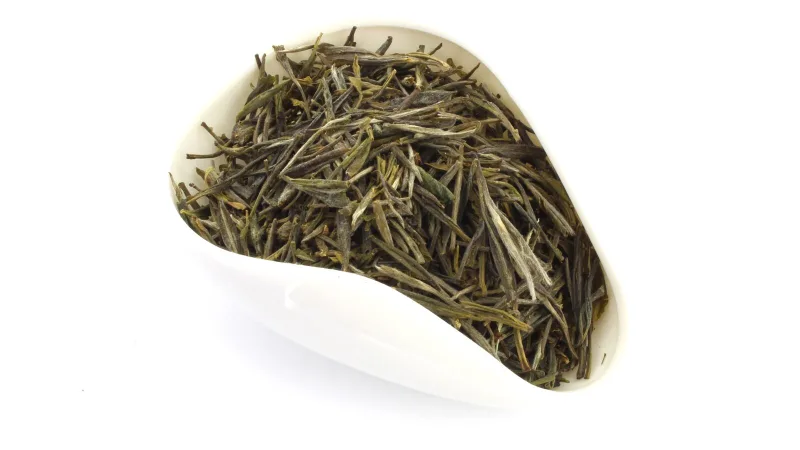
The rarest of the six tea types. It is made almost like green tea, with one extra step: the warm, damp leaf is covered and slowly turns yellow.
- Oxidation:
- light, non-enzymatic
- Key step:
- sealed yellowing (men huang) after fixation
- Provinces:
- Hunan, Sichuan, Anhui
- Raw leaf:
- buds, buds with young leaves, large leaf
- Liquor color:
- golden yellow
- Flavor:
- soft, sweetish, lightly viscous
Yellow tea starts out as green tea: the same tender spring leaf, the same fixation with heat. Then comes sealed yellowing, a step unique among the six types. Makers wrap the warm, damp leaf in cloth or paper and leave it for a few hours, sometimes two or three days. Leaf and liquor turn yellow, and the grassy edge fades.
Making it is slow and risky, so there is little of it. In 2022 China produced 13,000 tonnes of yellow tea out of a total harvest of 3.35 million, less than one percent1.
How yellow tea is made
There are four steps: fixation, rolling, sealed yellowing, drying. Bud-only teas skip rolling to keep the buds whole. The order varies from tea to tea. Some are yellowed right after fixation, some between two rounds of drying, some twice.
In Chinese the step is called men huangmen huangSealed yellowing: after fixation the warm, damp leaf is covered and left until it turns yellow. (闷黄), "to smother until yellow". By this point fixation has already switched off the enzymes, and the leaf changes under heat and moisture alone. Some of the polyphenols oxidize, chlorophyll breaks down, and the green color fades, taking part of the bitterness with it.
The maker judges the leaf by its color and smell. Under-yellowed tea still tastes almost green. Over-yellowed tea picks up a sour, musty note that cannot be fixed, and the mistake only shows at the very end, after drying.
Three famous teas
Jun Shan Yin Zhen (君山银针) is picked on Junshan Island in Dongting Lake, Hunan province, and is made of buds alone, covered in silvery down. The buds are yellowed twice, wrapped in paper between rounds of drying, and the whole process takes about three days. Under the Qing dynasty this tea went to the imperial court as tribute.
Meng Ding Huang Ya (蒙顶黄芽, "yellow buds from Mengding") comes from Mount Mengding in Sichuan. It is made from plump buds, sometimes with a barely opened leaf. The shape is flat and straight, somewhat like Longjing.
Huo Shan Huang Ya (霍山黄芽) comes from Huoshan County in Anhui province and is a bud with one or two leaves. Some Huo Shan Huang Ya on the market is made like green tea, with almost no yellowing; it brews a greenish liquor with a sharper taste.
There is also a large-leaf yellow tea, huang da cha (黄大茶), from Anhui as well. It is dried for a long time over a strong fire, which gives the liquor a toasted-rice note.
How to recognize yellow tea
In China yellow tea is summed up as "yellow liquor, yellow leaf" (黄汤黄叶). The dry leaf is yellowish green or golden, and the down on the buds has a golden sheen. The liquor is noticeably yellower than that of a green tea from the same province, and the spent leaf is yellowish too.
A bright green leaf and a grassy, astringent taste give away tea that was yellowed briefly or not at all, even when the package carries the name of a yellow tea. Only the cup will tell you.
Flavor and brewing
Good yellow tea brews a clear golden liquor. The taste is soft, sweetish and slightly viscous, with the grassiness of green tea muted.
Use soft water at 80–85 °C. Brew bud teas in a tall glass so you can watch the buds stand upright and slowly sink to the bottom. Leafier teas are easier in a gaiwan, with short infusions.
3 g of buds to 150 ml of water at 80–85 °C (176–185 °F). At first the buds float; after a couple of minutes they stand upright and sink one by one. The tea is ready after 3–4 minutes. When a third is left in the glass, top it up with hot water.
Store yellow tea as you would green: in a tightly sealed bag in the fridge. Drink it within the year it was picked, while the aroma lasts.
-
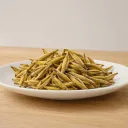 Jun Shan Yin Zhen
君山银针
Jun Shan Yin Zhen, a yellow bud tea from an island in Dongting Lake: how it yellows in paper for three days, how to tell it from green, how to brew it.
-
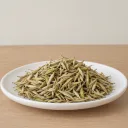 Meng Ding Huang Ya
蒙顶黄芽
Flat yellow buds from Mount Mengding, Sichuan. Wok firings and yellowing in paper, how it differs from its green neighbor, how to brew.
-
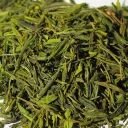 Huo Shan Huang Ya
霍山黄芽
Huo Shan Huang Ya is a yellow tea from Huoshan County, Anhui. How it yellows after partial drying, why it is often made as green tea, how to brew it.
Common questions
How is yellow tea different from green tea?
By sealed yellowing. After fixation the warm leaf is kept covered, turns yellow and loses some of its bitterness. The raw leaf and all the other steps are the same for both types.
Why is yellow tea hard to find?
Sealed yellowing takes anywhere from a few hours to three days and demands experience: over-yellowed leaf picks up a sour, musty smell. Green tea from the same leaf is faster to make and easier to sell, and many farms have switched to it.
What water should I use for yellow tea?
Soft water heated to 80–85 °C. Boiling water stews the buds and flattens the taste. See Water for tea for how to choose it.
-
Yellow tea industry review by China Baogao, May 2023. ↩