Darye: the Korean way of tea 茶禮
Darye is the Korean name for tea rites, from court offerings to brewing green leaf at home. Tea has been known in Korea since the 7th century, and today's form took shape in the 1960s to 1980s.
- Name:
- 다례, 茶禮: both the rite and everyday tea drinking
- Tea:
- pan-fired green leaf; matcha less often
- Dose:
- about 2 g per person, about 5 g for three
- Grades:
- ujeon, sejak, jungjak, daejak, named by picking date
- Main regions:
- Hadong (South Gyeongsang), Boseong (South Jeolla)
- Tea Day:
- May 25
Korean has no word for "ceremony" in the Japanese sense. It has darye (다례), which covers an offering of tea to royal ancestors and also a host brewing green leaf for two or three guests at home. That double meaning is what makes the subject interesting. The court rite broke off long ago, and what is called darye today was put back together.
Silla and Goryeo: from legend to state rite
When tea first reached Korea is unclear. The Samguk sagi (1145) says that in 828 the envoy Daeryeom came back from Tang China with seeds and King Heungdeok had them planted on Mount Jiri. The same entry says tea was already known under Queen Seondeok (632–647) and had now "become a great custom." Hadong County places the planting in the Hwagae valley by Ssanggyesa temple and has put up a stele to Daeryeom there. The monk Mujin disagrees: the place was Hwaeomsa, where tea had been grown since the mid-8th century.
A Japanese survey calls the story of Queen Heo Hwangok bringing tea in the 1st century a legend, and nothing documents it.
Under Goryeo (918–1392) tea became part of power. The "presenting of tea" (jindajindaThe court "presenting of tea" (진다, 進茶) under Goryeo: before a banquet the king and officials were served dasik sweets, then tea. Under Joseon the same rite came to be called darye., 進茶) came before the banquet at the Lantern Festival, a New Year reception, the elevation of a queen, the birth of an heir. The Goryeosa records the order: a courtier offers the king dasik (다식) sweets, then everyone else, all bow twice and eat, and then tea is served the same way. It was pressed tea, ground to powder and whisked in the Song manner. In 1124 the Song envoy Xu Jing described a hall where guests got tea three times a day.
The Dabang office (茶房) ran the ritual, and its tea came from taso, special tea districts; the Sejong-era geography lists more than 19 old ones. Yi Gyubo (1168–1241) wrote that in Hwagae officials drove old men and children into the hills to pick leaf and haul it to the capital on their own backs. Tea was a levy.
Joseon: tea retreats to the temples
The Dabang got its regulations in 1405, the office became the Sajunwon in 1447, and in documents the Goryeo "jinda" turned into "darye." The Annals of the Joseon Dynasty use the word 茶禮 2,063 times between 1401 and 1926, for entertaining Chinese envoys and for offering tea and snacks to the spirits of royal ancestors. The yangban took the rite up by the 16th century, and temples by the 18th.
Meanwhile tea was disappearing from daily life. Yi Mok (1471–1498) wrote an Ode to Tea but named only Chinese kinds in it. In 1474 Kim Jongjik laid out a tea garden and complained that he could not find "seeds passed down from Silla." Some texts from after the Japanese invasions of the 1590s say nobody in Korea drinks tea or even recognizes the bush. Envoys were served ginseng decoction, and the word "cha" (차) stretched to cover infusions of jujube, ginger, schisandra, yuja and grains.
That is why the memorial charye (차례), written with the same characters, has long done without tea. Yi I wrote that Koreans serve scorched-rice water instead, and Yi Jae struck every tea step from the order. Wine goes on the table.
Jeong Yak-yong and Choui: the leaf returns
In 1805 Jeong Yak-yong (Dasan, 1762–1836), in exile at Gangjin, sent the monk Hyejang a "Petition for tea" and called himself a "tea glutton." From 1808 he lived at Dasan Chodang, which had a hearth for tea and a spring. In 1818, as he left exile, he and 18 students founded the Dasingye tea fellowship, the first documented one in Korea. Its rules required each member to send, every year, a pound of loose tea picked around Gogu and two pounds of pressed tea picked before Ipha.
His student, the monk Choui Uisun (1786–1866), built the Iljiam hermitage by Daeheungsa temple in Haenam in 1824 and lived there for about forty years. In 1828 he copied out the tea section of the Chinese encyclopedia Wanbao quanshu and compiled the Dasinjeon, 22 entries on picking, processing, water, brewing and utensils. Later he wrote the Dongdasong, "In Praise of Eastern Tea": 31 stanzas, only six of them about Korean tea. Its date is given as 1837, "about 1837" or "after 1831."
Choui summed up the way of tea as "the right middle" (jungjeong, 中正): leaf picked and made properly, true water, tea brewed in measure. The Dasinjeon is also the source of a rule on the number of guests: one guest is "spirit," two "excellent," three or four "pleasant," five or six "distracted." For its author, cleanliness matters most in brewing.
The rule for adding leaf (投茶) comes from there too. In spring and autumn you pour half the water, add the tea and top up; in summer the water goes in first, in winter the tea. It is an excerpt from a Chinese book, not a Korean invention. The Boseong county office presents it as current practice, though in fact people put the leaf in first and control the temperature by cooling the water in the sukwusukwuThe cooling bowl (숙우). Boiling water goes into it first and waits there until it reaches the right temperature, then moves to the teapot. The finished tea is also poured into it to even out strength..
The 20th century: a rite rebuilt
Tea did not vanish under Japanese rule. In Gangjin, Yi Han-yeong (1867–1960) sold loose tea as Baegun okpan cha, Korea's first branded tea. In 1939 Japanese specialists picked Boseong for a plantation, and 29.7 ha were sown there in 1940. The monk Hyodang Choe Beom-sul wrote the first major study of tea and taught nearly every leader of the revival.
Kim Mi-hee founded the Myungwon tea circle in 1967, held the first academic conference on tea in 1979, and in 1980 staged the first reconstructions of court, temple, ancestral, guest and everyday darye. Court darye is on Seoul's intangible heritage list (No. 27, 2001).
What the revival amounts to is disputed. A 2022 study by Lee Haeng-cheol and Kwon Seok-hwan describes modern darye as a tradition created under Park Chung-hee, promoted as a cure for social decay, strongly anti-Japanese in tone and yet with an unavoidable Japanese trace from the colonial era. The Myungwon school speaks of "restoration." The Boseong county office concedes that no Korean text sets out a brewing order and that the forms were pieced together from paintings, ceramics and oral memory. Since the late 1970s darye has been taught in schools and private societies.
How tea is brewed today
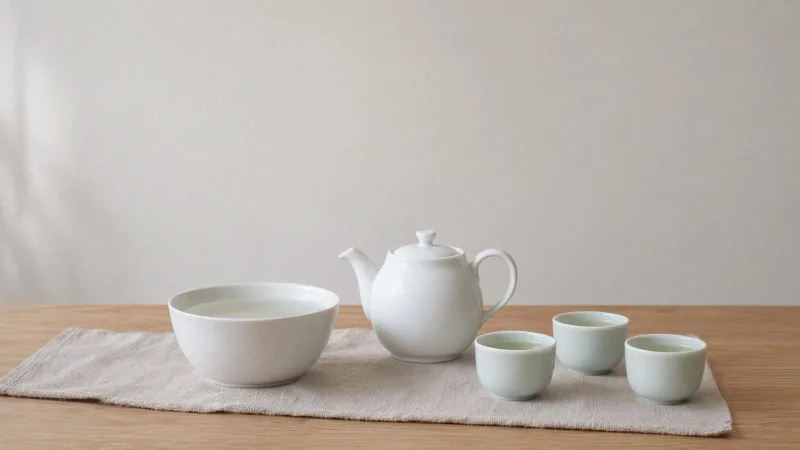
The host is the paengju (팽주). In front of the host are a side-handled pot, the tagwan (다관), the cooling bowl sukwu (숙우), a waste bowl, handleless cups on wooden stands and a wooden scoop. A cloth covers the tray; before starting, the host lifts it off, folds it and lays it on the right.
Water is brought to about 100°C (212°F), not boiled for long, and cooled in the sukwu. For tap water, the advice is to keep it boiling with the lid off for another 1 to 3 minutes to drive off chlorine. For green tea the usual figure is 70–80°C, lower for early picks.
Host and guests bow with palms together. Hot water goes into the sukwu, then into the tagwan, then into the cups, to warm the ware. Fresh boiling water goes into the sukwu to cool. Add the leaf with a wooden scoop, about 2 g per person, about 5 g for three. Pour the cooled water onto the leaf and empty the cups into the waste bowl. Pour in a circle, a little at a time, so every cup is equally strong: the left cup half full, the right half full, then the right again and the left. The guest takes the cup in the right hand, supports it with the left, looks at the color, breathes in the aroma and drinks in two or three sips. Three infusions are usual. Then the cups go back to the host.
Some hosts instead empty the whole brew into the sukwu and pour from there. For matcha, water goes in along the edge of the bowl and the powder is whisked slowly, then fast, then slowly again at the end. Drink it at once, before the foam settles. For the Japanese method, see matcha.
The tea: ujeon, sejak, Hadong and Boseong
Darye is built on Korean green tea, most often pan-fired (deokeumcha, 덖음차). In Hadong County's account, firing alternates with rolling on a straw mat, many times over. Grades are named by picking date, and the earlier the pick, the cooler the water.
Since 2016 the names have been set by the tea industry law, and an annex to a ministry decree lists five labels. Ujeon (우전) is picked before Gogu, around April 20, as one bud and two leaves. Gogu tea is picked on that day and up to a week after. Sejak (세작) comes 8 to 10 days after Gogu, one bud and three leaves. Jungjak (중작) is picked in May, daejak (대작) from June on. The pack gives the year, month and ten-day period of picking. It is a labeling rule and says nothing about what is in the cup.
The brewing figures below come mostly from the shop Maison Boseong. There is no standard, and sellers disagree (for ujeon you will even see 50°C).
| Grade | Water, °C | Steep time | Infusions |
|---|---|---|---|
| Ujeon | 60–68 | 45–60 s | 4–6 |
| Sejak | 65–75 | 60–90 s | 3–5 |
| Jungjak | 75–80 | 90–120 s | 3–4 |
| Daejak | 80–90 | 2–3 min | 2–3 |
Hadong, on the slopes of Jirisan, calls itself the cradle of Korean tea. Steep mountains cover 91% of Hwagae township; in 2015, 801 of its 951 households lived on tea and produced 20% of the national output. The area gained GIAHS status (the FAO's globally important agricultural heritage) in 2017. Hadong also makes jaeksaljaeksalOxidized tea from Hadong. The name is a local pronunciation of "sparrow's tongue" (작설). The leaf is withered, rolled and dried in the sun.: in May and June, once the leaf has coarsened, it is withered, rolled and dried in the sun. In 2015 jaeksal entered Slow Food's Ark of Taste.
Boseong in South Jeolla is younger, with a plantation dating from 1939–1941 and about 70 t a year by the late 1970s. Boseong green tea received Geographical Indication No. 1 in January 2002. Good leaf feels dry and looks even and tightly rolled. Ask the seller for the picking date and the leaf formula, not just the grade name.
Common questions
How is darye different from the Japanese tea ceremony?
In chanoyu guests drink whisked powdered tea in an order set by the schools, which took shape from the 15th century. Darye is built on loose green leaf brewed in a pot, with the water cooled in a separate bowl. For a guest the order is simple: a bow, the cup in both hands, a look at the color, the aroma, two or three sips.
Is darye an ancient unbroken tradition?
No. Tea left everyday life under Joseon, and no text describing a brewing order has been found in Korea. Modern forms were put together from paintings, ceramics and oral memory, took shape under Park Chung-hee (1961–1979), and the first reconstructions were shown in 1980.
Why is wine set out for ancestors instead of tea?
The word charye (차례) is written with the same characters as darye and once meant an offering of tea. But Yi I wrote that Koreans serve scorched-rice water instead, and Yi Jae struck every tea step from the rite in the 18th century. A modern charye table carries wine.