Anhua dark tea 安化黑茶
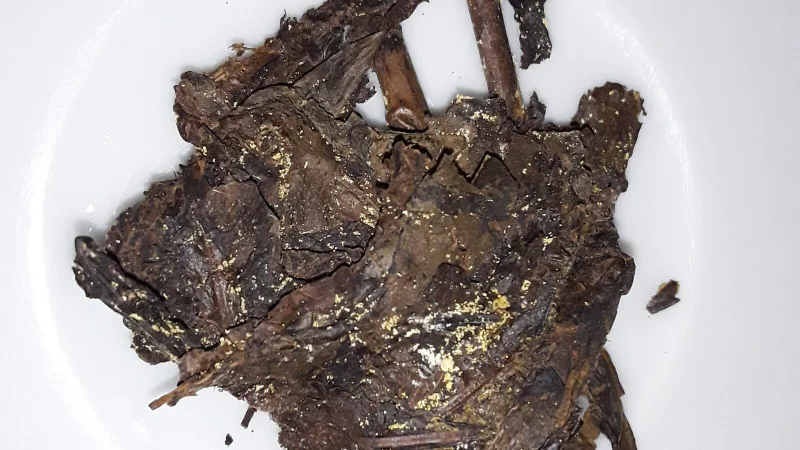
A family of dark teas from Anhua county in Hunan. The leaf is dried over pinewood fires and pressed into bricks, baskets and logs. In the fu zhuan brick, producers deliberately grow a fungus known as the "golden flowers".

- Province:
- Hunan, Yiyang, Anhua county
- Raw material:
- mature leaf with stems, hei mao cha in four grades
- Processing:
- short wet pile, drying over pine fire
- Kinds:
- fu zhuan, qian liang cha, tian jian, hei zhuan
- Form:
- bricks, baskets, logs
- Liquor:
- pine smoke, dried fruit, mushroom sweetness
Anhua dark tea (安化黑茶, Anhua hei cha) is the dark tea of Anhua county in Yiyang prefecture, Hunan province. The name covers a whole family: loose tea in baskets, bricks, logs as tall as a person. Locals sum it up as "three jian, three bricks, one scroll". The teas share one raw material, hei mao chahei mao chaThe half-finished dark tea of Anhua: leaf after fixation, rolling, piling and drying over fire. Bricks, baskets and logs are all made from it., and drying over pinewood fires, which leaves a light smokiness in the liquor.
It is the same type as pu-erh but a different school. The leaf here is coarser, the pile shorter, and the best-known feature is found inside the brick: the yellow specks of a fungus, the "golden flowers".
A county on the Zi River
Anhua lies in the Xuefeng Mountains on the middle reaches of the Zi River. The elevations are moderate, around 500 m, and the summers long and humid. The main variety is the local large-leaf Yuntaishan, from Mount Yuntai. Dark tea is made from mature leaf, stems included, and the mao cha is sorted into four grades, from a bud with two or three leaves (first grade) to a bud with five or six (fourth).
The word 黑茶 first appears in a document dated 1524, and the tea it describes is Anhua's. Hunan leaf was cheaper than Sichuan leaf, and merchants from the northwest bought it outside the official quotas. In 1595, after a dispute between two censors, the court allowed it to be sold to the northwest as official tea, to trade for the nomads' horses. From then on, merchants from Shanxi and Shaanxi kept offices and warehouses in the county, and the wharves along the Zi lived off the tea trade.
Hei mao cha and the seven-star stove
Fresh leaf is fixed in a wok over high heat, rolled, and piled wet. The pile lasts hours here, not the weeks it takes for shu pu-erh. Then the leaf is rolled again and dried on the qi xing zaoqi xing zaoSeven-star stove: a brick stove with seven fire mouths. A pinewood fire heats a platform of bamboo mats on which the leaf dries in layers., the seven-star stove. It is a brick stove with seven fire mouths, topped by a platform of bamboo mats. Workers spread a thin layer of leaf and, once it has dried a little, add the next one on top, building up layer by layer. The fire is fed with pine, plentiful along the Zi, and that is where the resinous smoke comes from.
Finished hei mao cha is packed into sacks and stored, sometimes for two years or more. Later it is made into bricks, baskets and logs.
Fu zhuan and golden flowers
Fu zhuan (茯砖) was invented in Jingyang, in Shaanxi province, where Hunan leaf was shipped and pressed into bricks. They were made in the hottest stretch of summer, the "fu days" (伏天), hence the name. People in Jingyang believed that without their water and climate a brick would not "flower". Anhua did not make its own fu zhuan until 1953, after warm chambers with the right humidity were built.
For the brick, the leaf is steamed, piled once more, pressed and sent off for fa huafa hua"Flowering": keeping raw fu zhuan bricks in a warm, humid chamber until golden flowers grow inside.. The raw bricks spend about two weeks at 27–30 °C and 70–80 % humidity1. Inside them grows the fungus Eurotium cristatum, in Chinese jin hua, "golden flowers": tiny bright yellow fruiting bodies, visible where the brick is broken. Stems are left in the raw material on purpose. They keep air between the leaves, and the fungus grows more evenly. Then the bricks are dried.
Good fu zhuan smells of bread, dried mushrooms and dried fruit, an aroma they call "fungal floral" in Hunan. The liquor is orange-red and soft, almost without bitterness. Bricks are either packed by hand, which makes them looser, or machine-pressed.
Qian liang cha
Qian liang cha (千两茶), "thousand-liang tea", weighs a thousand liang by the old measure, with sixteen liang to the jin. That comes to 36.25 kg. The log is about one and a half meters long and about 20 cm thick, much like a tree trunk. Its patterned wrapping earns it a second name, hua juan, "flower scroll".
Making one starts with a basket woven from fresh bamboo and lined with leaves. The mao cha is steamed, poured in and packed down with a stick. Then a team of five rolls the log along the ground, treads on it and tightens the wrapping with poles, again and again, until the tea is as dense as wood. The finished logs dry under sun and dew for 49 days.
Qian liang grew out of an older "hundred-liang tea" under the Qing dynasty. In 1958 a machine-pressed brick, hua zhuan, replaced the laborious log. In 1983 craftsmen made the first batch since the break, and regular production of qian liang resumed in the late 1990s. Since 2008 the techniques of qian liang and fu zhuan have been on China's list of intangible cultural heritage.
Tian jian and bricks
The "three jian" are loose teas, moderately compressed into bamboo baskets. Tian jian (天尖), "heavenly tip", is made from first-grade mao cha, gong jian from second-grade, sheng jian from third. Tradition has it that in the Daoguang era (1821–1850) tian jian and gong jian were sent to the imperial court. Tian jian is the most delicate of the Anhua teas: sweet, smoky, with an orange-yellow liquor. A basket used to weigh 50 kg; today's baskets are several times smaller.
Coarse leaf is pressed into hei zhuan, "black brick", and hua zhuan, the heir of qian liang. For centuries these went north and northwest to the nomads.
How to brew
Anhua tea needs water at a full boil. You can brew it gongfu cha style in a Yixing teapot or a gaiwan. Take bricks and qian liang discs apart along the layers with a pu-erh knife. Fu zhuan crumbles more easily, so take care not to lose the "flowers", which carry the sweetness.
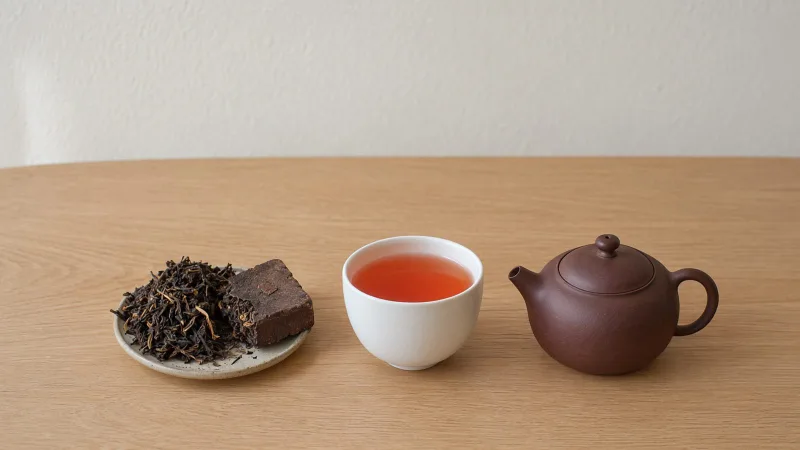
5 g per 100 ml, water at 100 °C (212 °F). Rinse the leaf: once is enough for fu zhuan, while dense qian liang gets two rinses. Start with infusions of 10–15 seconds, then add 5–10 seconds each time. A good brick gives 6–8 infusions. Simmer the spent leaf for 5 minutes over a low flame to draw out the last of the sweetness.
In the northwest and on the steppe, brick tea was boiled, often with milk and salt. Boiled plain, fu zhuan comes out thick and sweet: 7–10 g per liter, 5–10 minutes over a low flame.
Common questions
Are the yellow specks in a fu zhuan brick mold?
They are "golden flowers", colonies of the fungus Eurotium cristatum. Producers grow them on purpose, and the more there are and the more evenly they spread across the break, the more the brick is worth. The coating to worry about looks different: white, green or black fluff with a musty smell. It comes from damp storage, and tea like that goes in the bin.
How do you brew qian liang cha?
Hardly anyone buys a whole 36 kg log: it is sawn into discs about 3 cm thick. A disc is very dense. Break off a piece with a pu-erh knife and rinse it twice with boiling water. Then brew it like any dark tea; the piece opens up over a few infusions.
Can Anhua tea be boiled?
Yes, that is how it was drunk in the northwest for centuries. Drop 7–10 g into a liter of boiling water and keep it over a low flame for 5–10 minutes. The liquor comes out thick and sweet. Fu zhuan and hei zhuan boil best; tian jian is more interesting brewed in infusions.
-
T/HNTI 067-2024 "Rules for automated flowering and drying of fu zhuan", a standard of the Hunan Tea Society. For hand-packed bricks, flowering takes 288–336 hours. ↩