Tea in Turkey and Azerbaijan: the çaydanlık and the armudu
Turkey and Azerbaijan drink black tea, brewed as a strong concentrate and diluted with boiling water right in the glass. Turkish leaf grows around Rize, where the first crop came in 1938. In 2022 UNESCO listed the tradition as intangible heritage.
- Type of tea:
- black, almost all of it local
- Turkey:
- çaydanlık and ince belli glass (~125 ml)
- Azerbaijan:
- porcelain pot, samovar, armudu, jam
- Where it grows:
- Rize, Trabzon, Artvin, Giresun; Lankaran
- Home-grown tea:
- Turkey from 1938, Azerbaijan from 1937
- UNESCO:
- 2022, element no. 01685
In Turkey people drink tea all day: at the shop, at the office, at home. A runner brings a glass of red tea on a saucer with a small spoon, and turning it down feels awkward. Azerbaijani tea is a close relative, but there the sugar is bitten, not stirred in.
The çaydanlık: two pots, one on top
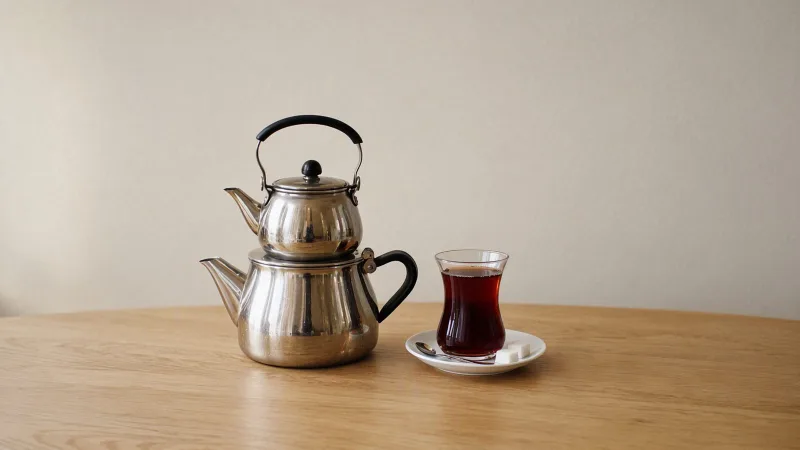
Turkish tea is brewed in the çaydanlıkçaydanlıkA stacked double teapot: water boils in the lower pot, and the concentrate (dem) steeps on its steam in the upper one (demlik)., a stacked double teapot. Water boils in the big lower pot, while the tea steeps over its steam in the small upper one (demlik). The pots come in stainless steel, copper or aluminum, sometimes with a porcelain upper pot, and standard models hold from 1 to 6 L.
There is no single standard. The figures below come from Turkey's official tourism portal and practical guides:
- Pour fresh cold water into the lower pot, set it on the heat, and put the upper pot with dry tea on top so the steam warms the leaf.
- When the water boils, pour 500–600 ml into the upper pot over 20–25 g of tea, then top up the lower pot.
- Turn the heat to its lowest and steep for 10–15 minutes. Don't let the upper pot boil, or the tea turns harsh. The longer it stands, the darker and more bitter it gets.
- Pour concentrate into the glass, usually about a quarter of it, and fill up with boiling water from the lower pot.
There is also a slower way: put the upper pot with the leaf and cold water on the lower one right away and heat the two together until the water starts to hiss.
Everyone picks their own strength. For a light glass, açık, use 1/5–1/4 concentrate; for a dark one, koyu or demli, 2/5–1/2. One upper pot makes 6–8 glasses. Sugar goes in as lumps; milk never does. Children drink paşa çayı, hot tea topped up with cold water.
The ideal color in the glass is called tavşan kanıtavşan kanıTurkish for “rabbit’s blood”: the ideal color of tea in the glass, fiery red and clear., “rabbit’s blood”: fiery red and clear. If it looks cloudy, dull or brownish, the tea is considered poor.
Nobody has dated the çaydanlık itself. Food journalists trace it to the samovar, but that story has no primary source. The only real danger is letting the lower pot boil dry. It works like a samovar with a teapot on top, keeping strong concentrate and boiling water apart.
Ince belli and armudu: the glass as a measure
The name of the Turkish ince belli glass means “slim waist.” A typical one holds about 125 ml, stands 90 mm tall, and measures 60 mm across the rim and 37 mm at the base. Larger ones hold 155 ml. According to O. F. Sağıroğlu's thesis, glasses of this shape appeared in the last quarter of the 19th century, and Şişecam (Paşabahçe) has made them by machine since 1935. The glass comes on a saucer with a spoon and one or two lumps of sugar. A guest who has had enough lays the spoon across the top.
The Azerbaijani armudu (armudu stəkan, “pear-shaped,” also boğmalı, “pinched”) looks more like a pear than a tulip. It is made of glass, porcelain, faience or silver. Nobody fills it to the brim: 1–2 cm stays empty, the dodaq yeri, “lip space.” In Turkey the same gap is dudak payı. People often say the narrow waist sends the hot layer back down so the tea stays warm longer, but no one has published a measurement. See also glass teaware.
Rize: where Turkish leaf comes from
Almost all tea in Turkey is local and black. In 2024 Rize province supplied 68% of the fresh leaf, Trabzon 19%, Artvin 11% and Giresun 2%. Picking runs from May to October in three flushes, and quality drops from the first flush to the third.
The history is short. In 1912 Hulusi Bey, head of the Rize chamber of agriculture, planted seedlings from Batumi, but the First World War put an end to the project. On February 6, 1924, law no. 407 permitted growing tea, citrus and hazelnuts in Rize and Borçka. Seed came from Batumi: 20 t in 1937, 30 t in 1939, 40 t in 1940. In 1938 came the first fresh leaf and the first dry tea.1 The state company Çaykur started work in Rize in 1973, and law no. 3092 of December 4, 1984 opened the industry to private capital.
Çaykur processes its leaf with a rotorvane combined with orthodox rolling. The finished tea is sieved into seven grades: OP1–3, BOP1–3 and dust. The small broken grades release color and astringency quickly, which makes them good for long steeping. The result is the dark red, mouth-drying liquor that both the TS 4600 standard and the “Rize Çayı” specification call for. Since 2021 Rize Çayı has been a registered designation of origin (no. 707). Still, a report prepared for the applicant admits that it does not differ noticeably from other tea of the eastern Black Sea coast, and that factories in Rize blend in leaf from Artvin and Trabzon.
Turkey drinks 290–320 thousand t of dry tea a year. In 2024 Çaykur supplied 129 thousand t, private factories 135–145 thousand t, and 10–15% was foreign tea, some of it smuggled in. One journal article puts consumption at 6.96 kg per person per year, but don't trust that figure. The state report gives 3.5–4 kg of dry tea, and it looks like the article's authors took pounds for kilograms.
The tea stand and the teahouse
In Turkey, tea comes to you. A çay ocağı, “tea hearth,” is a tiny stand in a stairwell or under a staircase: a multi-burner stove, shelves of glasses, a hanging tray. All day a runner, the çaycı, carries glasses to the shops and offices nearby, and orders reach him by shout, phone or intercom. By law an employee is entitled to at least two tea breaks a day. Teahouses, çayhane and kıraathane, go back to the Ottoman Empire: from the 1860s places serving only tea opened along the Divanyolu, Beyazıt and Şehzadebaşı route. Some habits came with settlers. Samovar tea in Erzurum and Kars shows Russian influence, and the very strong tea of Van and Hakkari shows Iranian.
In the east kıtlamakıtlamaA way of drinking tea in eastern Turkey: you hold a lump of sugar under your tongue or in your cheek and leave the tea unsweetened. is common: sugar is cracked with tongs and held under the tongue, and the tea stays unsweetened. Neighboring Iran has its own tea customs, and Central Asia has its teahouse, the chaikhana.
Azerbaijan: jam and sugar in the teeth
Azerbaijanis drink strong black tea, often from Lankaran or from Ceylon. The Lankaran method calls for 15 g of dry tea per 300 ml of boiling water. Rinse a porcelain pot with boiling water, add the leaf, fill the pot a third of the way, wrap it in a towel for 5–10 minutes, then top it up with boiling water. The concentrate goes into the armudu first, followed by boiling water from the samovar.
Sugar comes in lumps cut from a sugarloaf (kəllə qənd); granulated sugar is not served with tea. You dip a lump in the tea, bite off a piece and sip, hence the phrase dişləmə çay. Jam (mürəbbə) is made from quince, figs, watermelon rind, apricots, sweet cherries, cornelian cherries and young walnuts. People eat it from a spoon on its own rather than stirring it into the glass. Thyme, clove, cinnamon, ginger or rose water often come with the tea.
The çayxana, a men's club, serves only tea and sweets, no food. If the matchmakers get sweet tea at the end of their visit, the bride's family has said yes. Sources disagree on the history of local tea: the first bush near Lankaran is credited to Novoselov in the late 19th century, though the exact year varies. The trial plantings had died by 1920, plantations were laid out in the 1930s, and the first packs came out in 1937. The peak was 1988, with 34.5 thousand t of leaf from 13.2 thousand ha. After 1991 the industry collapsed to 300 t in 2008, and by 2018 it had recovered to 900 t from 1,100 ha.
Making it at home
You don't need a çaydanlık: two teapots will do, one with boiling water and one with tea. Take small-leaf black tea, 20–25 g for 500–600 ml of water in the upper pot, and keep it on the lowest heat for 10–15 minutes. Don't let the tea boil. Fill a quarter of the glass with concentrate, top up with boiling water, and leave a couple of centimeters at the top. For the Azerbaijani version, put lump sugar and a spoonful of jam on the saucer, and dip the sugar in the tea before biting it.
What the two share
In 2022, at the committee session in Rabat, the “Culture of Çay (tea)” of Azerbaijan and Turkey was inscribed on the Representative List of the Intangible Cultural Heritage (decision 17.COM 7.b.44). The title names what matters: tea as a symbol of identity, hospitality and social interaction. Neither tradition uses green tea, oolong or pu-erh.
Looking after a çaydanlık is simple. After each use, empty out the leaf, rinse the pot, leave it open to dry, and check the spout, where the fines settle. Diluted citric acid takes the scale out of the lower pot, and about 30 minutes of boiling with baking soda removes tea stains. When buying tea, look at the color of the liquor and at the sediment: in 2018 a workshop in Mersin was raided for dyeing spent leaves with black chemical dye and selling them again.
Common questions
Why is Turkish tea served in such a small glass?
An ince belli (“slim waist”) holds about 125 ml. You dilute the tea to the strength you like, drink it hot, and get a refill once it cools. The narrow waist is easy to hold, and clear glass shows the color: good tea looks red and bright.
How is the armudu different from the Turkish glass?
The armudu is the Azerbaijani cousin of the ince belli, with a more pronounced pear shape. It comes in glass, porcelain, faience or silver. It is never filled to the brim: 1–2 cm is left as “lip space” (dodaq yeri).
Do Turks add milk to tea?
No. Turks add lump sugar, while Azerbaijanis bite off sugar between sips and eat jam from a spoon on the side. Neither tradition uses milk.
-
The years differ: the TDV encyclopedia says the first output appeared “only in 1928,” while Çaykur and a parliamentary question give 1938. See Çaykur's history. ↩