Tea Tasting: ISO 3103 and Professional Cupping
Professional tasting rests on one rule: brew every sample the same way and compare them side by side. Under ISO 3103 that means 2 g per 100 ml of boiling water, 6 minutes for black tea, and white porcelain. The method is for comparing teas, not for making a nice cup.
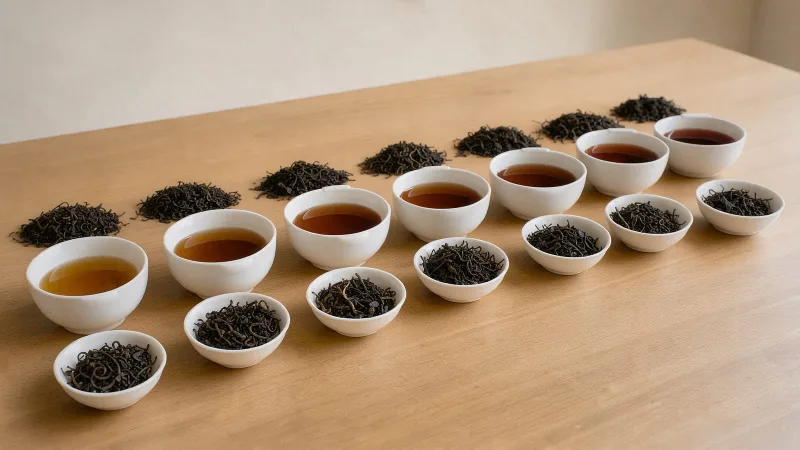
- Standard:
- ISO 3103:2019, first edition 1980
- Leaf and water:
- 2 g per 100 ml, boiling
- Time:
- black 6 min, leaf green 5, fannings 3
- Small set:
- 2.8 g of tea, about 140 ml of water
- Ware:
- white porcelain, pot with a serrated rim
- What is judged:
- dry leaf, liquor, infused leaf
You cannot compare two teas brewed in different ways. A difference in the cup could come from the leaf, or from water temperature, steeping time, or the vessel. So tasting begins with a protocol that strips out everything else: one weight of leaf, one volume of water, one time, the same white ware. Only the leaf is left.
The method is set out in the international standard ISO 3103. The first edition came out in 1980, and in Britain the same text was published as BS 6008. The second edition, from 2019, was reviewed and confirmed in 2025.
What ISO 3103 specifies
The parameters are simple: 2 g of tea to every 100 ml of water, poured on boiling.1
| Tea | Leaf | Water | Time |
|---|---|---|---|
| Black | 2 g per 100 ml | boiling, about 100 °C | 6 min |
| Leaf green | 2 g per 100 ml | boiling, about 100 °C | 5 min |
| Green, fanningsfanningsSmall broken particles of black or green tea left over when leaf is graded. They brew faster than whole leaf, so the standard gives them less time. | 2 g per 100 ml | boiling, about 100 °C | 3 min |
Green tea was added only in 2019, under a shared framework with the same equipment. Critics note that six minutes of boiling water is rough on fine green teas, which are usually brewed below 90 °C and rarely for longer than three minutes. With such teas, tasters often follow the producer's recommendations instead. The 2019 text kept boiling water for green tea and shortened only the time.
The ware is specified more tightly than the water: a pot of white porcelain or glazed ceramic with a serrated rim and a lid that fits loosely inside it, and a bowl of the same material on which the pot and lid are laid to drain. There is a large set (pot of 310 ml, 5.6 g of tea, about 285 ml of water) and a small one (150 ml, 2.8 g, about 140 ml). The pot is filled to 4–6 mm below the rim.
Even the mass of the ware is fixed, which the standard says keeps the temperature profile repeatable and equal across neighboring samples. A heavy pot cools differently from a light one, and the comparison falls apart.
The procedure: weigh the leaf to within ±2 %, pour, cover, wait, and decant through the serrations while holding the lid. Then turn the lid over, lay the infused leaf on it, and set it on the empty pot. Dust grades may need a strainer.
The water should be close to the drinking water of the region where the tea will be drunk. Distilled water is allowed only as an exception, with a note that the minerals in ordinary water change the taste and look of the liquor. More on water for tea.
What the standard does not promise
ISO 3103 is not a recipe for the perfect cup. It is a method of preparing liquor for sensory tests, and reviews stress that it does not say how to brew tea for drinking. The 1999 Ig Nobel Prize in Literature went to BSI for a "six-page specification of how to make a cup of tea". The prize was for the length of the text, not for any error in it.
The logic behind it is sound. The regime was built for blended black tea, which Britain drinks with milk. Hence the boiling water, the long steep, and the milk in the protocol. The point is to keep a blend tasting the same from one harvest to the next. Twinings master blenders taste each blend at least six times on its way from the bush to the shelf.
People value the harsh regime because it hides nothing. Stéphane Erler (Tea Masters) puts it this way: it is a way to wring everything out of the leaf, if not the best way to brew it. If a tea holds up under it, gentle brewing will only make it better. How the leaf releases its compounds into water is covered under extraction.
The taster at work
In the British tradition tasters fell into three groups: buyers (the big packers), brokers, and sellers, meaning plantation agents. Tasting rooms look much the same everywhere. Dry leaf lies on sheets of heavy white paper on a long wooden counter. Behind it stand cups of liquor, each with its own pot and the leaf on an upturned lid.
The taster looks at the dry leaf (size, color, dust, stalk), then at the infused leaf, and only then tastes. Tasters slurp the tea with air and spit it into a spittoon, often one on wheels. According to the memoir of a Ceylon taster from the 1950s, water was boiled in big whistling kettles, and each kettle served only a limited number of cups, because water that has gone off the boil makes a flat liquor.
Sources give different workloads: 60–80 cups a day at an agency firm in Ceylon, up to 300 for the chief taster of the US FDA in 1995, up to 400 for the Twinings team. Training takes years: about five years of taste training by the Guardian's account, and 9–12 years at Twinings before the title of master blender. Blenders there describe a batch with a set of 95 descriptors. In India the taster also judges how many cups a kilogram will yield: 300–400 for orthodox tea, 400–500 for CTC.
Auctions
The first East India Company auction took place in London in March 1679. Lots were sold "by candle": bidding ran while an inch of candle burned. The last London sale was held on June 29, 1998. By then the trade had long since moved to the auctions of Calcutta, Colombo, and Mombasa. Calcutta held its first sale on December 27, 1861.
The day before the London auction closed, brokers at Wilson Smithett tasted about 50 samples from Rwanda and Tanzania. An exact dose of leaf, a spoon of milk, no sugar, a big spittoon.
The sixpence
Tradition has it that the leaf was weighed against a weight equal to an old silver sixpence. Modern authors give its mass as "just under three grams" or as 2.86 g. No reliable archival record confirms it, so it is more lore than fact.
Contests in Asia
Asian contests follow their own protocols, which are easiest to compare in a table.
| System | Leaf and water | Time |
|---|---|---|
| ISO 3103, black | 2 g per 100 ml | 6 min |
| India, UPASI | 2.9 g per 120 ml | 5 min |
| Taiwan, contests | 3 g per 150 ml | 5–6 min |
| Japan, Shizuoka market | 3–4 g per about 200 ml | varies |
Taiwan's 3 g in 150 ml for 6 minutes was designed for rolled and ball-shaped oolongs. So much water on so little leaf exposes any thinness and gives the leaf room to open fully. Since 1976 the Lugu contest has judged only one tea, Dong Ding oolong. Samples get random code numbers, and a flight is capped at 30 cups; any more and the water cools during pouring, so conditions are no longer equal. Ranks run from the special prize down to "two plum blossoms". In winter 2025, of 4,598 samples, 108 earned first class and 2,242 were eliminated.
The Lugu association also warns about contests that sellers run themselves, where they judge their own tea and hang a "special" prize on it. The association advises sticking to well-known, large-scale contests.
At Japanese markets, tea is inspected in the haikenhaikenThe Japanese inspection of tea at the market: dry leaf on a black tray, liquor in a white bowl. The word means "respectful viewing".: dry leaf on a black tray, 3–4 g in a white bowl, boiling water to the brim, and the leaf skimmed out with a net. The All-Japan Tea Competition has run since 1947 and scores out of 200 by deduction against a reference sample. For ordinary sencha that means 75 points for aroma, 75 for taste, 30 for liquor color, and 20 for the dry leaf. China's shenping system works differently.
Japan also judges its judges. At the tea-judging skills contest, entrants identify the variety, the flush, and the region from the liquor and the dry leaf. The top rank, tenth dan, is called "chashi judan", and in 2025 thirty people held it.
A side-by-side tasting at home
A home tasting needs only what is in your kitchen. The method draws on Stéphane Erler's practice and on tasters' training exercises.
- Take identical white glazed bowls, one per sample, a spoon, and a cup for rinsing the spoon.
- Warm the bowls. Use a small, equal dose: 1–2 g per bowl for a five-minute steep without a lid. For oolongs you can use 3 g in a porcelain gaiwan with boiling water for 6 minutes, as at the Dong Ding contest.
- Have a helper lay out the samples under the letters A, B, C, so the tasting is blind.
- Pour water into every bowl from the same height and at the same speed.
- Compare the color and clarity of the liquor. Then smell the spoon taken out of the liquor, taste, and last, feel the infused leaf.
- Rinse your mouth with water between samples, and dip the spoon in boiled water and wipe it, or use one spoon per sample.
Ceylon tasters had a training exercise: brew each of three teas twice, then find the pairs among the six cups.
This regime is too harsh for drinking. For choosing between three lots of the same tea, though, it beats any recipe. To put words to what you find in the cup, see the language of taste.
What tasting cannot measure
A contest score is not the same as quality in the chemical sense. In a 2003 study by the TRES station, aroma and taste differed significantly between ranks, while liquor color and appearance differed mainly between passed and eliminated teas.2 Among the prize winners, the bulk density of ball oolong was unrelated to rank.
Chemistry and the palate are kept apart, too. ISO 3720 states outright that an expert can tell which tea is unlikely to pass the chemical requirements, so it is cheaper to send only suspect samples for analysis. UPASI in India found a direct correlation between the biochemistry of high-grown teas and taster scores, but maintains that analysis will not replace the taster. These are single studies, and it is too early to generalize them to all tea.
Common questions
Can you brew tea at home by ISO 3103?
You can, but it will not guarantee a good cup. The standard describes how to prepare liquor for sensory tests, so that different samples are compared under equal conditions. For drinking it is harsh: six minutes of boiling water is usually too much for green tea. As a test of the leaf, though, it is useful. If a tea holds up under this regime, it will only taste better brewed gently.
Does milk go in first or second?
The standard puts milk in the cup before the liquor, to avoid scalding it, but allows the reverse order if that is the practice in your organization. If milk goes in after the liquor, the authors' experience is that the best results come at a liquor temperature of 65–80 °C. The order is recorded in the test report. In the 2019 edition the milk section applies to black tea only.
Why do tasters spit?
A taster samples dozens or hundreds of cups a day, each with caffeine and tannins. Most spit; some swallow, believing they get a better sense of the tea's character that way. Tasters slurp the sample loudly from a spoon so that tea and air pass over the receptors in the mouth.
-
ISO 3103:2019, Tea: Preparation of liquor for use in sensory tests. Standard page. ↩
-
Chen Guo-Ren, Lin Jin-Chi. Tea quality and bulk density of competition tea samples by grade. Taiwan Tea Research Bulletin 22 (2003) 143–152. Station page. ↩