Boiling tea (zhu cha) 煮茶
Instead of steeping the leaf, you keep it in boiling water over a flame. It suits aged white tea, liu bao, ripe pu-erh and dense pressed bricks that a gaiwan cannot open.
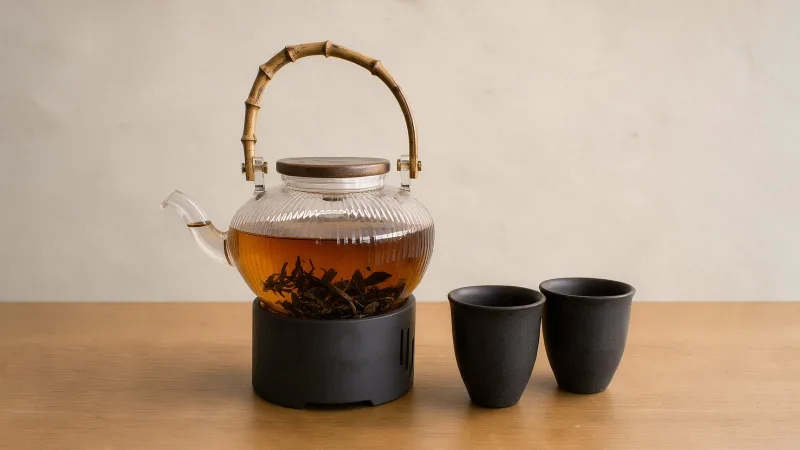
- Name:
- 煮茶, "to boil tea"
- Temperature:
- 98–100 °C, gentle boil
- Ratio:
- 0.5–2.5 g per 100 ml
- Time:
- 2 to 20 minutes
- Teas:
- aged white, liu bao, ripe pu-erh, Anhua and Hubei dark tea
Boiling tea (煮茶, zhu cha) is a way to make tea without a separate teapot: you put the leaf in a pot or kettle, set it on the heat and keep it in boiling or nearly boiling water. It differs from gongfu cha in every respect. You use 2 to 10 times less leaf, count the time in minutes rather than seconds, and end up with one liquor instead of a series of infusions.
Today people boil aged white tea (shou mei, gong mei, pressed cakes), liu bao, ripe pu-erh and the pressed dark teas of Anhua and Hubei.
Why boil
Dense, long-aged leaf takes a long time to soak through. In a gaiwan the water cools, and a pressed brick never gets the chance to open. Over a flame that limit is gone: the water stays near 100 °C and there is no hurry.
The lab numbers bear this out. Chinese researchers compared boiling with a standard tasting infusion under GB/T 23776 on Hubei qing zhuan brick. After the standard infusion the spent leaf still had unopened clumps; after boiling it unfurled completely. Polyphenol yield reached 75.66%, against 27.56% and 41.22% for the first and second standard infusions. Those are the best results across the test series. Under the recommended settings (1:80, two minutes of boiling, 2–4 minutes of resting) the polyphenol yield was 59.67–65.15%.
Bricks vary widely in density, and density decides whether ordinary steeping can open them:
| Tea | Density, g/cm³ |
|---|---|
| Hubei qing zhuan | 1.6–1.90 |
| Hunan hua zhuan | 0.71–0.99 |
| Hunan hei zhuan | 0.73–0.89 |
| Sichuan zang cha | 0.56–0.84 |
| Hunan fu zhuan | 0.41–0.62 |
Qing zhuan is made to survive long transport and long storage, and most of it is sold to Inner Mongolia and northwest China. That is where people boil it.
What to boil and what to leave alone
Boil old, fermented, coarse, large-leaf tea. As white tea ages it loses caffeine and polyphenols, so it gets less bitter. Shou mei, made of big leaves and stems, soaks up water slowly and benefits from boiling.
Leave delicate, fresh and bud teas alone. White tea less than a year old loses its freshness in the pot. Lightly fermented, "green" young liu bao turns bitter, and young raw pu-erh goes harshly bitter.
Two myths can go right away. "Aged white tea should only be boiled": a good old white tea shows best in a gaiwan, and boiling is for leaf that has already been steeped. "Only white tea of seven years or more can be boiled": the Fuding saying "one year tea, three years medicine, seven years treasure" is not a rule for the pot, and people boil 3–4 year old shou mei too. If an "aged" tea only comes alive in a pot and tastes empty in a gaiwan, suspect weak raw material or artificial aging.
How to boil
The steps are the same for every tea; the numbers are in the table below.
- Break off pieces smaller than 2 cm, splitting the cake along the grain with a knife or pick.
- Rinse the leaf with boiling water for 10–20 seconds and pour it off.
- Fill the pot a third to half full with fresh water, so it does not boil over. Do not use water that has been boiled several times.
- Bring the water to a boil (212 °F) and drop the leaf into the center of the whirlpool so it sinks at once.
- Keep it at a gentle simmer, not a rolling boil. Taste the first cup after 1–2 minutes.
- Turn off the heat and let it rest. Qing zhuan is best after 2–4 minutes, shou mei from a cold-water startcold-water startThe leaf goes into cold water and heats up with it to a boil. Some sellers promise more aroma and sweetness, others warn of bitterness. after 5.
- Pour off the liquor, leaving a little behind, and top up with water. Each round is weaker than the last, so it stays on the heat longer.
The liquor left behind is called the "root" (留底): it keeps the flavor more even from one potful to the next.
Boiling-water start and cold-water start
With a boiling-water startboiling-water startThe leaf goes into water that is already boiling. The liquor comes out thicker and softer, and the strength is easier to control. the leaf goes into water that is already boiling. With a cold-water start it goes into cold water and heats up along with it. Sources disagree, and each method has its followers.
Liu bao sellers in Malaysia credit the boiling-water start with thickness and softness and the cold-water start with aroma and sweetness. A Chinese article on boiling says the opposite: a cold start brings bitterness or a dull note, while a hot start makes the strength easier to control. A Fuding site insists on cold water for shou mei, claiming that boiling water "coagulates proteins", but none of the studies consulted for this page has tested that claim.
Try both and go by taste. Beginners will find the boiling-water start easier, since the strength shows right away.
Ratios and time
For boiling, use 0.5 to 2.5 g per 100 ml. The four- to fivefold spread comes down to the tea and to how long it stays in the water.
| Tea | Leaf : water | Time |
|---|---|---|
| Shou mei, 3–4 years | 2–2.5 g : 300–400 ml | until it boils again, then switch off |
| Aged white, shou mei, gong mei | 5 g : 500 ml | at least 5 min of gentle boil |
| Shou mei, 3+ years, cold-water start | 6 g : 500 ml | 10–20 min, rest 5 min |
| Liu bao (Wuzhou) | 5 g in a bag : 500 ml | 5–10 min |
| Everyday liu bao | 5–8 g : 1 L | first cups after 1–2 min, then keeps simmering |
| Ripe pu-erh, cold-water start | 4–5 g : 500 ml | 2–5 min without a rolling boil |
| Qian liang (千两) | about 15 g to 1 L | 1 min on high, then 3 min on low |
| Qing zhuan | 1:80 | 2 min boiling and 2–4 min rest |
For Anhua teas, the Hunan standard DB43/T 660–2021 calls for water at 100 °C that has not been re-boiled: 5–7 g for one or two people, 8–10 g for three to five. For a tea-boiling machine with a bag it specifies 10 g to 500 ml and 15 g to 600 ml, and from the third boil on it recommends 20 ml less water.
The weaker the boil, the longer it stays on. Qian liang lasts for three boils, and liu bao gets topped up with water and a pinch of fresh leaf.
Steep first, boil after
For a good tea the usual advice is 5–10 infusions in a gaiwan first, then the spent leaf goes into the pot. The gaiwan brings out the layers of aroma, and boiling pulls out what is left. With spent leaf, use more water and less leaf, and judge by the color of the liquor. For the gaiwan stage, see leaf ratio and warming and rinsing.
Vessels
Anything that can stand the flame and has no smell of its own will do.
- A glass kettle of borosilicate glass on an infrared ceramic hotplate: you can see the color of the liquor and judge when to switch off, and glass picks up no smells. A mesh insert keeps the leaf from scattering but slows extraction.
- A clay or silver kettle with a loop handle is common for shou mei in Fuding; clay is recommended for a "thick" taste.
- A pot of enameled cast iron or stainless steel suits aged white and spent leaf. A pot you have cooked food in will pass its smells on to the tea.
- A steam-spray tea maker (喷淋壶): boiling water rises through a tube and showers the leaf sitting above it. The program is fixed, and with a lot of leaf it overcooks the tea.
A Yixing teapot does not go on the flame. A metal kettle rusts, and iron ions darken the liquor. The idea that "a cast iron kettle softens water" is a myth: hardness comes from calcium and magnesium, and iron does not change it.
What to keep in mind
Brick tea releases more fluoride when boiled. China sets the limit at 300 mg/kg, but in a sample of 49 factory bricks the geometric mean was 460 mg/kg (range 102 to 1,797), and only 28.6% were within it.1 Between 71 and 83% of a brick's fluoride ends up in the liquor, and pouring off the first infusion cuts daily intake by 48%. With bricks, then, rinse the leaf and go easy on the amount.
Aroma suffers too. The top notes escape with the steam, so an expensive tea bought for its aroma deserves a gaiwan first.
The fashion for "boiling tea around a brazier" (围炉煮茶) over charcoal reached China in 2021. In the month before January 17, 2024, Chinese monitoring recorded more than 30 cases of carbon monoxide poisoning and more than 270 people affected. Do not boil tea over charcoal in a closed room: use an electric hotplate.
By December 2022 the hashtag #围炉煮茶 had 2.42 billion views on Douyin, and at one Yixing maker charcoal stoves went from 10% to 70% of sales.
Common questions
Can any tea be boiled?
No. Boil old, fermented, coarse and large-leaf tea: aged white, liu bao, ripe pu-erh, dark tea. Delicate green, fresh white and bud teas turn bitter in a pot and lose their aroma. Young raw pu-erh also goes harshly bitter.
How long should it boil?
There is no single time. For 2–2.5 g of shou mei in 300–400 ml, wait until the water comes back to a boil. Liu bao and ripe pu-erh take 2–10 minutes, and a qing zhuan brick takes 2 minutes plus 2–4 minutes of resting. It all depends on the heat, the volume of water and the amount of leaf.
Do you need to rinse the tea?
For pressed tea, yes: boiling water for 10–20 seconds, then pour it off. With aged white tea a rinse is optional, but it clears away storage smells.
-
Guo Baofeng et al., Investigation on fluoride content of brick tea, Chinese Journal of Endemiology, 2019. DOI 10.3760/cma.j.issn.2095-4255.2019.06.008. The norm comes from the mandatory standard GB 19965–2005. ↩