Tea in continental Europe
The first cargo reached the Dutch Republic in 1610, and the continent’s most deeply rooted tea tradition is in East Frisia: a strong blend, rock candy, cream and three cups in a row.
- First cargo:
- 1610, Dutch East India Company
- East Frisia:
- northwest Germany, heritage register since 2016
- East Frisian blend:
- mostly second-flush Assam
- Brewing:
- ≈10 g per 1 L, 3–5 minutes
- France:
- salons de thé, flavored blends
- Czech Republic:
- tea rooms since 1993
The word “tea” reached most of Europe through the Dutch. Dutch thee goes back to Southern Min te, and German Tee, French thé and Swedish te follow it. Polish herbata took another road, from Latin herba thea, “tea herb”.
Every country on the continent took to tea in its own way, not the way Britain and Russia did. Those two have their own pages: tea in Britain and Ireland and Russian tea drinking. This one covers the rest: the Netherlands, East Frisia, France, the Czech Republic, Poland and Scandinavia.
The Netherlands: trade and the first fashion
The first known shipment reached the Dutch Republic in 1610 on ships of the Dutch East India Company (VOC). It was Japanese powdered tea in clay jars, loaded at Hirado. Chinese leaf tea in wooden chests followed in 1634. Sources name different ports of arrival, so the safest wording is “in the Republic”.
From 1650 apothecaries sold tea as medicine. In 1678 the physician Cornelis Bontekoe published a treatise on the “most excellent herb tea”, advising 8–10 cups in the morning and again in the afternoon.
Tea was not only for the elite: inventories from the 1660s list it among the possessions of merchants, VOC employees, sailors and shopkeepers. In Enoch Krook’s 1701 farce The Tea-Sick Ladies, a heroine cannot leave after “just twenty cups”.
Delft workshops made cups and teapots from 1666. In 1678–1679 the potters Lambertus Cleffius, Samuel van Eenhoorn and Ary de Milde quarreled over the right to make red teapots in the Yixing manner, and instead of a single patent the States of Holland gave each his own mark. A strong brew was made in a small clay trekpotje and thinned in the cup with boiling water from a large kettle on a brazier. De Milde’s teapot, 11.5 cm tall, was enough for about ten people, by the estimate of the museum that holds it. For the pots themselves, see European teapots; for their Chinese models, Yixing clay.
East Frisia: tea as a way of life
Nowhere else on the continent is tea so much a part of daily life as in the northwest corner of Germany. Skippers in Dutch service brought tea to East Frisia soon after 1610. Around 1675 it was still taken as medicine, and by 1720 the trade was in full swing.
The authorities tried to ban it. By 1778 at the latest the Prussian king had ordered an end to “excessive drinking of tea and coffee”. The estates replied that a ban could not be enforced, and that without tea the common man would turn not to beer but to genever. In a letter of 1779 they wrote that the habit ran so deep that giving it up would mean remaking human nature. Nothing came of it beyond threats.
During the Second World War tea was declared a “non-essential pleasure”. East Frisia was classed as a “tea drinkers’ district”: residents over 35 got 20 g a month, later 30 g, against a prewar average of about 3.5 kg per person per year.
The set and the blend
The East Frisian tea set is called Teegood. It includes:
- the Treckpott, a porcelain or double-walled teapot, sometimes with a strainer in the spout;
- the StövchenStövchenA teapot warmer heated by a tea light. Essential in the East Frisian set., a warmer with a tea light;
- small thin-walled Koppke cups, once without handles or saucers;
- the Kluntjepott for candy, with Kluntjeknieper tongs;
- the Rohmlepel, a cream spoon with a curved handle, like a tiny ladle.
Everyone knows the porcelain patterns: the “Ostfriesische Rose”, a multicolored overglaze rose, and the blue underglaze “Strohblume”. Both came from Wallendorf in Thuringia. Dealers sold them as “Dresmer”, “Dresden ware”, to borrow some of Meissen’s glory. Today only Wallendorf still paints the rose by hand; other makers fire on a decal.
The tea itself is the “Echte Ostfriesische Mischung”, a strong blend of black teas, mainly second-flush Assams, with Ceylon, Darjeeling or Indonesian leaf. It may be called genuine only if it was blended in East Frisia. Bünting’s best-selling blend, “Grünpack”, sold since 1935, is 80% Assam. In season the tasters work through 200–300 samples a day: every harvest is different, yet the blend has to taste the same, so batches are mixed.
The water in the region is soft because it never passes through limestone. For hard water Bünting sells separate blends.
The ceremony, step by step
Only loose leaf is used. Sources differ on details such as the dose, from 4 tsp per liter (Ostfriesische Landschaft) to 10 g per liter (Teeverband), but the principle is the same.
- Rinse the teapot with boiling water.
- Add the tea, fill a third to half of the pot with freshly boiled water, and cover.
- Steep 3–5 minutes, top the pot up and set it on the Stövchen.
- Put a KluntjeKluntjeA large lump of white or brown rock candy. It goes into the cup before the tea and crackles when the hot tea hits it. in each cup and pour the tea. If the candy crackles, the tea is hot enough.
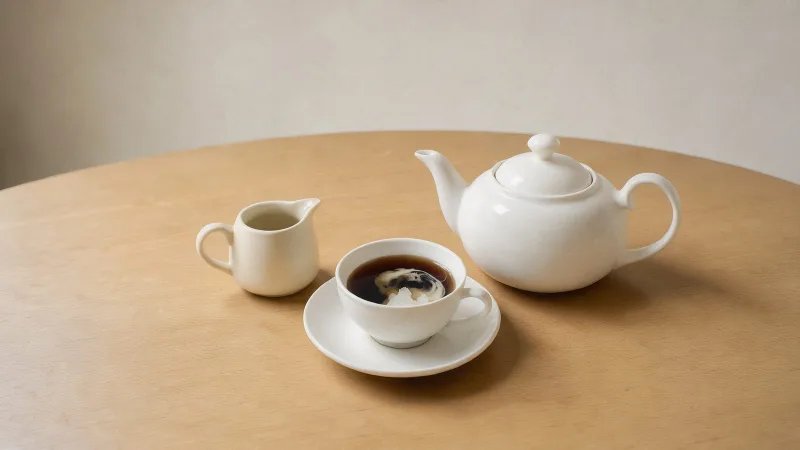
- With the Rohmlepel, spoon cream in at the edge of the cup, counterclockwise, “to stop time”. It sinks, then rises as a WulkjeWulkjeThe cream “little cloud”: cream spooned in at the cup’s edge sinks first, then rises as a white cloud..
- Do not stir: soft cream first, then strong tea, and last the sweetness of the candy.
10 g of leaf per 1 L of soft water, boiling (100°C, 212°F), 3–5 minutes, then top up to a full pot. The cream was originally “Rohm”, the layer that settles on raw milk; today people use store-bought cream.
The host pours the first cup for himself to check the tea. Guests get refills without asking, at least three times: “Dree is Oostfreesenrecht”. One lump of candy is meant for three cups. To decline, lay the spoon in the cup or turn the cup upside down on its saucer.
People drink tea up to six times a day: early in the morning, around 11 (Elführtje, sometimes with schnapps), around 3 p.m. and around 9 p.m. As the saying goes, “Tee as Ölje, Kluntje as’n Sliepsteen un Room as’n Wulkje”: tea like oil, candy like a grindstone, cream like a little cloud.
Myths about East Frisia
East Frisian tea culture is not on the UNESCO World Heritage list. In December 2016 it was entered in the German national register of intangible heritage, on an application from the East Frisian Tea Museum in Norden.1 The tea trade association itself wrote in 2017 that this “created the precondition” for international recognition. Yet the claim that it is “the only tea tradition in the world with a UNESCO award” turns up even in scholarly papers.
The second myth is “300 liters per person per year”. The figure comes from the trade association Teeverband, and in 2021 the “record” was made official. In 2025 an SWR journalist showed that it divides 140 million liters by 470,000 residents, leaving out some 100,000 tourists a day and the fact that Bünting sells over a third of its tea outside the region. Around 240 liters is more realistic. The average German drinks 28.2
The third concerns the age of the ritual. The German Commission speaks of “about 300 years”, Teeverband of “more than 400”. Martin Krieger, a historian in Kiel, thinks the ritual became “East Frisian” only in the last decades of the 19th century, riding the wave of the regional identity movement. The director of the museum in Leer links it to Assam becoming cheaper after 1850, once the British began growing tea in Assam.
France: the salon de thé
Tea appeared in France under Louis XIII, and sources disagree on whether it came through the Dutch or the Jesuits. In a letter of 16 February 1680 Madame de Sévigné tells her daughter that Madame de la Sablière “took tea with her milk”. This is usually cited as the earliest mention of milk in tea in Europe.
Until 1700 tea reached France by way of Holland. Direct imports began when the ship L’Amphitrite returned in 1700, and in 1766, 1,000 tonnes passed through Lorient. The Revolution condemned tea as a luxury; under the Second Empire, Anglomania and Empress Eugénie’s salon brought it back into fashion.
France’s great contribution was a place to drink it. In 1862 Louis Ernest Ladurée opened a bakery on rue Royale, and Jeanne Souchard set up a salon de thé upstairs, where women could go without men and without setting foot in a café of doubtful repute. Black tea dominated until the 1970s, then came the vogue for flavored blends, and after that for green tea.
Czech Republic, Poland, Scandinavia
Czech Republic. In socialist Czechoslovakia the shelves held mostly “Pigi” and “Klub” tea bags. From 1987 a semi-legal circle formed around Aleš Juřina, with tea smuggled in from Hungary, East Germany and England. The first Dobrá čajovna opened on 1 June 1993 at Wenceslas Square 14, where stables and garages had once stood. By 2009 the country had more than 350 tea rooms, 22 of them in the Dobrá chain.
“Orthodox” tea rooms serve no coffee or alcohol. Each tea is served the way it is drunk where it comes from, from the gaiwan to Turkish glasses, and guests sit at tables or on cushions on the floor. Juřina calls such a place “something between a church and a pub” for the least religious country in Europe.
Poland. According to Polish Wikipedia, tea arrived from France in 1664 and is first mentioned in a letter from John II Casimir to his wife. That date could not be confirmed independently. In the 1990s, in the eastern lands and among repatriates, tea was called czaj and made in a samovar. Today Polish homes drink mostly black tea (about 70% of sales), and 85% brew it with boiling water right in the mug. People add lemon (47.5%) and honey (30.7%), milk only 4.1%. The Czech tea room came to Poland in 2006 with Czajownia Kraków.
Scandinavia. The Swedish East India Company operated from 1731 to 1813 and shipped 600–1,200 tonnes of tea a year, about 15% of Europe’s imports from China. Most of it was cheap Bohea. From the late 1750s to the 1780s some 95% was re-exported, mostly smuggled into Britain. The Commutation Act of 1784 cut the British duty from 119% to 12.5%, and smuggling no longer paid. In Scotland people also knew the pricier “Gothenburg Congo”.
On 12 September 1745 the Götheborg, home after 30 months at sea, struck a rock 900 m from the quay. Over the next two years a third of the cargo was salvaged. Sweden itself drank little tea: the aristocracy took it between meals, and Linnaeus thought it weakened the body. Tea became an everyday drink in the 1960s and 1970s.
Common questions
Why is East Frisian tea not stirred?
The taste comes in layers: soft cream first, then strong tea, then the sweetness of the candy. The reason given more often is thrift: expensive rock candy had to last several cups, and one lump is meant for three.
How many cups are you expected to drink in East Frisia?
At least three: “Dree is Oostfreesenrecht”, “three is the East Frisian’s right”. Your host refills your cup without asking, and to decline you lay the spoon in the cup. Stopping before the third cup is considered rude.
Is East Frisian tea culture on the UNESCO list?
Not the world list. In December 2016 it was entered in the German national register of intangible cultural heritage kept by the German Commission for UNESCO. The custom has no international recognition.