Is tea safe? What is in the cup 茶汤安全
The risk in tea is rarely the leaf. It is how you drink it: too hot, too much, or boiled for too long. The rest has been measured and comes down to a few rules.
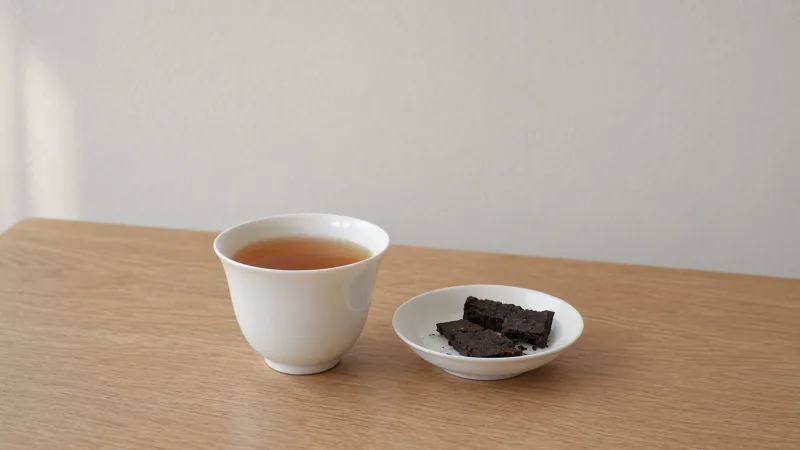
- Hot drinks:
- above 65 °C: IARC group 2A
- Fluoride:
- brick tea from mature leaf, by the liter
- Pesticides:
- 1–4 % or 90–100 % reach the cup, by solubility
- Rinsing:
- cuts pesticide risk by 5–59 %
- Tea and iron:
- an hour after a meal, not with it
- Tea bags:
- plastic at 95 °C: billions of particles
Ask what is dangerous in tea and you will hear about pesticides, heavy metals and "chemicals." The measurements tell a different story. Three things matter most for the safety of a cup: drinking temperature, volume, and which leaf you boil. Everything else depends on how much of a substance moves from the leaf into the water, and only part of it ever does.
Leaf and infusion are two different numbers
Regulations limit the dry leaf: how much lead or pesticide per kilogram of tea. You drink the infusion. Between the two sits the transfer rate, and it differs by an order of magnitude from one substance to the next.
It depends on the substance's solubility in water, the water temperature, steep time and leaf maturity. The hotter the water and the longer the steep, the more reaches the cup. Old leaves accumulate more fluoride and aluminum than buds and young shoots.
Published studies give these figures:
| Substance | Share reaching the infusion |
|---|---|
| Fluoride | above 50 % |
| Aluminum | 14 % (green) to 33 % (white), by type |
| Lead | 20–50 % in one review; 31.5 % in Tie Guan Yin |
| Nickel | 70.4 % in Tie Guan Yin |
| Pyrethroids | 1–4 % |
| Neonicotinoids, carbamates | often above 60 % |
Studies disagree, sometimes widely. For lead, figures run from 7.1 % in green tea to 58.6 % in black. No single number covers everything, so what follows sticks to ranges.
Temperature: the main risk
Since 2016 IARC has placed drinking very hot beverages above 65 °C in group 2A. The link is with squamous cell carcinoma of the esophagus, and the harm comes from the temperature, not the drink: the same was shown for maté, and in animal tests very hot water promoted tumors with no tea in it at all.1
The most rigorous study of tea comes from Golestan, in northern Iran. Researchers followed 50,045 people for 10.1 years and measured tea temperature with a thermometer instead of asking. Those who drank tea at 60 °C or above had a 41 % higher risk than those who drank it cooler (HR 1.41, confidence interval 1.10–1.81). People who drank 700 ml a day or more at 60 °C and above were at roughly 90 % higher risk than those who drank less and cooler. Waiting 6 minutes or longer after pouring carried less risk than drinking within 2 minutes.2
The threshold is not sharp: in Golestan the risks at 60–64 °C and at 65 °C and above were comparable. A 2022 meta-analysis found the link in most subgroups, but only for squamous cell carcinoma, not for adenocarcinoma.
The riskiest thing is a big mug of just-poured boiling water, so let it stand a few minutes. Japan's National Cancer Center gives the same advice for any hot food and drink. None of this is a reason to fear tea, only a reason not to scald yourself.
Fluoride and aluminum: when the leaf ages
The tea bush pulls fluoride from the soil and stores it in old leaves. So green, white, yellow, oolong and black tea, made from buds and young shoots, contain less. The main fluoride risk comes from dark teas from mature leaf, especially those pressed into bricks.
Tibet shows how far this can go. A 2016 study found 96.5 to 1,085.7 mg/kg of fluoride in brick tea, median 732.8, while China's standard GB 19965-2005 allows no more than 300 mg/kg. One sample out of 107 met it. Herders drank a median of 3.2 liters of tea a day and took in about 24.7 mg of fluoride daily, against an endemic threshold of 3.5 mg. Researchers found dental fluorosisfluorosisDamage to teeth and bones from excess fluoride built up over years. Tea can be one of the sources. in 33.6 % of children aged 8 to 12.3
Boiling matters too. It draws more fluoride out of dark tea, so do not simmer zhu cha for hours or drink liters of it every day.
Bagged tea holds no less fluoride than brick tea: in the UK, medians were 1,164 mg/kg for blended black tea, 877 for specialty and single-estate teas, and 1,464 for decaffeinated. Fluoride in the cup climbs between 40 and 360 seconds of steeping, most of all with cheap bags. Risk depends on volume as well as leaf: nobody drinks bagged tea by the liter the way Tibetan herders drink brick tea, and the authors, whose study was industry-funded, judge usual consumption acceptable for most age groups. So do not leave a bag in the mug longer than western brewing calls for.
Aluminum is similar. Young leaves hold 380 µg/g, old ones 6,866. Longer steeping raises transfer; it is lowest in green tea. Matcha is the exception: you drink the powder along with the leaf, and Germany's BfR calculated that two 2 g servings a day at the highest levels found use up about 100 % of the weekly limit.
Pesticides, metals and the rinsing question
The pesticide myth is half true. The share of a pesticide in the cup depends on its solubility: below 10 mg/l only 1–4 % passes into water, above 170 mg/l 90–100 % does. The rest stays in the spent leaf, and boiling water does not destroy it. "It all goes in the cup" and "none of it goes in" are both wrong.
Rinsing removes some. In a Chinese experiment with eight insecticides, a 5–30 second rinse carried off 0.2–24 % of the pesticide and cut the infusion's risk by 5–59 %, at a cost of 0–11 % of the EGCG and caffeine. Taiwan's Ministry of Agriculture is more relaxed: gardens mostly use poorly soluble products, which are usually not detectable in the cup, and the first infusion at tastings is poured off for flavor and to clear foam. The ministry adds that its own tea research station does not pour it off. The two views fit together. A rinse washes something off, and poorly soluble compounds barely reach the water anyway.
In practice, rinse pu-erh and dense pressed teas for flavor and to open up the leaf. Rinsing green or yellow tea for safety has no clear benefit.
The same goes for metals. In Tie Guan Yin the transfer ratetransfer rateThe share of a substance in the dry leaf that ends up in the infusion. For fluoride it is above 50 %, for pyrethroids 1–4 %. ran from 10.2 % for copper to 70.4 % for nickel, and the estimated daily intake of all five metals came out far below tolerable limits. Standards set limits for dry leaf: lead 5.0 mg/kg under China's GB 2762-2022 and 10.0 mg/kg under the Eurasian Union's technical regulation TR CU 021/2011.
Iron, oxalates and plastic
Iron. Tea tannins bind non-haem ironnon-haem ironThe iron in plant foods: grains, legumes, vegetables. Tea tannins bind it, so less is absorbed. from plant foods, so less is absorbed. In a trial of 12 healthy women, iron from porridge was absorbed at 5.7 % with water and 3.6 % with tea, and with tea an hour after the meal it went back to 5.7 %. The difference between tea with food and tea an hour later was significant (P = 0.046); the difference between tea with food and water was not (P = 0.398). The sample is small, so treat the figures as a guide, not a rule. Milk does not remove the effect.
If your iron is fine, this is no reason to change habits. If you watch it, waiting an hour is enough.
Oxalates. One case of "iced-tea nephropathy" is on record: a 56-year-old American drank 16 glasses of strong black tea a day and took in over 1,500 mg of oxalate. Recommended daily intake is under 40–50 mg, and the average American gets 152–511. This is an extreme dose, not an ordinary cup.
Plastic tea bags. In a McGill University experiment, a plastic bag at 95 °C released about 11.6 billion microparticles and 3.1 billion nanoparticles into the cup. A 2024 Barcelona group compared nylon-6, polypropylene and cellulose: nylon gave the fewest nanoparticles, polypropylene 1.2 × 10⁹ per ml. The methods differ between studies, and harm to people from these particles is not proven. Still, the easy choice is paper bags or loose leaf.
What to do about it
- Do not drink tea right after pouring: in Golestan, risk was lower for those who waited 6 minutes or more.
- Do not boil pressed dark tea from mature leaf for hours or drink it by the liter.
- Do not leave a bag in the mug longer than the flavor needs.
- Rinsing is for the flavor of the leaf, not for safety.
- Tea and iron: an hour apart.
- Paper bags, or better, loose leaf.
Common questions
Does hot tea cause esophageal cancer?
Since 2016 the International Agency for Research on Cancer (IARC) has classed drinking very hot beverages above 65 °C as group 2A, "probably carcinogenic". It ties the risk to temperature, not to tea: in most countries tea and coffee are typically drunk below 65 °C. The simple advice is to let the cup cool.
Should I pour off the first infusion to wash away pesticides?
Not for safety. In a lab test, a 5–30 second rinse cut the pesticide risk of the infusion by 5–59 %, but Taiwan's Ministry of Agriculture calls the first infusion a flavor step, not a cleaning one. Rinsing is your call, not a protective measure.
Is the fluoride in ordinary tea a problem?
For most people drinking a cup or two a day, the figures fall within limits: the authors of a British study judged usual consumption acceptable for most age groups. The fluoride risk is documented in people who drink liters of brick tea from mature leaf, like herders in Tibet.
-
IARC Monographs vol. 116 and the IARC Q&A on Volume 116, 2018: iarc.who.int. ↩
-
Islami F. et al. A prospective study of tea drinking temperature and risk of esophageal squamous cell carcinoma. International Journal of Cancer, 2020: PMC7477845. ↩
-
Fan Z. et al. Prevalence of Brick Tea-Type Fluorosis in the Tibet Autonomous Region. Journal of Epidemiology, 2016: PMC4728115. ↩