Shou Mei 寿眉
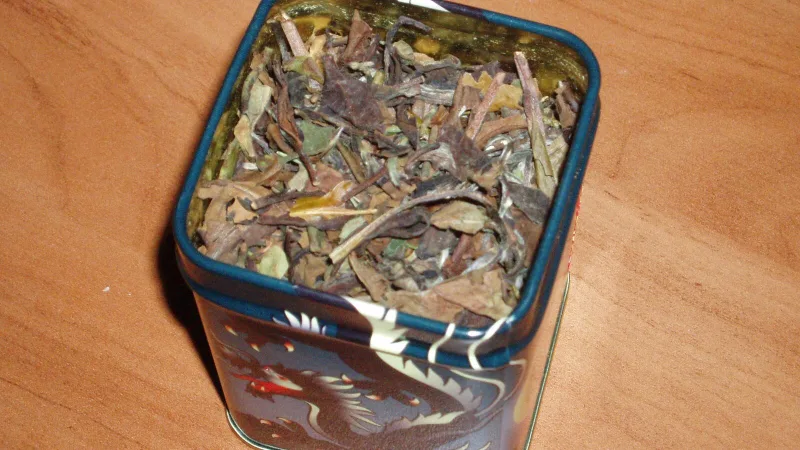
The leafiest and least expensive white tea. Fresh Shou Mei smells of hay and dry leaves; aged in a cake, it moves toward dates, honey and medicinal herbs.
- Province:
- Fujian: Fuding, Zhenghe, Jianyang
- Oxidation:
- light, happens on its own during withering
- Raw material:
- leaves from later pickings, few buds
- Form:
- loose leaf or pressed cake
- Harvest:
- late spring, summer, autumn
- Flavor:
- hay, dried fruit; with age, dates and herbs
Shou Mei (寿眉, "longevity eyebrows") is the leafiest of the four types of white tea. It has few buds, and its long dry leaves, gray-green mixed with brown, recall an old man's white eyebrows. Bai Hao Yin Zhen is made only from buds, Bai Mu Dan from a bud with leaves, and Shou Mei is almost entirely leaf. The processing is the same: withering and drying. Yet Shou Mei is the white tea most often pressed into cakes and left to age.
Leaves from later pickings
The standard defines Shou Mei broadly: young shoots or leaves of Da Bai cultivars, Shui Xian or local seed-grown bushes1. In practice it is the late part of the harvest. In spring, once the buds have gone to Yin Zhen and Bai Mu Dan, pickers return to the same bushes for the grown-out leaves, and they pick again in summer and autumn. In Fuding, autumn batches are sometimes labeled by the seasons of the Chinese calendar: Bai Lu ("white dew") and Han Lu ("cold dew").
During withering, large leaves oxidize more than buds, so the dry tea is mottled: green, olive, brown. Stalks and stems turn up in it. The standard sets two grades, first and second: the first has more small leaf and the occasional bud, the second larger, darker leaf.
Fresh Shou Mei brews a dark gold liquor, thicker and darker than Bai Mu Dan's. It smells of hay, dry leaves and dried apricot. There is little astringency, and the sweetness is dense and bready. Bud teas win on aroma, Shou Mei on body.
Shou Mei and Gong Mei
The same standard lists Gong Mei (贡眉) alongside it; gong means "tribute to the court". It is made only from cai chacai chaLocal seed-grown bushes of Fujian with small leaves. Gong Mei is traditionally made from them., local seed-grown bushes with small leaves1, usually from a bud with two or three leaves. Shou Mei can come from any bushes.
People have mixed up the names for a long time and still do. Until recently, Chinese reference books said Gong Mei and Shou Mei were the same tea. In Jianyang, tea from cai cha was called Gong Mei, while in Fuding a similar tea went by Shou Mei. In Hong Kong and Guangzhou, teahouses have long served Shou Mei with dim sum, and there the name covers almost any white tea except Yin Zhen. Little cai cha is left today, and most Shou Mei on the market comes from the same large-bud cultivars as Bai Mu Dan.
Pressed white tea
Loose Shou Mei is bulky and brittle: a kilogram fills a whole crate, and the leaf crumbles in transit. So in the early 2000s Fuding producers borrowed the presses used for pu-erh in Yunnan and began making white tea cakes. The first cakes came out loose and uneven, and until 2006 only a handful of makers produced them. The Fuding cake settled into its familiar shape by the late 2000s. Since 2016 a separate standard has covered pressed white tea2.
Finished white tea is sorted, blended, steamed, pressed in a mold and dried for a long time. Cakes range from 100 to 350 g. Steam and pressure change the leaf, so pressed tea brews a darker liquor and a duller aroma than loose tea from the same batch. That is why makers usually press plainer leaf, Shou Mei above all. The stalks leave air gaps in the cake, so it is easier to pry apart with a knife from the side, layer by layer, and the leaf inside ages more evenly.
Aging
Fresh Shou Mei can be drunk right away, but it is prized for what happens later. In dry storage the polyphenols in the leaf slowly oxidize. The liquor darkens from gold to amber and dark red, the grassy notes fade, and honey, dates, prunes and a note the Chinese call "medicinal aroma" arrive. Bitterness drops, and the texture grows softer and thicker. The first noticeable changes show within three to five years, and by seven to ten the dates and herbs come to the fore.
Producers began aging white tea deliberately for sale in the 2010s. Before that, people in Fujian drank it fresh, and families kept old leaf as a cold remedy. Hence the sales slogan: "one year it's tea, three years it's medicine, seven years it's a treasure". Keep it the way you would store any tea at home: dry, dark and away from odors.
Brewing and simmering
Shou Mei needs water close to boiling, because large leaves release their flavor slowly. In a gaiwan, 5 g per 100 ml is enough; with aged tea you can go up to 6–7 g. A piece of cake is rinsed once with boiling water so the leaf opens out.
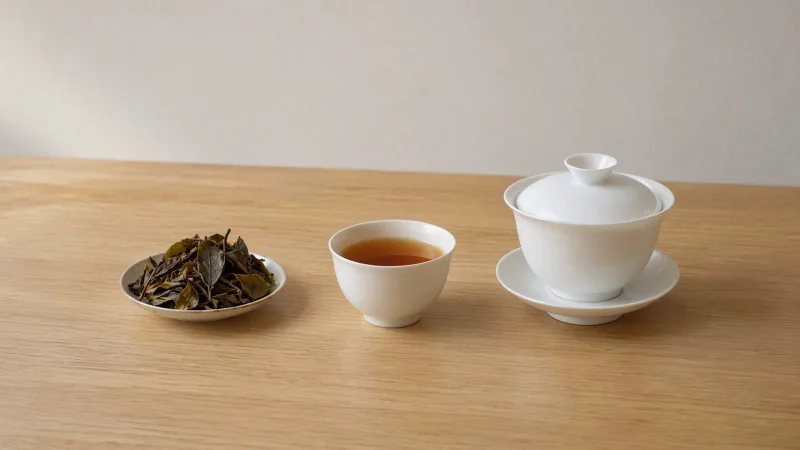
5 g per 100 ml, water at 95–100 °C (203–212 °F). First infusion 15–20 seconds, each following one 10–15 seconds longer, 8–10 infusions in all. Then the spent aged leaf goes into a pot of boiling water, 500–700 ml, and stays over a low flame for 3–5 minutes.
Simmering, zhu chazhu chaSimmering tea: the leaf goes into boiling water and stays over a low flame for a few minutes. This is how people drink aged Shou Mei and dark teas., is a winter favorite in Fuding. The brew comes out thick, sweet and dark amber, with a note of dates. Dark teas such as Liu Bao are simmered the same way. Don't simmer young Shou Mei: it still holds a lot of polyphenols, and long boiling makes it bitter. Brew it in a gaiwan or teapot instead, 4 g per 250 ml for 4–5 minutes.
Common questions
How is Shou Mei different from Gong Mei?
Under the standard, it comes down to the bushes. Gong Mei is made from local seed-grown small-leaf bushes, Shou Mei from any: large-bud Da Bai, Shui Xian or the same local ones. In practice the names get mixed up, and in Hong Kong almost any white tea except Yin Zhen is called Shou Mei.
Can you trust the year on a white tea cake?
Only if you trust the seller. There is no way to check the year on a wrapper, and young tea can be made to look old: roasted darker or kept in damp conditions. Genuinely old leaf darkens unevenly but smells clean, of wood and dried fruit. Mustiness or mold is a reason to walk away.
How old should Shou Mei be before you simmer it?
Simmering makes sense for tea older than three to five years: young tea is high in polyphenols and turns bitter in boiling water. Fresh Shou Mei is better brewed in a gaiwan or teapot, and the spent leaf can be simmered after the infusions.
-
GB/T 22291-2017 "White tea" (白茶): Gong Mei is made from shoots of seed-grown (population) cultivars, Shou Mei from shoots or leaves of Da Bai, Shui Xian or seed-grown cultivars. ↩ ↩
-
GB/T 31751-2015 "Pressed white tea" (紧压白茶), in force since February 1, 2016. The history of Fuding cakes follows the 8fu.cn portal: first trials in 1999–2002, mass production from the late 2000s. ↩