Tea leaf chemistry
The taste, smell and lift of a cup come from a handful of compound groups in the leaf. Their shares in dry tea have been measured, and they explain where much brewing advice comes from.
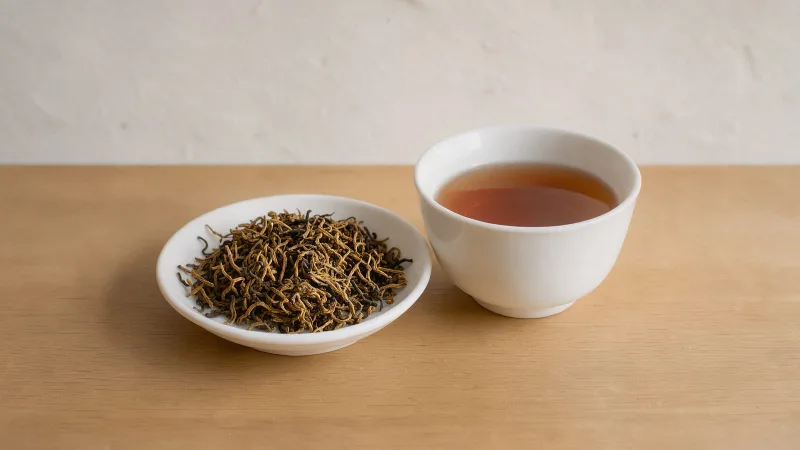
By dry weight, the largest group in tea leaf is polyphenols, at 18–36%, and catechins make up 70–80% of them. They account for astringency, liquor color and the haze in cooled tea. Caffeine runs at 2–5%, highest in the bud and first leaf, and only part of it reaches the cup: a 30-second rinse removes about 9%. The Japanese chemist Sakato Yajiro described theanine in 1949. Shaded gyokuro and matcha have the most, pu-erh almost none.
Aroma is harder to pin down. Researchers have found about 600 volatile compounds in tea, yet the recognizable aroma of a given tea rests on a few dozen, and almost all of them form during withering, roasting and other processing rather than in the fresh leaf.
Where tea safety is concerned, the measured risks come less from the leaf than from drinking habits. Temperature comes first: IARC classes drinks above 65 °C as Group 2A. Next comes fluoride, for people who drink liters of brick tea made from mature leaf, and then pesticides. Depending on solubility, anywhere from 1–4% to 90–100% of the residue passes into the liquor.
-
 Caffeine
咖啡碱
How much caffeine tea leaf holds and how much reaches the cup: the role of cultivar and plucking, heat and time, and why a rinse removes so little.
-
 Polyphenols
茶多酚
What tea polyphenols are: catechins in green leaf, theaflavins in black tea, where astringency comes from, why tea clouds, and what to change when brewing.
-
 Theanine and umami
茶氨酸
What theanine is and where tea umami comes from: shaded gyokuro, amino acids by type, why 50-60 °C water makes a soft cup, and what not to expect.
-
 Aroma
香气
Where tea aroma comes from: glycosides, indole, pyrazines, how withering and roasting build them, and how to smell the lid, the steam and an empty cup.
-
 Tea safety
茶汤安全
What in tea is up to you: drinking temperature, fluoride in brick tea, pesticides and rinsing, iron, plastic tea bags. Numbers from studies and standards.