Tokoname and Banko: Japanese clay teapots 常滑焼・萬古焼
Tokoname and Banko are the two main centers of Japanese clay kyusu for loose-leaf tea. Both fire iron-rich clay without glaze, yet the colors come out different: red in Tokoname, purplish brown in Banko.
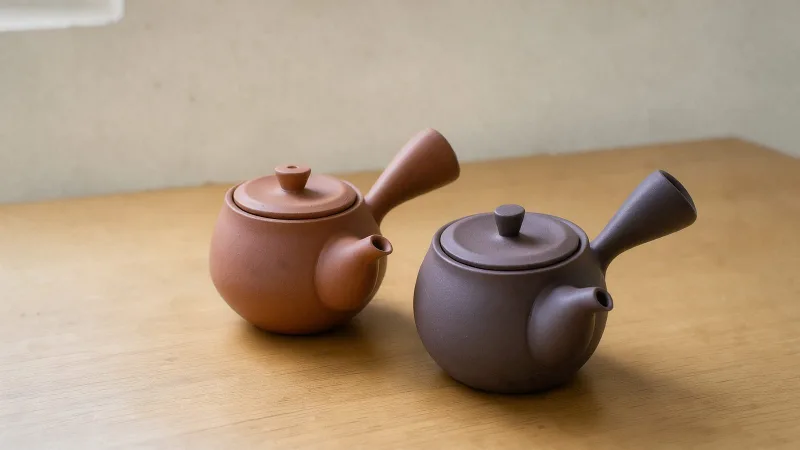
- Tokoname:
- Chita Peninsula, Aichi Prefecture
- Banko:
- Yokkaichi, Mie Prefecture
- Craft status:
- Tokoname 1976, Banko 1979
- Red shudei:
- oxidation firing, about 1120–1150 °C
- Purple shidei:
- reduction firing, 1180–1200 °C
- Glaze:
- none, inside or out
The Japanese teapot, kyusu, comes in porcelain, cast iron and clay. Clay kyusu for loose-leaf tea come mostly from two places: Tokoname on the Chita Peninsula (Aichi Prefecture) and Banko in Yokkaichi (Mie Prefecture). Both use iron-rich stoneware fired without glaze, and both looked to Chinese Yixing for ideas, but they went their separate ways.
Tokoname: red clay and the Six Ancient Kilns
Tokoname is one of Japan’s Six Ancient Kilns. Around 1100, cave-style anagama kilns went up in the Chita hills and turned out “mountain bowls” and large storage jars. The remains of about 3,000 medieval kilns have been found on the peninsula. In the Kamakura period (1185–1333) jars over half a meter tall were shipped to places as far apart as Tohoku and Kyushu.
Teapots came late, in the second half of the Edo period, when potters added sake bottles, kyusu and other small wares to their large pieces. In the Bunsei years (1818–1830) Inaba Shozaemon got hold of a book with drawings of old teapots and began making kyusu. Ina Chozaemon II then found white hakudei clay at Itayama and invented hiro-yaki, in which dry seaweed laid on a white body leaves red salt marks after firing. The technique later became known as mogake.
The red teapot was modeled on Chinese ones. Hirano Chushi, a physician who collected Yixing pots, showed them to the potter Sugie Jumon, who made a local version. The date depends on the source: Ansei 1 (1854) for the Tokoname Tonomori museum and the Six Ancient Kilns site, the Bunkyu years (1861–1864) for the Ceramic Society of Japan and the local potters’ association. In 1878 Jin Shiheng (金士恒), a Chinese man versed in Yixing technique, came to town, and Sugie Jumon and Ina Chozaemon IV studied with him. Accounts differ on what he taught: the city credits him with beaten-panel forming called “pan-pan”, the potters’ association with carving in tiny characters. The beating method did not take root, and makers went back to the wheel.1
Tokoname ware became a designated traditional craft on June 2, 1976.
Banko: a merchant, a seal and the purple teapot
Banko goes back to Nunami Rozan, a merchant from Kuwana. A keen follower of the tea ceremony, he built a kiln in the village of Obuke (now Asahi) between 1736 and 1741. He stamped his pieces with the seals “Banko” and “Banko fueki”, “unchanging for ten thousand ages”. Wares of his time are called ko-banko (old Banko). After Rozan died in 1777, production stopped.
In the Tenpo era (1830–1844) the brothers Mori Yusetsu and Mori Senshu of Kuwana revived the kiln, using collapsible wooden molds, shoenji glaze and Yamato-e style painting. In 1853 Yamanaka Chuzaemon built a kiln in Yokkaichi and by 1870 had mass production going. Throwing kyusu on the wheel was worked out with the potter Shimizu Heishichi of Mino-Akasaki. Mizutani Torajiro introduced semi-porcelain in the Taisho era. Banko became a traditional craft on January 12, 1979. Yokkaichi and Komono now have more than a hundred workshops.
Banko also has a sideline in cookware. About 80% of Japan’s clay donabe pots are made here. Since 1959 potters have added petalite to the body, so the pots can go on a gas flame. Teapots are made from a different body.
Clay and firing: red and purple
What separates the two centers is mainly the kiln, not the raw material.
| Tokoname, shudei | Banko, shidei | |
|---|---|---|
| Raw material | paddy-field clay and refined red mountain clay; today red iron oxide (bengara) replaces the mountain clay | local iron-rich clays, kibushi clay, porcelain stone |
| Body | stoneware | stoneware, “semi-porcelain” |
| Firing | oxidation, about 1120–1150 °C | heavy reduction, 1180–1200 °C, about a day |
| Color | red-orange | “the color of adzuki beans” |
In shudeishudeiThe red clay of Tokoname and teapots made from it. Its iron is fully oxidized in the kiln, which gives the red-orange color. the iron is fully oxidized, like red rust. In shideishideiThe purplish-brown body of Banko. The raw clay is pale and takes its color from heavy reduction firing. it is reduced, like black rust, and the surface partly oxidizes again as the kiln cools. Banko potters call their reduction extreme: a typical kyusu is fired at an oxygen sensor reading of about −5%. Raw Banko clay is pale and turns purplish brown only in the kiln. The name “shidei” sounds like Chinese zini, but the process differs. For comparison, see the Yixing clays.
Tokoname has other finishes as well. With manganese dioxide in the body, potters get shidei and black udei. There is also ivory-colored hakudei, natural ash glaze and rough namban firing. For decoration they use hidasuki (straw marks), mogake with seaweed, and ibushi (smoking).
Banko potters carve their decoration: “toshikamon” (a pierced pattern), “biri” (a chattering tool), senjuji (fine lines) and “mushikui” (needle work). In “chosai”, the potter cuts a design through white slip on the raw clay and paints it, and the whole piece goes through a single reduction firing.
Tokoname has used up its local mountain clay, so today’s shudei gets its red from bengara. Banko’s local raw materials are exhausted as well. None of this is forgery, but a body matching the nineteenth-century one is now rare.
Taste: what is proven and what is not
The kilns claim that iron reacts with tannins, making tea softer and sweeter. Lab results are more modest. Inagaki and Nishikawa of the Mie Prefecture industrial research institute showed that catechins settle on pores and rough spots of the surface, while no surface absorbed the amino acids (glutamine, arginine, theanine). Nothing adds umami: the tea simply ends up with fewer astringent compounds and the same amount of amino acids.2
Firing matters a lot: tannin levels varied almost twofold between samples fired differently. In Yamazawa’s test (85 °C, 1 min 30 s), 100 ml of tea brewed in shudei held 73.2 mg of tannins, against 86.9 in black kokudei and 88.9 in porcelain. Tea from porcelain thus had 21% more astringency than tea from shudei, a fair argument for porcelain if you want a neutral vessel. The Mie authors themselves rate the kyusu’s influence as small next to temperature, time and steeping method. Before buying a pot for its taste, get brewing sencha and gyokuro right.
In practice, an unglazed kyusu from either center suits sencha, fukamushi and bancha. For a neutral cup with full astringency, use porcelain from Arita, Hasami or Kyoto. For gyokuro, choose a pot by size and strainer, not by color.
How to choose and read a maker’s mark
Start with three things.
The lid. On a proper kyusu the lid is ground to the neck (“suriawase”) and fired together with the body. There is no gap, heat stays in, and the lid does not rattle at a boil.
The strainer. Tokoname potters make three kinds: “doake” with holes right in the wall, “debeso” of domed ceramic mesh, and an inserted steel one. The last two suit fine-leaf fukamushi, since leaf slips through the large doake holes.
How it is made. Body, spout, handle, strainer and lid are formed separately and then joined. A craftsman throws the parts on the wheel; factories slip-cast them in plaster molds. Either way the pot is assembled by hand, and the difference shows in price and uniformity.
Since the nineteenth century Tokoname kyusu have carried the maker’s name. Watanabe Yahei started the practice; the lord of Owari granted him the name “Tokoname Genkosai”. Yamada Jozan III (1924–2005) won the grand prix at the Brussels exhibition in 1958, took that name in 1961, and in 1998 was recognized as a bearer of important intangible cultural heritage for “Tokoname-yaki (kyusu)”. He made more than a hundred kyusu forms. As for Banko, the “Banko” or “Banko fueki” stamp is the very seal that gave the whole center its name.
The traditional craft seal (densho-shi) confirms that a piece was checked for technique and materials, but a piece without one is not necessarily fake. Verified sources give no figures for Chinese imitations marked “Tokoname”, so judge by the lid, the strainer and the maker’s signature.
Tokoname, Banko and Yixing
Japanese researchers trace shudei and shidei directly to the Yixing zisha line. Tokoname still dates its ties with Yixing, now its sister city, to 1878. “Shidei” sounds like Chinese zini, but the processes behind the two differ.
A kyusu and a Yixing teapot are best compared by what each is for. A Yixing pot is made for gongfu cha: many infusions, each poured off in seconds. A kyusu is for sencha and gyokuro, with two or three infusions and short steeps as well.
These care rules come from the Tokoname tourism portal. Wash the pot with the spout toward you, because most kyusu get broken during washing. Pour water out through the spout so the stream rinses leaf off the strainer. Skip detergent, since the clay absorbs its smell. Clean a clogged strainer with a soft toothbrush once the pot is dry. Dry it with the lid off, spout down. For general rules, see teaware care.
Common questions
How is a Tokoname kyusu different from a Banko kyusu?
In color and firing. Tokoname is known for red shudei, fired in oxidation at 1120–1150 °C. Banko makes purplish-brown shidei, fired in heavy reduction at 1180–1200 °C for about a day. In the cup the difference is small, so choose by how the pot sits in your hand, the lid and the strainer.
Does the iron in the clay make tea sweeter?
Not quite. The kilns attribute it to iron reacting with tannins, but in lab tests catechins settle on the surface pores while amino acids stay in the tea. Nothing adds umami; the tea just gets less astringent. Water temperature and steeping time matter more.
Does a good teapot need a traditional craft seal?
No. The densho-shi seal confirms that a piece passed a check for technique and materials, but a piece without one is not necessarily fake. Check the lid fit, the strainer and the maker’s signature on the base.
-
The sources disagree: the city of Tokoname names the “pan-pan” method (city.tokoname.aichi.jp), while the Ceramic Society of Japan says the Chinese beating method did not take root (ceramic.or.jp). ↩
-
Inagaki D., Nishikawa T., Mie Prefecture Industrial Research Institute, “急須の表面状態が緑茶の呈味成分に与える影響” (pref.mie.lg.jp). Tannins in six kyusu: Yamazawa K., Journal of Cookery Science of Japan 55(3), 2022 (jstage). ↩