Chinese teahouses: yum cha, Sichuan and Beijing 茶馆
In a Chinese teahouse you pay for the place more than the tea: in Canton people come for dim sum, in Chengdu for talk, in Beijing for a bowl at two fen. The tea itself is usually plain.
- Name:
- 茶馆 (chaguan); in Canton often 茶楼 (chalou)
- First tea shops:
- Tang, Kaiyuan era (713–741)
- Canton:
- yum cha, "one cup, two dishes"
- Sichuan:
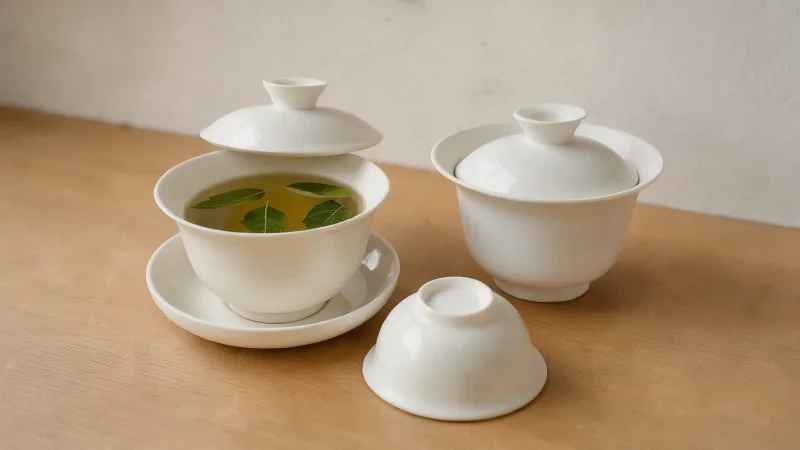
- three-piece gaiwan and a copper kettle with a spout up to a meter
- Beijing:
- big-bowl tea, 2 fen a bowl since 1979
China has several words for a teahouse, and each belongs to its own world. 茶馆 (chaguan) is the general term, in use since the Ming. 茶楼 (chalou, "tea tower") is the multistory Cantonese house that serves food, and 茶肆 and 茶坊 were the tea shops of the Tang and Song. A teahouse is a public institution rather than a way of brewing: people come for the company, and the cup is an excuse to sit.
Where teahouses came from
The first tea sellers appeared under the Tang. Feng Yan's Records of Things Seen and Heard says that in the Kaiyuan era (713–741) monks of the Lingyan temple on Mount Tai began drinking tea to stay awake, the habit spread to the cities, and there "many shops opened, boiled tea and sold it, without asking whether you were a monk or a layman". The word 茶馆 shows up in the writings of Zhang Dai under the Ming and becomes common under the Qing.
In Southern Song Lin'an (today's Hangzhou) tea shops were already tastefully furnished. According to the Menglianglu, they set out flowers of the four seasons and hung paintings by famous artists. In winter they sold pounded tea 七宝擂茶 and onion tea, in summer "plum blossom wine". Some had singing girls on the upper floor, and officials met in others.
By the late Qing, regional types had taken shape, and they survive today. Three of them are worth telling apart.
Canton and Hong Kong: yum cha
In mid-19th-century Guangzhou the first houses were the "two-li teahouses" (二厘馆): a thick porcelain pot, a clay cup, coarse leaf, and a price equal to the tea. Next came the 茶居 and the three-story 茶楼, with 三元楼 said to be the first of the big ones. Hence the saying: whoever has money goes upstairs, whoever has none squats below. According to city commerce bureau records, the best known of the old houses, 陶陶居, was founded in 1880 as Putaoju, and in 1925 it became the first to combine a teahouse with a banquet restaurant.
Yum cha (饮茶) comes down to the formula 一盅两件: one "cup" and two portions of food. The house charges 茶位 per head, so the waiter's first question is how many you are. The tea list is standard: Tieguanyin, puer and a scented tea. Hong Kong restaurants favor shou puer: guests do not ask to have the dark liquor changed, it cuts through greasy food, and unlike oolong it does not have to be sold quickly.
Everything follows a set ritual:
- Give the number of guests and choose the tea.
- Rinse the tableware with boiling water: pour it over cups and chopsticks, then into a bowl. Cantonese sources call it ritual rather than hygiene.
- The younger person pours for elders and watches strength and temperature.
- Whoever receives tea taps the table with bent fingers.
- For a refill, push the lid of the empty pot to its edge.
The tap and the lid both have legends. In one, the Qianlong emperor, traveling incognito, poured for his servant, who answered with a finger tap. The lid story features a bird: a thrush in one version, a canary in another, a quail in a third. There is no historical evidence for the Qianlong tale, and the setting changes from one telling to the next.1 In 2022 the "Cantonese custom of yum chayum chaCantonese for "drink tea": a morning or midday trip to a teahouse for tea and dim sum." was added to Guangdong's provincial intangible heritage list.
Sichuan: gaiwan and long spout
A Sichuan teahouse starts with a three-piece gaiwan (三件头): bowl, lid and a saucer called the "boat". The bowl has a wide mouth for topping up and a narrow base where the leaf settles. Drinkers use the lid to push floating leaf aside and sip through the gap. In noisy houses the porcelain saucer was often swapped for copper or aluminum, which is lighter and does not break.
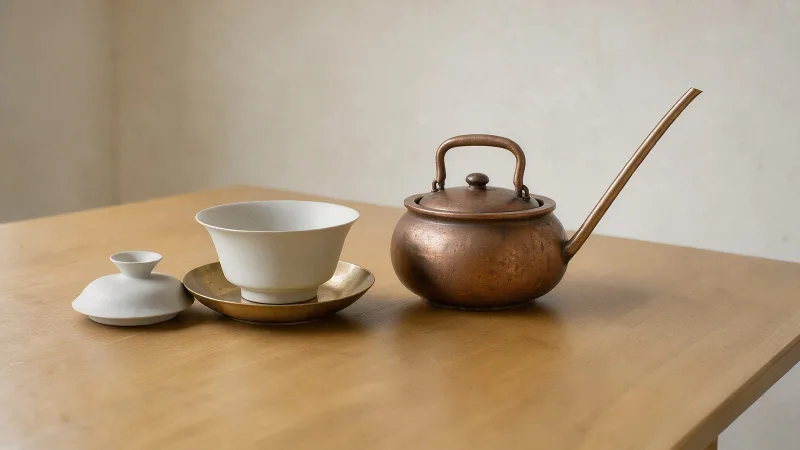
The waiter does the pouring, and this is where the long spout comes in. The copper kettle 长嘴壶 has a spout of 33–66 cm and up to a meter, longer still for the stage. With it the waiter can pour from a distance without interrupting the talk, and the water cools to 80–90 °C in the stream, which by one account suits green and jasmine leaf. The Chengdu master Wu Dengfang holds the kettle at about 75° to the bowl. The claim of thousand-year origins rests on oral tradition, and according to one version the set of "eighteen forms" was put together only in 2000.
The waiter was called the "doctor of tea" (茶博士). Historian Di Wang describes wartime Chengdu in 1942: Pockmarked Zhou at the Jinchun teahouse carried a kettle in one hand and a stack of twenty-odd sets of tableware in the other, dealt out saucers, set down bowls, poured boiling water from a distance and flicked the lids on with his little finger.
Chengdu had a great many teahouses. The Chengdu tonglan counted 454 on 516 streets in 1909, one for about 600 residents, and by 1935 there were 599, with some 120,000 customers a day.2 People went to the teahouse to find work, hear the news and listen to storytellers. It also hosted the arbitration called 吃讲茶: the parties arrived with kin and a mediator, and the one in the wrong paid for every table. The authorities banned the custom from the late Qing on, in Chengdu in 1914 and 1946. The Paoge secret society kept its lodges in teahouses: of 119 known addresses, 36 were teahouses.
The house had its own slang too. Step out for a moment and you leave the lid upturned on the table: the tea stays, and so does the seat. "Own leaf, you pay for the hot water" was 免底, a rush of customers was 打涌堂, a lull 吊堂. You could finish someone's abandoned tea (加班茶) only if the bowl had no lid.
Beijing: big bowl and storytelling houses
Beijing's teahouses fall into two worlds. The first is the houses: the "big teahouse" (大茶馆) with pastries and dishes, the "pure teahouse" (清茶馆) with tea only, and the storytellers' and chess houses. A classic big teahouse took 3–5 bays of frontage and 6–7 in depth, with a stove at the door, a hall under an awning and separate seating along the sides. In the morning the pure teahouse filled with carpenters, masons and roofers looking for work, and by day with housing brokers.
The second world is the street: "big-bowl teabig-bowl teaBeijing street tea: strong, cheap, served in a coarse bowl to porters and passers-by." (大碗茶). That meant a booth of planks under an awning, or a peddler with a shoulder pole, a kettle in a quilted cozy on one end and a basket of coarse bowls on the other. The tea is boiled rather than brewed: tea dust below top grade, sometimes spent leaves, goes into a cauldron, and people drink it in one go. Big-bowl vendors already belonged to a tax-exempt guild in 1582.
In June 1979 Yin Shengxi and a group of young people who had come back to the city opened a booth by Qianmen tower with one stove, six kettles and a hundred blue-rimmed bowls, at 2 fen a bowl. It grew into the Lao She Teahouse, which opened in December 1988. Its booth, Laoerfen, was still selling jasmine tea at the old price in 2023.
The house is named for Lao She, author of the play Teahouse (written in 1956–1957, premiere March 29, 1958). Its three acts are set in the Yutai teahouse in 1898, in the early republic and in the late 1940s.
Hangzhou, Shanghai, Suzhou
Along the Yangtze, people went to the teahouse for the stage. In Hangzhou around the fall of the Qing teahouses stood by the docks and canal bridges, and many had a platform for local opera and storytelling. By 1931 the city counted 555 of them, with 1,273 workers. The famous ones included Yingbin Lou, Xiyutai, Xiyuan and Bixia Xuan.
In Shanghai the Huxinting pavilion (湖心亭), rebuilt in 1784, has been counted since 1855 as the city's first teahouse. In Suzhou, storytelling with zither and lute (评弹) belonged to the teahouse: until 1911 performances took place there, and from 1911 to 1949 the city had 117 book halls. The storytellers' guilds also met over tea. Tongyishe, for example, was founded in 1916 at the Pinfang teahouse, and a new member had to drink tea there three days running.
What they share, and what stands apart
All of them share one thing: the tea is cheap and familiar, and what people pay for is time. In Chengdu in 2000 a cup in an upscale teahouse cost 10 to 100 yuan, a private room up to 600 yuan an hour, and street tea 1 to 5 yuan. After 1949 Chengdu's teahouses declined, and they began to revive after 1978.
That sets a Chinese teahouse apart from the chaikhana of Central Asia, with its different food, vessels and company. It also differs from ceremonial chaxi: there the tea is chosen to fit the idea of the table, here the table takes shape around whoever turns up.
Little is standardized. The trade norm SB/T 10654-2012 covers service in teahouses, while the star rating SB/T 11072-2013 is marked "withdrawn" on the SAMR portal and "in force" on ndls. The sources give no grams or steeping times for teahouses, so none appear here.
Common questions
What is yum cha, and how does it differ from ordinary tea drinking?
Yum cha (饮茶, "drink tea") is the Cantonese trip to a teahouse where tea comes with dim sum. The formula 一盅两件 means "one cup and two dishes". The house adds a per-person tea charge, 茶位, and keeps topping up the pot while guests eat and talk.
Why do people tap the table in a Chinese teahouse?
It is a thank-you to whoever poured. The recipient taps one or two bent fingers so the conversation goes on uninterrupted. A popular legend credits the Qianlong emperor, but there is no historical evidence for it.
What does an upturned gaiwan lid mean in a Chengdu teahouse?
The guest has stepped out for a moment: the tea will not be thrown out and the seat will not be given away. Taking the lid off and sipping means something else: the guest has to leave and is thanking the host.
-
Natalie Yee Chu. The Impacts and Significance of Yum Cha for the Cantonese Diaspora. Asian American Research Journal 3 (2023). doi.org/10.5070/rj43060697. ↩
-
Di Wang (王笛), Longmenzhen: Chengdu teahouse culture, Guangming Daily, 2011; Chengdu tonglan of 1909 per Xinhua, 2024. Excerpt. ↩