Tea in Vietnam: chuyên trà, lotus and trà đá
Vietnamese tea has three layers: fresh leaf from a village pot, green Thai Nguyen in a small teapot, and cheap iced trà đá on the sidewalk. Lotus tea from Hanoi sits at the top.
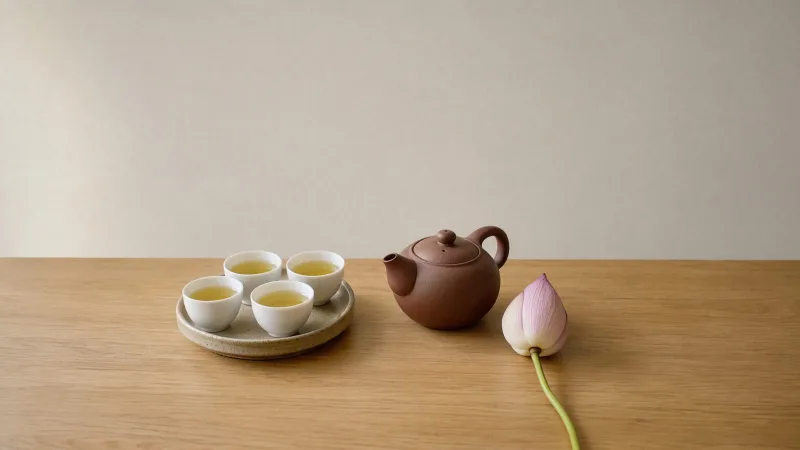
- Three layers:
- fresh leaf, chuyên trà, trà đá
- Chuyên trà:
- took shape under the Le (1533–1789), settled under the Nguyen (1802–1945)
- Main tea:
- pan-fired green, Thai Nguyen
- Lotus tea:
- West Lake, Hanoi; national heritage since August 9, 2024
- Cups:
- 3 in the south and Hue, 4 in the north
Vietnam has three ways with tea, each from a different era. Villages drank fresh leaf long before dried tea arrived, chuyên trà grew out of court and scholarly culture, and iced trà đá appeared on city streets in the second half of the 20th century.
Three layers of Vietnamese tea
The oldest layer is rural: fresh leaf (chè tươi) or whole twigs, with boiling water poured over them in a clay pot. According to Vu The Ngoc, before the Ming and Qing the Vietnamese knew only fresh leaf, and imported dried "northern tea" was for the elite. A saying recorded in the south ranks drinkers this way: gentlemen of the first class drink Chinese tea, of the second Hue tea, of the third plain water.
The way fresh leaf is prepared varies from province to province. The Muong of Thanh Hoa pound old leaves in a mortar, while in Ha Tinh people boil whole twigs. Hanoi markets sold fresh leaf, and the brew was kept warm in a clay vat wrapped in sacking and set inside a wooden box. People poured off the first water ("cleaning the tea's fur") and kept the second.
The second layer is the literary one, chuyên trà. The third is urban trà đá, iced tea with nothing in common with the old ceremonies.
Chuyên trà: the set and the order
The word appears in the 1798 dictionary Nhật dụng thường đàm, and the practice itself is traced to the restored Le dynasty (1533–1789). In "Mính ẩm", an essay in Rainy Day Jottings, Pham Dinh Ho writes that after the Kangxi reign (1662–1722) steamed tea gave way to steeped tea and small cups came into fashion. The custom became established under the Nguyen (1802–1945).
It all comes down to a small pot, thin cups, boiling water, plenty of leaf and a short steep. The tea comes out dense and layered, with a long aftertaste. A full set had 16 pieces, but four matter most:
- ấm chuyên, a thin-walled brewing pot of unglazed clay, 60–160 ml, built on the same principle as Yixing teapots;
- chén tốngchén tốngA large bowl, the "general cup", that the whole pot is emptied into. The strength evens out and sediment settles in it before the tea goes into the small chén quân cups. and chén quân, the serving bowl and small cups of thin white "eggshell" porcelain, whose white inside shows off the color of the liquor;
- siêu, a copper or terracotta water kettle with a side handle, 350–550 ml;
- lò, the charcoal stove under it.
There are three or four cups. The Hue court set out three, and a saying went: tea for three, wine for four. The north uses four, and a small plate, the đĩa dầm, goes under the chén tống. Sources differ: some give three cups to the whole south, others describe a single chén tống and two or three chén quân at court.
Boil water in the siêu over charcoal. Spring water or river water from the uplands was considered best. Warm the pot, the chén tống and the chén quân with boiling water. Use a lot of leaf: a Thai Nguyen producer recommends 6–7 g per 150 ml. Rinse the leaf briefly ("waking the tea") and pour the water off. Brew with water at about 85 °C (185 °F); older accounts give 90–95 °C for oolongs and lotus tea. Steep the first infusion for 40 s and each one after it 10–15 s longer. Pour the whole infusion into the chén tống and only then into the cups.
The figures in the box come from a single Thai Nguyen producer, and no independently verified proportions exist for classical chuyên trà. The idea is the same as in gongfu cha: lots of leaf, many infusions, short steeps. After tea the set is washed, dried and covered with a red cloth, the vuông điều. The leaf is stored in a narrow-necked caddy, ideally a tin one.
Chinese-made ware: porcelain and teapots
Chuyên trà ware was ordered from China's potters and porcelain makers. The Trinh lords were the first to commission it in the 18th century, for their northern palaces, followed by the Nguyen in the south. Artists of the court painting office drew the shapes and patterns, the sketches traveled with embassies to Jingdezhen, and on the way back the envoys bought clay teapots in Yixing. The commissioned blue-and-white is known as Bleu de Huế, though none of it was made in Hue: the Frenchman Louis Chochod coined the term, and scholars consider it inaccurate.
Court pieces carry marks such as "Minh Mạng niên chế" and the character 日 (Nhat), the dynasty's personal mark. The octagonal Thieu Tri sets (1841–1847) with dragon medallions are especially prized.
Buyers knew teapots by a rhyme: "first Thế Đức, second Lưu Bội, third Mạnh Thần." The order is there for the rhyme, not for quality. Mạnh Thần is the late Ming Yixing master Hui Mengchen (惠孟臣). In Vietnam his name came to mean a small pear-shaped pot, and that shape is the one most often faked. Thế Đức is a trading-house mark, and Lưu Bội is the pseudonym of Shao Jingnan (1796–1874).
Lotus tea of West Lake
The finest of Vietnam's scented teas is made in Hanoi, in the Quang An quarter on the shore of West Lake (Tây Hồ). There are 157 ha of water here and 11 ponds of the "hundred petal" lotus (Bách Diệp). The base is green tea from Thai Nguyen. The flowers are picked from boats between 4 and 6 a.m., before the buds open. A decision of August 9, 2024, added the craft of lotus scenting to the national list of intangible heritage.
There are two methods:
| Dry (gạo sen) | In the flower | |
|---|---|---|
| Scent carrier | white tips of the anthers | the whole flower |
| How it is made | layer of tea, layer of gạo sengạo sen"Lotus rice": the white anther tips picked out of a lotus flower. Tea is layered with them and takes on their scent., rest, drying, sifting; 5–7 cycles | about 15 g of tea goes into a half-open flower, the petals are tied with a ribbon, the flower stands in water overnight |
| Quantity | 1000–1200 flowers per kg (up to 2000 by other accounts) | one flower per serving, which makes 2–3 pots |
| Time | 15–21 days | one day |
| Result | deeper, scent lasts several infusions | lighter and fresher, keeps poorly |
In the morning the flower-scented tea is vacuum-packed and kept in the fridge or freezer. With the dry method the leaf soaks up moisture from the anthers and darkens to gray-black.
In Hue they scented their own tea with white lotus from Tinh Tam Lake, leaving a pinch of tea in the bud for 24 hours. The base has to be good. On coarse, astringent leaf the delicate lotus disappears behind the bitterness, so producers use buds.
Real lotus tea is expensive. According to press reports from 2024, more than 30 families in Quang An made about 500 kg a season, and the top grade costs 7–10 million dong per kilogram. Cheap "lotus" tea is ordinary tea with artificial flavoring, about a gram to 3 kg, plus a pinch of gạo sen sprinkled on top for show. The fake smells sharp; the real thing smells light.
The lovely story of Emperor Tu Duc gathering dew from lotus leaves and tucking tea into the flowers at night remains a legend. One producer went looking for a Nguyen-era document and found none.1
Thai Nguyen and Shan tuyet
Vietnam's main tea is green, and it is pan-fired rather than steamed as in Japan. Thai Nguyen is prized for its aroma of young sticky rice (cốm), gentle astringency and sweet aftertaste. The finished leaf is bluish black and hook-shaped, with a bloom called mốc cau. A veteran known as Doi Nam founded the hamlet of Tan Cuong near Thai Nguyen, and in 1935 its tea took first prize at an exhibition in Hanoi.2
Grade depends on the pick. One producer's prices for 2026:
| Grade | Pick | Price, dong per kg |
|---|---|---|
| trà đinh | bud only | 2.5–5 million |
| nõn tôm | bud and one leaf | 0.6–1.5 million |
| móc câu ("fishhook") | bud and two leaves | 0.3–0.6 million |
| trà búp | bud and three leaves | 0.15–0.3 million |
Local authorities warn that coarse, dyed tea gets passed off as móc câu and nõn tôm. Be wary of leaf and liquor that are an unnaturally bright green.
Shan tuyet ("snow" Shan) grows in the north, in Ha Giang, Yen Bai and Dien Bien. It is a large-leaf tea from ancient trees, growing from 600 m up according to the "Hà Giang" geographical indication (2018) and at 1200–2000 m according to a botanical survey. Some of the trees are over 300 years old, and 220 trees at Cao Bo are recognized as "Vietnam Heritage Trees".
Trà đá: tea on the sidewalk
Trà đá is the cheapest green or jasmine tea, heavily diluted. In Hanoi a strong concentrate is brewed, then ice goes into a glass, water on top of it, and the concentrate last. In Saigon you get a pitcher of pale amber jasmine tea. A glass once cost 500 dong, and in 2011 two or three thousand.
Ice arrived with the French; trà đá became a Hanoi habit after 1975 and really took hold in the 1990s. Accounts differ: some say the drink came from Saigon, others that it reached the north only in the late 1990s.
Tea at home
No family rite goes without tea. It is part of the gifts for the matchmaking visit and the betrothal, and it goes onto the ancestor altar on the 1st and 15th of the month and at Tet. In old Hanoi the head of the family lit incense at Tet and brewed a pot, and 5–10 minutes later the children went to greet their elders. In some regions a layer of dry tea was spread in the coffin under the body.
If you keep one picture, make it a small pot and three cups on the table, with trà đá on the street outside. Both are Vietnam.
Common questions
What is chuyên trà?
The Vietnamese way of drinking tea from a small clay pot (ấm chuyên), a large serving bowl and three or four tiny cups, with plenty of leaf, boiling water and short steeps. The term (專茶, chuyên trà) appears as early as a 1798 dictionary.
How do you tell real lotus tea from flavored tea?
Real lotus tea has a light scent that lasts into the third or fourth infusion. A sharp, strong smell gives away artificial flavoring. The real leaf also darkens to gray-black from the moisture of the anthers.
Is trà đá an old Hanoi tradition?
No. Ice arrived with the French, and trà đá only became a mass drink in Hanoi after 1975, especially in the 1990s. Before that, people in the city drank hot tea and fresh leaf.
-
The producer's assessment: Đỗ Hữu Thuận, Vietnamese lotus tea, TRAVINA. ↩
-
Báo Thái Nguyên, "Mốc xanh, hương cốm, xoăn hình móc câu", 2011. Sources differ on when the hamlet was founded: the name Tan Cuong is known from 1922, and the workshop opened in 1925. ↩