Tea evaluation and tasting
To compare two teas, tasters brew them identically and describe them in shared terms. A pleasant cup is beside the point.
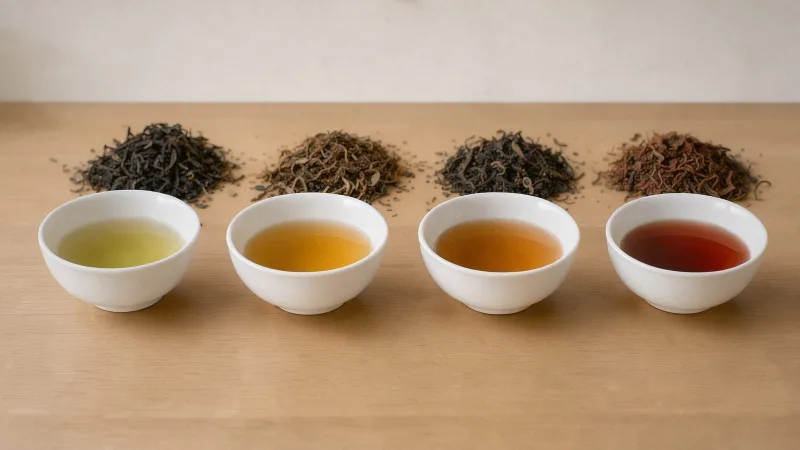
Two teas can only be compared when everything else is held equal: leaf weight, water volume, time and white porcelain. On this the Chinese and international methods agree. Shenping under GB/T 23776-2018 calls for 3 g in 150 ml of boiling water for 4–6 minutes, or 5 g in 110 ml over three infusions for oolong. Tasters score the finished tea on eight factors against a reference sample. The method grew out of export inspection in 1930s Shanghai.
Western tea tasting follows ISO 3103, first published in 1980: 2 g per 100 ml, 6 minutes for black tea and 5 for whole-leaf green, brewed in a white porcelain pot with a serrated rim. Tasters look at the dry leaf, the liquor and the infused leaf.
Then the sensations need names, and the language of taste supplies them. The Chinese standard GB/T 14487-2017 defines 417 terms, ISO 6078:1982 covers black tea only, and the T/CTSS 58-2022 flavor wheel lists 155 attributes. Intensity is rated from "none" (0) to "pronounced" (5).
-
 Shenping
审评
How tea is judged in China under GB/T 23776-2018: white porcelain, 3 g in 150 ml, eight factors, scores against a standard, and the taster profession.
-
 Tea tasting
How professionals taste tea: ISO 3103 (2 g per 100 ml, 6 minutes), British tasters, Taiwanese and Japanese contests, and a side-by-side tasting at home.
-
 Tasting vocabulary
The Chinese standard GB/T 14487, the English trade vocabulary, Japanese terms and words like hui gan: how to name what you taste and train your palate.