Song whisked tea: diancha and doucha 点茶
Under the Song (960–1279) tea was whisked, not boiled: powder from a pressed cake was ground to a paste in the bowl, topped up with hot water and beaten into a thick white froth. The same froth was judged in doucha contests.
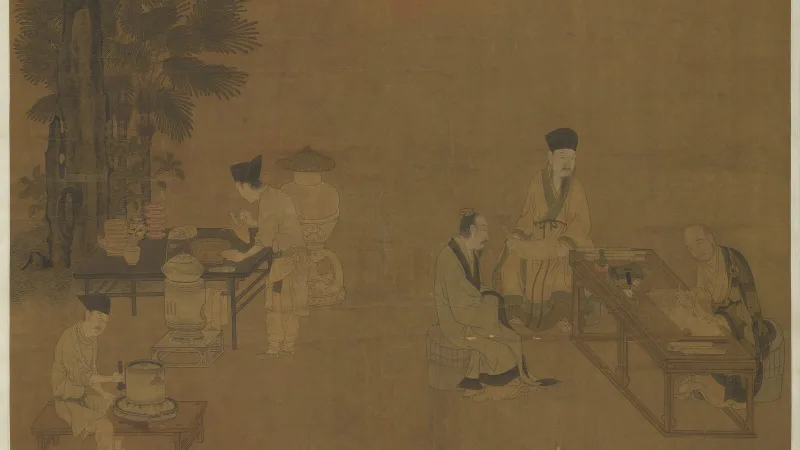
- Era:
- Song, 960–1279
- Material:
- pressed "yatuan" cake
- Birthplace:
- Jian'an, Fujian
- Equipment:
- dark bowl, ewer, whisk or spoon
- Key texts:
- Cha lu (1049–1053), Da guan cha lun (1107–1110)
- End in China:
- edict of 1391
Tang drinkers boiled their tea in a pot. Under the Song it was whisked, much as matcha is today. The method was called diancha (点茶), "dian" meaning to pour in small portions. Water goes in a little at a time, and between pours the tea is beaten with a spoon or whisk until the froth stands.
The raw material was still a pressed cake, but the way of drinking it changed. For the Tang way of boiling with salt and ginger, see Lu Yu and The Classic of Tea; for how it all ended, see the shift to steeped leaf.
From contests to court ritual
Diancha grew out of a local pastime. According to a Tang note by Feng Zhi, people in Jian'an, in northern Fujian, called a tea contest a "tea battle" (mingzhan). Song officials and monks took up the custom, and the region sent the court its best cakes.
In 1049–1053 Cai Xiang, a former transport commissioner of Fujian, wrote the Cha lu (Record of Tea) at the request of Emperor Renzong.1 It covers the equipment and the procedure. When the manuscript was stolen and printed with errors, he corrected the text and had it carved in stone in 1064. He notes that neither Lu Yu nor Ding Wei had written about actually preparing tea. The historian Shen Dongmei believes officials quickly switched to diancha after the Cha lu appeared.
The other key text is the Da guan cha lun (Treatise on Tea of the Daguan Era), attributed to Emperor Huizong. Sources date it either to "1107" or to the Daguan years, 1107–1110. Its twenty chapters cover everything from the weather at picking to drying, equipment and the seven pourings. Cai Jing records that in the twelfth month of 1120 the emperor himself poured the water and whisked tea for his ministers, and "white milk rose to the surface of the bowl like sparse stars and a pale moon".
How the tea was made
If a cake was old, it was first dried over a fire. It was then wrapped in clean paper, broken up, ground quickly and sifted, ideally twice. Freshly ground powder is white; left overnight, it turns dull. Fine powder floats, and that was the aim, since the froth forms from this light suspension.
The steps, following the Cha lu and the Da guan cha lun:
- Bring water to a boil in the ewer. If it is underheated, the froth floats about; if overheated, the tea sinks. The right moment was judged by ear: "past the second boil, just entering the third".
- Warm the bowl. In a cold one the tea will not rise.
- Add the powder ("one qianbi", a spoon-sized measure) and a drop of water, and work it into a smooth paste. Huizong says it should be "like melted glue".
- Pour in water in a circle and whisk until the water reaches "four parts" of the bowl.
The old texts give no weights in grams. One qianbi is about 2 g by the pharmacy measure, or about 0.6 g if it means the powder held by a single character on a coin. The sources themselves disagree, so any figure in a modern recipe is a reconstruction.
Huizong's seven pourings
Huizong divides the process into seven pours. In the first, water goes in a ring along the wall, not onto the tea. The paste is stirred first, then beaten with a light hand and a heavy whisk. The result is "sparse stars and a clear moon", the base of the froth. The second pour is quick and strong: the color comes up and the froth looks like scattered pearls. The third takes more water and steadier strokes. Now the froth resembles millet and "crab eyes", and the color is about six or seven tenths of the way there.
From then on there is less water each time, and the strokes grow wider and slower. By the fifth pour the froth is "like thickened mist, frozen snow". The sixth and seventh pours are for finishing: where the froth has clumped, smooth it; where it is thin, beat it. When it spills over the rim and stands still, it "bites the bowlbites the bowlYao zhan: the froth clings to the wall so tightly that it stands still and does not settle. The sign of a well-whisked bowl." (咬盏). The advice was to drink the light, floating part.
Faults have names too. "Jingmiandian" is a heavy hand with a weak whisk, so no froth stands. "Yifadian" is too much water at once and hard strokes, so the froth never sets.
Equipment
Huizong calls for a dark, blue-black bowl with even "jade hairs". White froth shows best against it, and its thick wall holds heat. The ewer needs a tight, drip-free spout that pours a thin, controlled stream. The powder was ground in a boat-shaped roller and sifted through a silk sieve.
At first the tea was whisked with a spoon. Cai Xiang wants a heavy metal one, ideally gold; ordinary people used silver or iron. Bamboo, he writes, is too light. The whisk is first mentioned by Huizong: old bamboo, a heavy handle, sparse springy tines with thin tips "like the spine of a sword". One museum researcher suggests the spoon was also given up because it scratches the bowl, but there is no proof of this.
In 1269 an author writing as Shen'an Laoren published the Cha ju tu zan, the first illustrated catalog of tea equipment. It names twelve objects as officials: the brazier is Wei Honglu, the sieve Luo Shumi, the bamboo whisk Zhu Fushuai. Each has a name, a courtesy name, a literary nickname and a verse of praise. The Chinese and English versions of the text disagree on what exactly lies behind Qidiao Mige and Tang Tidian, a stand or a ewer.
For the rest of the tea table, see utensils and ceramics.
Doucha: whose froth wins
Judges looked at two things: how white the froth was and how long it held against the wall. The first to show a "water markwater markShuihen: the trace of water that shows along the bowl wall when the froth pulls away. Whoever saw it first lost." (水痕) lost: the froth pulled back and a trace of water showed along the rim. Cai Xiang notes that with too little tea and too much water the "cloud feet" scatter, and with the reverse the surface tightens "like gruel".
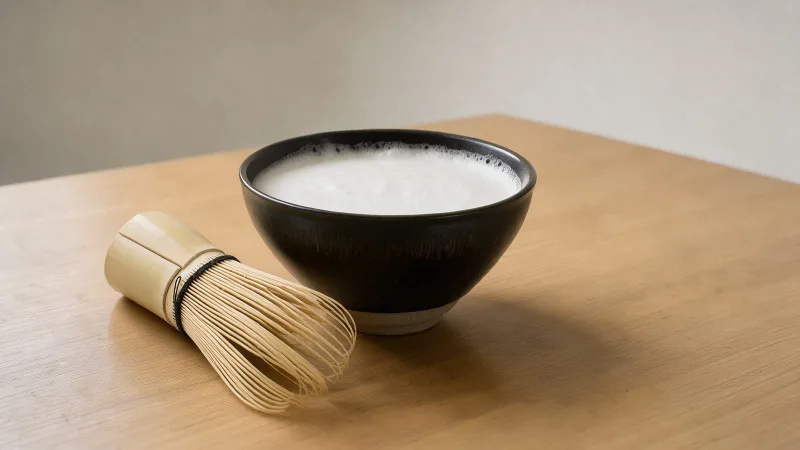
Whiteness comes down to the raw material: tender leaf, correct steaming, good pressing. Huizong ranks liquor color with pure white first, then blue-white, gray-white and yellow-white. His "white tea" was not the modern white type but a rare variety from wild bushes on Fujian cliffs, which yielded two or three pressed cakes a year.
Huizong also explains how to pick a cake. Thin paste gives a wrinkled surface, thick paste a dense one. A cake pressed on the day of picking is blue-violet; one pressed the next day is a gloomy black. A good one rings when struck. Fakes were around as early as the 12th century: finished cakes were re-pressed into other makers' molds, and persimmon leaves were mixed in. Whisked, such tea spread across the surface like light down and never formed millet-grain froth.
Contests were not only a Northern Song affair. The court painter Liu Songnian, active around 1174–1224, painted Tea Contest in a Tea Garden, showing a street doucha, and a scroll, Grinding Tea, in which one servant turns a stone mill, another pours water into a bowl, and a whisk and a celadon bowl sit on the table. On the Lianhua Peak cliff in Quanzhou an inscription of 1247 reads "came back from a tea contest". Some sources describe contests over color and froth staying power, others over taste, and both kinds existed side by side.
Pictures on the froth
Tao Gu's Qing yi lu records a 10th-century game he calls "a hundred tea games" (chabaixi). With a spoon, people drew birds, beasts, fish and flowers on the froth, and the picture soon blurred. According to the same text, the monk Fuquan could write a line of verse by pouring water, and a whole quatrain across four bowls. What "fencha" means is disputed: some see a picture on froth, others the serving of finished tea from a large bowl into small ones. Today the master Zhang Zhifeng of Wuyishan draws with plain water on dark froth and insists it is not latte art.
What came after
The method reached Japan with monks. Eisai (1141–1215) traveled to the Song twice, brought tea seeds home in 1191, and presented his Kissa yojoki to the shogun in 1214. Historians believe it was the Southern Song method, with the whisk as the main tool, that reached the islands. The Japanese tea ceremony and matcha are a separate story.
In China, diancha faded after Zhu Yuanzhang's edict. In the ninth month of 1391 he abolished "dragon cakes" as tribute and ordered leaf tea instead. Zhu Quan in the Cha pu (around 1430–1448) still whisks his tea, but from leaf, and by the time of Gu Yuanqing (around 1535) the bamboo whisk was used only for washing dishes.
Since the 2000s the method has been coming back. In 2005 Zhang Zhifeng revived "yatuan" production, and the chabaixi technique was entered in the Wuyishan city register (2010) and the Fujian provincial one (2017). The Jingshan tea banquet joined the national intangible heritage list in 2011. The group standard T/QGCML 1012-2023 sets rules for diancha contests in six disciplines, from speed whisking to drawing, and caps the seven-pour cycle at 15 minutes. It comes from a single trade association and is not a national standard.
Common questions
How is diancha different from Japanese matcha?
The two are related: both involve powder, a bowl, a whisk and froth. But Song powder came from a pressed cake, and the tea was not only green. Emperor Huizong ranked a "white tea" from wild Fujian bushes highest. Japanese practice descends from the Southern Song method that Eisai brought home.
Can diancha be recreated today?
Yes. People in China have been doing it since the 2000s, with powdered white, green or black tea, a warmed bowl, an ewer with a thin spout and a bamboo whisk. Song texts give no exact grams or temperatures, so modern figures are conventions.
What is chabaixi?
Pictures drawn on the froth. Modern masters draw with plain water on dark foam. The term is late, but the game is known from the 10th century.
-
Cai Xiang, Cha lu, text at the Chinese Text Project: https://ctext.org/wiki.pl?chapter=621539&if=gb. Other catalogs give the Huangyou years as 1049–1054. ↩