Ming and Qing: the shift to steeped leaf 明清
In the two centuries after the 1391 decree, Chinese tea went from frothed powder to leaf in a pot. The Ming wrote the rules of the new brewing; the Qing added the gaiwan and court porcelain.
- Period:
- 14th–19th centuries, Ming and Qing dynasties
- Turning point:
- 1391: Zhu Yuanzhang's tribute decree
- Key texts:
- Chalu (c. 1595), Cha shu (1597, printed 1607)
- Tea types:
- almost only green in the Ming treatises
- New tableware:
- teapot, white cups, gaiwan
- What faded:
- mill, whisk, black Jian bowls
In 1391 the first Ming emperor, Zhu Yuanzhang, ordered the court to stop making dragon cakes, pressed tea stamped with a relief pattern. Two hundred years later, Chinese writers were describing the teapot, the rinsing of the leaf and how many infusions to pour. Powder, mills and whisks had gone.
The 1391 decree
In 1375 the Hongwu emperor closed the Yuan tea bureau on Mount Guzhu in Zhejiang and demanded 2 jin of loose-leaf tea a year instead. The main decree came out on the 16th day of the ninth month of the 24th year of his reign, which is 1391, and was entered in the Veritable Records of Taizu.1 Making "large and small dragon cakes" is heavy labor for the people, it says, so production is to stop and Jianning is to send only buds of four kinds.
The reason is stated outright: officials extorted fees and bribes from 500 tea households exempt from corvée. Production at Beiyuan, the imperial "Northern Garden," withered after the decree.
This is easy to get wrong. The decree did not ban pressed tea altogether: cakes kept going to the border regions. Nor did it invent loose leaf, which was known under the Tang and Song but was ground as well. Historians disagree on whether the decree pushed the change along or simply recognized a practice that had long been widespread.
A century and a half of transition
Practice in the first half of the Ming was mixed. Ordinary people boiled or steeped the leaf, while the Jiangnan elite went on whisking powder with a bamboo whisk, as in Song whisked tea.
A good example is the Chapu of Zhu Quan, the 17th son of Hongwu. It is dated to around 1440, though scholarly estimates run from 1429 to 1448. Zhu praises loose-leaf tea "boiled to keep its nature." But in his account of a tea gathering he grinds the leaf to powder, puts a few spoonfuls in a large bowl and whisks. Taiwanese scholars read this as a transitional form. So Zhu Quan cannot be called the first to steep leaf: his text has no brewing in a pot.
By the 16th century, several methods coexisted even within one region. Around 1593 Chen Shi describes two: in Suzhou the leaf is boiled in a porcelain vessel until "crab eyescrab eyesThe first stage of boiling: small bubbles the size of a crab's eye form on the bottom and sides of the kettle. For Ming writers this is the herald of ready water, not the water itself.," in Hangzhou a pinch goes into a cup and boiling water is poured over it. That is pinch steepingpinch steepingA 16th-century method, 撮泡 (cuopao): a pinch of leaf goes into a cup and boiling water is poured over it. People still brew this way when there is no pot.. Chen Shi disapproves, because the flavor does not come out fully and the leaf is thrown away after one infusion.
The texts: how tea was brewed in the late Ming
Around the turn of the 17th century, treatises appear that set out the whole procedure. Zhang Yuan wrote the Chalu around 1595, Xu Cishu the Cha shu in 1597 (printed 1607), Wen Zhenheng the Zhangwu zhi, and Feng Kebin the Jiecha jian around 1642. In the scholar Zanini's view, Xu was the first to describe the new methods systematically, from his own experience rather than excerpts from older books.
Four things matter to tea, Xu writes: water, fire, kettle and pot. Lose any one and "everything falls apart." The best kettle is tin, and the best fire is hardwood charcoal, first burned red so the smoke is gone.
His pot is small, about "half a sheng." With a Ming sheng of 0.987 liters that is about 490 ml, and with Vogel's sheng (1.0737 liters) up to 540 ml. A gongfu pot today is several times smaller. The cups should be white and small: the emerald color of the liquor was prized, and Tu Long considers the black Jian bowls of the Song unsuitable. The best cups, in his view, are the white ones of the Xuande reign.
Pour boiling water into the pot and drop in the leaf at once, then cover. After "three breaths" pour everything into a cup and back into the pot to "shake up the aroma." After another "three breaths," serve the guests. A pot is good for two rounds: the first is fresh, the second sweet, and by the third it is over. The text gives no seconds and no grams. "Five fen" of tea for half a sheng works out to about 1.9 g if a fen is 0.1 qian, but that is our own calculation, and how to read the unit has not been settled.
For Xu Cishu, water is ready just past the "crab eyes," when a fine ripple runs over the surface. Boiling it hard until it goes quiet overheats it, and "the aroma is scattered." Zhang Yuan demands "fully ripened" water, "five boils," and explains why: under the Song, powder "floated" on young water, while whole leaf opens only in mature water.
Zhang also gives three ways of adding tea by season. In winter, tea first, then water (下投). In spring and autumn, half the water, the tea, then the rest (中投). In summer, water first, then tea (上投). Feng Kebin repeats the seasonal rule for Jie tea and adds a rinse of the leaf with hot but not boiling water. People still rinse the leaf today.
The Ming authors write almost only about green teas: Luojie from Changxing, Songluo from Anhui, Longjing, Huqiu and Tianchi from Suzhou. Jie tea, says Xu Cishu, is steamed rather than pan-fired: it is picked late and the leaf is coarser. There is no oolong in these texts.
The teapot and the first Yixing forms
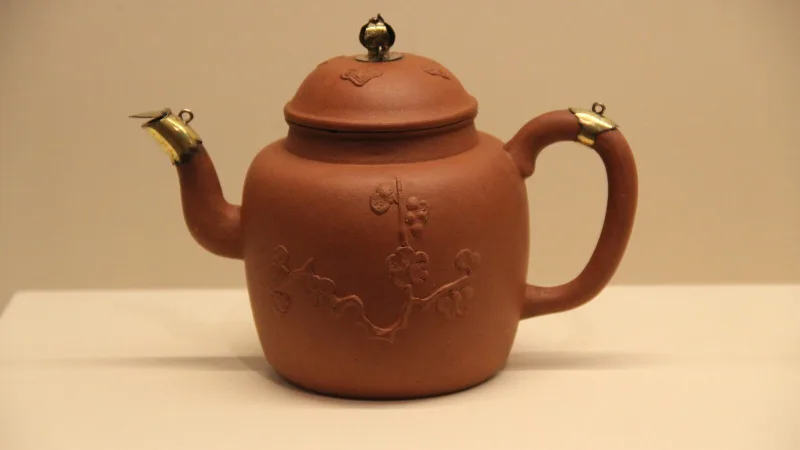
The early Yixing pot is often pictured as tiny. It was not. The earliest dated one was found in 1966 in Nanjing, in the tomb of the eunuch Wu Jing, buried in 1533: about 18 cm tall, coarse body, drips of glaze on its sides from neighboring wares in the kiln. Ming paintings show such pots right on the brazier, and the early clay bodies could take the heat.
The writers disagreed. Wen Zhenheng thought a clay pot the best of all, because it does not take away aroma. Xu Cishu valued the makers Gong Chun and Shi Dabin but ranked clay below tin and silver: it cools, turns sour, "falls short of tin by three parts." Feng Kebin called ceramic best and tin second. The claim that Ming literati unanimously set Yixing clay above everything does not fit the texts.
Yixing teaware and its potters went on to a history of their own. The small gongfu pot came later. In Chaozhou around 1800, Yu Jiao describes gongfu cha with a Yixing pot of "half a sheng at most" and even smaller cups. Japanese authors note that the early excavated pots are larger than today's oolong pots.
The Qing: the gaiwan and the court cup
The gaiwan, a bowl with a lid and a saucer, came into use once people began steeping leaf right in the bowl. Its origin is disputed. A Chinese design study places it in the Ming, the Hong Kong Museum of Art in the Kangxi era, and the China National Tea Museum adds that under Kangxi it was a lidded bowl without a saucer, with the full three-piece set spreading after Yongzheng.2 Lids came in two types: "heaven covers earth," wider than the rim and resting on top, and an inset one, smaller than the rim. The first slipped off and fell out of use; the second survives. How a gaiwan is built and how to choose one is a subject of its own.
The Qing court drank from pots and cups of porcelain, Yixing clay, metal and jade. Kangxi loved painted enamels, and in his reign they appeared on Yixing pots. Yongzheng ordered porcelain copies of Yixing forms from the imperial kilns. Qianlong had Yixing pots covered in carved lacquer.
In 1746 Qianlong composed verses on "Three Purities tea": plum blossom, pine nuts and Buddha's hand citron, steeped in melted snow, then a brew of Longjing. The same year, according to the Archive of Orders, cups modeled on a Jiajing cup, with the verses and a design on the bottom, were made for him at Jingdezhen. The surviving cup is 5.4 cm tall and 10.9 cm across, without its lid.
Ming and Qing beyond China
Ming brewing traveled to Japan with the monk Ingen (Yinyuan Longqi), who reached Nagasaki in 1654 with a party of about 30: roughly 20 disciples, 10 craftsmen and helpers, though the numbers in sources vary. Yixing pots have turned up in the debris of Nagasaki's 1663 fire. In Kyoto, sencha spread in the 18th century thanks to Baisao.
Europe bought porcelain from China. The Dutch bought it at Asian markets from 1602, ordered it at Jingdezhen from 1632, and from 1728 the Dutch East India Company bought directly at Canton. A single ship could carry more than 200,000 pieces; the porcelain went in as the bottom layer and kept the tea chests above it dry. Red Yixing pots were so rare that in the early 18th century Delft potters began to fake them.
The ship Geldermalsen left Canton on December 18, 1751, with 203 chests of porcelain and 686,997 pounds of tea, and sank near Batam in January 1752. Of the 112 people aboard, 80 died.3 The cargo, a cross-section of Qing tea life, was raised from the seabed in 1985.
Common questions
Did the 1391 decree invent loose-leaf tea?
No. Loose leaf existed under the Tang and Song, but it was ground too. The decree concerned only tribute to the court: buds were to be sent instead of dragon cakes. Historians disagree on whether it started the shift or simply recognized a habit that had already spread.
When did the gaiwan appear?
Sources disagree. A Chinese design study places the lidded bowl in the Ming; the Hong Kong Museum of Art and the China National Tea Museum place it in the Kangxi era (1662–1722). According to the Hangzhou museum, under Kangxi it was a lidded bowl without a saucer, and the three-piece set spread after the Yongzheng reign.
How did Ming brewing differ from today's?
The pot was several times larger than a gongfu pot, about 490 ml, very little leaf went in, the leaf was rinsed, and the order of adding tea and water changed with the season. The treatises mostly describe green tea; tea from Wuyishan shows up in descriptions only around 1800.
-
Steven D. Owyoung, "Emperor Ming Taizu & The Abolition of Caked Tea", Global Tea Hut, April 2017. The date of the decree and the names of the varieties match the entry in the Xu wenxian tongkao. ↩
-
China National Tea Museum (Hangzhou), entry on a Guangxu-era gaiwan; Hong Kong Museum of Art, K.S. Lo Collection. ↩
-
Rijksdienst voor het Cultureel Erfgoed, "Geldermalsen". The wreck date of January 3, 1752 is from the Nationaal Archief. ↩