Tea tray (cha pan) 茶盘
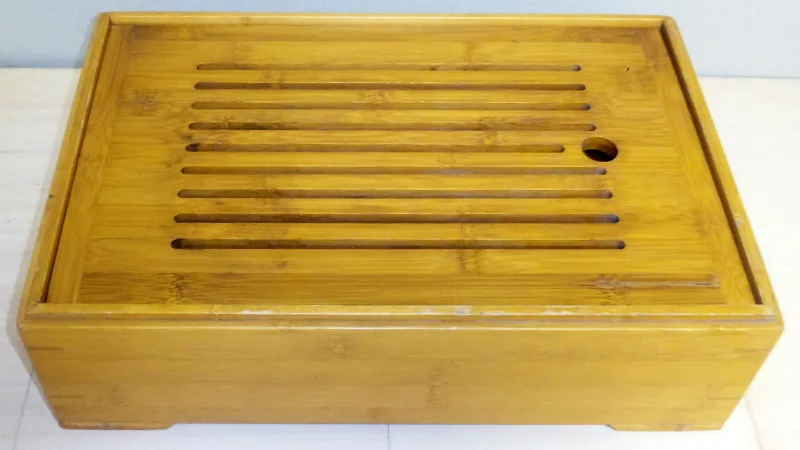
A grate over a basin, big enough for all the teaware for gongfu cha. Water from warming the teaware and rinsing the leaf drains away, you can pour over the teapot, and the table stays dry.

- Translation:
- “tea tray”
- Design:
- grate over a basin
- Drainage:
- into a pull-out drawer or by hose to a bucket
- Material:
- bamboo, wood, stone, porcelain, metal
- Cup tray in the standard:
- 15–22 cm across, 2–5 cm high
- Care:
- dry it after every session
A cha pan (茶盘), or tea tray, is a board over a basin where you set out the teaware for gongfu cha. The top is a grate or slats over a water reservoir. It catches the boiling water used to warm the teaware, the rinse, the dregs of each infusion and the water you pour over the outside of a Yixing teapot.
The character 盘 means “dish, tray”, so cha pan is literally a tea tray, and that is what this site calls it.
Tray, tea boat, pot stand
Three objects are easy to mix up, and shops often treat them as one. Each does a different job.
- The tea tray holds the whole wet side of the setup. In its “wet” form the top is a grate, and water runs into a basin or down a hose.
- The tea boattea boatA deep bowl (cha chuan) you set the teapot in and can fill with hot water. The oldest and smallest form of the tea tray., cha chuan (茶船), is a deep bowl. You set the teapot in it and can douse it with boiling water. This is the oldest and smallest form.
- The pot standpot standA shallow dish or bowl under the teapot (hucheng) that catches drips from the spout, water from the lid and steam from the base., hucheng (壶承), is a shallow dish or bowl under a teapot or gaiwan. It catches drips from the spout, water from the lid and steam from the base. Water from warming and rinsing goes into a separate bowl, called jianshui (建水) or shuiyu (水盂). In Japan a similar vessel is called kensui, familiar from the tea ceremony.
A stand is worth having with or without a big tray, and on a dry table it does most of the work of keeping water in check.
Where the board came from
In Chaozhou, where gongfu cha took shape, there was no big board. The China Tea Science Society group standard T/CTSS 5-2019 describes a different set. Its 茶盘 is an open, shallow porcelain dish 15–22 cm across and 2–5 cm high, with three cups arranged on it in the shape of the character 品. The teapot sits on a separate stand 4–5 cm high, on a loofah pad, and water goes into three bowls to the brewer’s left and right. Everything runs in one line out from the brewer1.
In his Chaozhou Tea Classic (1957), Weng Huidong wants such a tray wide enough for four cups, with a flat bottom and a low rim. He rates blue-and-white porcelain from the official kilns of Raozhou highest, followed by Longquan and white Ding ware.
The modern tea tray started in Taiwanese tea shops. According to Cai Rongzhang, trays grew from 20 to 40 cm across in the late 1970s and early 1980s, and they were made of stainless steel and plastic. In 1982 the Lu Yu Tea Center in Taipei brought out a tea cart with a shallow tray set into the tabletop, a drain hole in it and a metal drawer beneath. People kept pouring water wherever they liked, and the wooden tray could not take it. Lu Yu’s small-teapot school stopped dousing the teapot and drained into a small bowl instead, and two-tier trays gave way to shallow single-tier ones: carved wood, stone, porcelain, or just a piece of cloth2.
Later, shops that brew all day filled up with carved boards and stone trays with a hose to a bucket. Cai sees this as a step away from the original idea. Dry brewing reached the mainland from Taiwan, and a Shanghai shop owner told Vice that trays and tea tables sold worse afterward. When dry brewing appeared is disputed: the 1980s according to Cai, the early 1990s according to Vice.
Drainage: drawer, hose or dry brewing
On a tray with a drawer, water runs through the grate into a basin or pull-out drawer. You need no hose or bucket, so you can set it on a work desk and put it away after the session. Capacity is limited, though, and if you pour generously over the teapot you will have to empty the drawer mid-session.
A hose tray has a single layer. An outlet with a fitting in the bottom feeds a tube that runs to a bucket under the table. You can pour as much as you like, but once set up, the tray stays put. Keep an eye on the bucket and keep the hose free of kinks. Don’t shake spent leaf onto the grate, or it will clog the tube.
The third way is gan paogan paoDry brewing: you neither pour over nor soak the teapot, and waste water goes into a small bowl. No big tray is needed., “dry brewing”. According to Cai, you fill the teapot to about 90 percent rather than to overflowing, so you don’t wash the foam off the surface, you neither pour over nor soak the pot, and if you warm the cups, you do it outside the boat. A small bowl is then enough for both the warming water and the squeezed-out leaves. People brew this way when traveling or at a cramped table.
Not every tea calls for pouring over the pot. The Chaozhou standard keeps it for oolongs brewed with boiling water, above all Feng Huang Dan Cong. For lightly roasted oolongs and for white tea in a gaiwan, many people skip it. Cai makes the same point: some teas are brewed below boiling, so there is no reason to douse the pot. People still argue over whether dousing warms the liquor. In the thermometer readings Cai cites, soaking the teapot in hot water does not warm the tea inside.
Materials
Bamboo
Bamboo is the most common and cheapest material: a glued slab, light and warm to the touch. The weak point is the glue seams. Neglected, they dry out and split, and mold settles in the grooves. Bamboo trays have their own industry standard, LY/T 2982-2018, developed in Zhenghe County, Fujian. When buying, check that the drawer slides out freely and that there is no sharp smell.
Wood
Russian shops find that pear and bamboo dry out and rot faster, while wenge, beech, ebony and rosewood last longer. Near a radiator or in direct sun, wood dries and cracks. Wipe the board dry after a session and skip hard brushes and abrasives: they strip the finish, and the wood underneath starts to rot. In a room with a wood or bamboo tray, keep humidity at 40 percent or more.
Tea tables with a carved drain are a genre of their own. They take up as much room as furniture and cost about as much.
Stone
Stone trays are usually sold as “wujin stone” (乌金石), a black stone. That is a trade name, not a rock type: granite, basalt and other black stones from different provinces all go under it. Ask the seller what the rock is, where it was quarried and how the surface was treated. A black color doesn’t prove the stone is natural, since dyed, waxed and resin-soaked stone turns up too.
A stone tray is heavy, and that is a plus: it doesn’t slide across the table when you pour. Porous stone soaks up tea, and the stains won’t come out. Chinese reference books advise rubbing the tray with tea so a patina (包浆) builds up over time, while a maker in Xiamen warns that stains on porous stone are permanent. The choice is yours: grow an even color, or buy treated stone.
Porcelain, ceramic, plastic
Under group standard T/GDCZCYXH 002-2022, a Chaozhou porcelain tray absorbs no more than 5 percent water and survives a drop from 160 to 20 °C. A good tray sits steady on a flat surface, with no crazing, chips or through cracks. Never heat it empty. Pot stands are most often made of coarse ceramic, in brown, yellow and black tones.
Plastic needs the most caution. Melamine resin sold as bamboo does not break down in nature, and with hot liquid it releases melamine and formaldehyde3.
Choosing a size
The board has to hold the brewing vessel, the fair cup and the cups, with room left over for pouring off. Weng Huidong measured width in cups: four of them must fit. If the cups end up at the very edge, the board is too small. Go wider for company and smaller for yourself, and choose by the teaware rather than by looks.
Three quick checks when buying:
- set an empty cup on the grate and nudge it with a finger: it must not rock;
- pull out the drawer: it should slide without catching;
- sniff it: a sharp smell means bad glue or plastic.
With a gaiwan you need a big tray less often than with a Yixing teapot, since a gaiwan is filled from above and not poured over.
Care
After a session, take the teaware off, wash the leaves off the grate, empty the drawer or bucket and rinse it. Let the board dry in pieces, with the grate off and the drawer pulled out. Water left overnight in the basin turns slimy and starts to smell. Flush the hose with hot water once a week. Stands with holes collect tea and limescale deposits and small leaf bits, so give them a more thorough wash.
Use a soft cloth and baking soda on tea stains. Dark specks in the grooves of bamboo are mold: scrub the board and dry it longer, and if the spots come back, replace it. For everything else, see caring for teaware.
Never carry the tray with the teaware on it: water sloshes in the drawer, the grate shifts, and the cups end up on the floor. Take off the teapot, fair cup and cups first, then carry the board away.
Common questions
Cha pan, chaban or tea tray: which is right?
In pinyin 茶盘 is written chá pán, and that is the standard spelling. You will also see “chaban”, the form common in the Russian tea trade, while English-speaking shops simply say tea tray. The character 盘 means “dish, tray”, not “board”, as some shops explain it.
Can I do without a tea tray?
Yes. For dry brewing, set the teapot on a shallow stand and pour the water from warming and rinsing into a small bowl; the whole setup fits on a cloth. You still want the stand, since drips from the spout and lid land on it.
Does “bamboo” plastic stand up to boiling water?
No. A tray labeled bamboo is often melamine resin with bamboo filler. Germany’s BfR warns that with hot liquid it releases melamine and formaldehyde and breaks down over time. For boiling water choose glued bamboo, wood, stone or porcelain.
-
T/CTSS 5-2019, “Technical Regulations for Chaozhou Gongfu Tea” (潮州工夫茶艺技术规程), China Tea Science Society, published 18 Dec 2019, in force 21 Dec 2019. Standard record. ↩
-
Cai Rongzhang, “A history of tea-brewing trays” (泡茶盘变迁史), 27 Jun 2012: contemporaryteathinker.com. ↩
-
BfR, “Questions and answers on tableware and kitchen utensils made of melamine-formaldehyde resin”, 25 Nov 2019: bfr.bund.de. ↩