Tie Guan Yin 铁观音
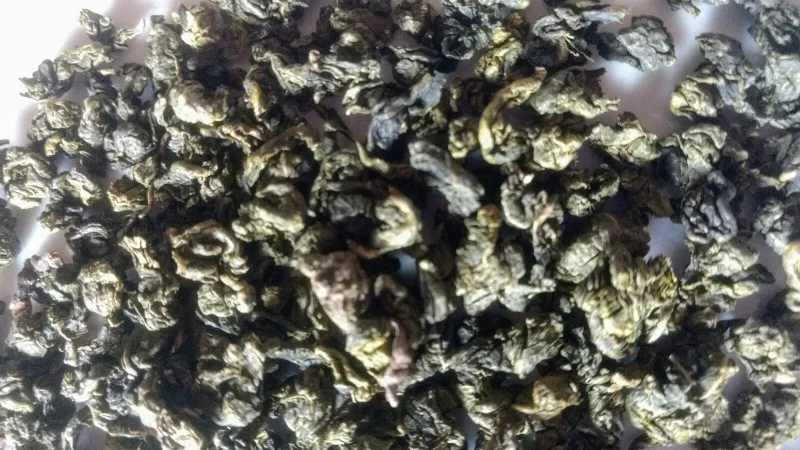
The best-known oolong of southern Fujian. Its leaf is rolled into tight balls that unfurl into whole leaves in the gaiwan. The flavor depends on the style: fresh Tie Guan Yin smells of orchid, roasted of nuts and honey.

- Province:
- Fujian, Anxi County
- Oxidation:
- light to medium
- Plucking:
- shoot tip with 2–3 mature leaves
- Leaf shape:
- tight balls with a short stem tail
- Styles:
- qing xiang (fresh) and nong xiang (roasted)
- Taste:
- orchid and cream; roasted: nuts, honey
Tie Guan Yin (铁观音) translates as “Iron Goddess of Mercy”, after the bodhisattva Guanyin. The dry oolong looks like dark green pellets: tight balls, each with a short stem tail. In a gaiwan they swell until, by the third infusion, they push up the lid.
Anxi
Tie Guan Yin comes from Anxi County, in the hills northwest of Quanzhou. Xiping township is held to be the cultivar’s birthplace, and Gande and Xianghua are well known too. The bushes grow on terraced hillsides, in fog and poor red soil. Anxi growers prize two harvests: spring, for its fuller taste, and autumn, the most aromatic.
Two legends tell where the bush came from. In one, a farmer looked after an abandoned temple of the bodhisattva Guanyin, and in a dream she showed him a bush growing by a rock. In the other, a scholar presented the tea to the Qianlong Emperor, who named it for its leaf, heavy as iron, and its beauty, worthy of Guanyin. The name covers both the cultivar and the tea made from it, though oolongs from other Anxi cultivars are often sold under it too.
How the leaf is rolled
Oolong calls for more mature leaf than green tea. Pickers wait until the shoot has opened and take the tip with two or three leaves.
Workers wither the leaf in the sun, then in the shade, and shake it several times in bamboo drums. Shaking bruises the edges, which oxidize while the center stays green. Once the grassy smell turns floral, the leaf is fixed in a hot drum.
Then comes the rolling that makes Tie Guan Yin recognizable at a glance. The method is called bao roubao rouCloth rolling: the hot leaf is wrapped tightly in a cloth knot and rolled, then unwrapped and rolled again. This is how the leaf curls into a tight ball.. Workers wrap the hot leaf in cloth, twist it into a tight knot and roll it on a table or in a machine. They untie the knot, break up the clumps, dry the leaf a little and wrap it again. They repeat this many times, and each round squeezes the leaf harder until it curls into a tight ball. Taiwanese makers use a similar method to roll Dong Ding into half-balls.
Fresh and roasted styles
For a long time Tie Guan Yin was oxidized to a medium degree and always roasted over charcoal. In the 1990s the market fell for the fresh style, qing xiang (“pure fragrance”). It is less oxidized and barely roasted, with bright green leaf, a pale yellow liquor and an aroma of orchid and creamy sweetness. Fresh tea loses its aroma quickly, so it is packed in 7–8 g vacuum sachets and kept in the fridge.
For the roasted style, nong xiang (“strong fragrance”), the leaf spends hours over charcoal or in an electric oven, sometimes in several rounds. The leaf darkens to brown, the liquor turns amber, and the taste shifts to roasted nuts, honey and caramel. Roasting drives out the last moisture, and this tea keeps for years, slowly mellowing. In character it is closer to Wuyi oolongs such as Da Hong Pao and Rou Gui, only lighter and more floral.
In both styles connoisseurs look for guanyin yunguanyin yun“Guanyin rhyme”: the long, sweet aftertaste by which connoisseurs recognize a good Tie Guan Yin., a long aftertaste of floral sweetness that comes back to the throat a minute after you swallow.
How to brew
Brew Tie Guan Yin gongfu cha style: lots of leaf, little water, short infusions. A 100–110 ml gaiwan takes 7 g, exactly one vacuum sachet. Fresh tea wants water at 90–95 °C; roasted tea, a full boil.
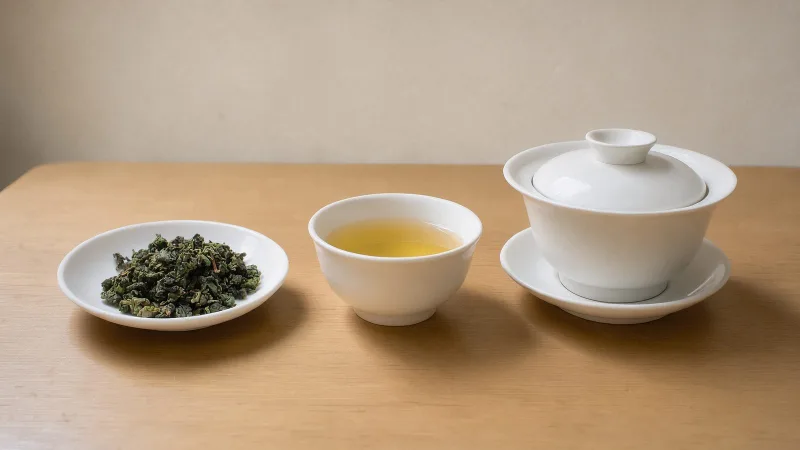
Warm the gaiwan, add 7 g of tea, pour in water and drain it at once: the balls will start to open. Steep the first infusion for 20 seconds, and each one after that 5–10 seconds longer. Pour every drop into a fair cup so the leaf doesn’t sit and stew. A good Tie Guan Yin holds up for 7–9 infusions.
Roasted tea brews well in a Yixing teapot. The thick clay holds heat, and the dense roasted leaf needs it.
After the session, unfold a couple of leaves. Traditional Tie Guan Yin shows a reddish rim around a green center, the mark left by shaking in the drums.
Common questions
How is qing xiang different from nong xiang?
Qing xiang is lightly oxidized and barely roasted. It is green and floral and keeps for a few months, best in the fridge. Nong xiang is roasted over charcoal or in an oven: the leaf is dark, the taste nutty and honeyed, and it keeps for years without refrigeration.
How many times can you steep Tie Guan Yin?
In a gaiwan at 7 g per 100 ml, a good tea lasts 7–9 infusions. When the leaf has fully opened and the liquor turns watery, the tea is done.
Should I pour off the first infusion?
A short rinse of 3–5 seconds helps the tight balls open, and the first real infusion comes out more even. You can drink the rinse; it is simply weaker.