Zheng Shan Xiao Zhong 正山小种
China's oldest black tea, known in the West as Lapsang Souchong, comes from the village of Tongmu in the Wuyi Mountains. The classic leaf is withered and dried over pine-wood smoke, and the liquor smells of resin and dried longan. The unsmoked version smells of honey and fruit.
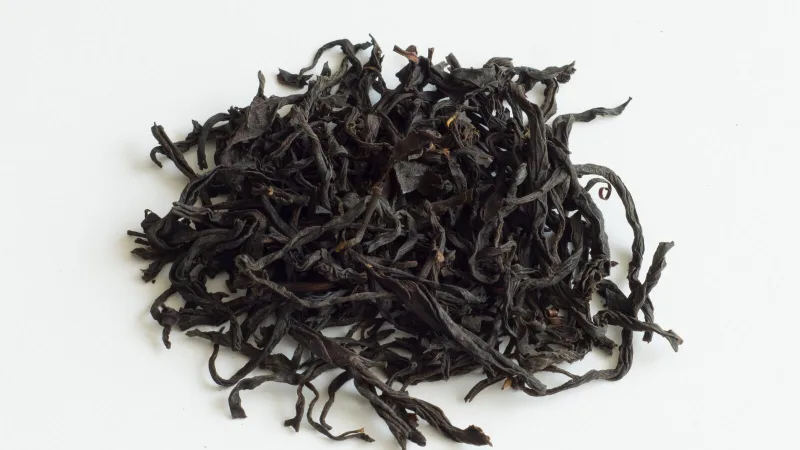

- Province:
- Fujian, Wuyi Mountains, Tongmu village
- Made since:
- late Ming dynasty, by tradition
- Raw material:
- bud with two or three leaves
- Processing:
- withering and drying over pine smoke
- Dry leaf:
- tight black strips with a sheen
- Liquor:
- pine smoke, dried longan, honey
Zheng Shan Xiao Zhong (正山小种) means "small variety from the true mountain". Xiao zhong is the old name for a group of black teas from the Wuyi Mountains in northern Fujian. Zheng shan, "the true mountain", refers to the historic zone around the village of Tongmu. Tea from outside it is called wai shanwai shan外山, "outer mountains": tea grown outside the historic zone around Tongmu. It is sold as xiao zhong or smoked xiao zhong, without the words "zheng shan"., "outer mountains".
The tea reached Europe as Lapsang Souchong. The second word grew out of "xiao zhong", and in the English trade souchong also became the name of a leaf grade. Accounts of where "Lapsang" comes from differ; in China the name is written 立山小种.
Tongmu
Tongmu is a mountain village in Xingcun Township of Wuyishan city, near the Tongmuguan pass on the border with Jiangxi. It has been part of the Wuyishan Nature Reserve since 1979, and since 2021 it has sat in the core zone of the national park. A checkpoint guards the road into the valley, and tourists without an invitation are turned back.
The bushes grow singly and in clumps on steep slopes among bamboo and forest, and locals call them wild. The climate is cold and damp, with more than 2000 mm of rain a year and fog on more than a hundred days. The spring harvest runs from April to June. For the classic grade, pickers wait for the shoot to grow out and take a bud with two or three leaves.
The same mountains produce the rock tea Da Hong Pao, but Tongmu lies deep inside the reserve. Rock oolongs are roasted over charcoal; in Tongmu the leaf meets fire while it is still raw.
A tea born of smoke
No record of the first batch survives. The best-known legend dates it to 1646, when Qing troops were finishing off the last Ming loyalists. Soldiers occupied the village, the fresh leaf sat in sacks longer than it should have, and to save it the villagers dried it hastily over pine fires. Dutch merchants bought the oddly scented tea and came back for more. In another version the soldiers are Taiping rebels of the mid-19th century.
The prosaic explanation is simpler. The damp valley gets little sun for drying and has plenty of pine on its slopes, so people dried the leaf over fire.
Either way, China regards Zheng Shan Xiao Zhong as the first black tea. The Wuyi technique gave rise to the gongfu hong cha of Fujian and later to Anhui's Qimen.
Pine smoke
Traditional Zheng Shan Xiao Zhong is made in a qing louqing lou青楼: a wooden house of three or four stories with a firebox at the bottom and slatted floors where the leaf is withered and dried over pine smoke., a wooden house of three or four stories blackened inside by soot. Masson pine logs smolder in a firebox at the bottom, and the floors above are slatted gratings of poles.
Makers spread the fresh leaf a few centimeters deep on bamboo trays and wither it in warm smoke at about 30 °C, turning it every 20–30 minutes. Then they roll it and pack it into baskets under a damp cloth to oxidize. Next comes a step other black teas lack, guo hong guoguo hong guo过红锅, "passing through the red wok": a brief toss of the oxidized leaf in a red-hot wok before the second rolling.: the oxidized leaf goes into a red-hot wok and is tossed for a few minutes. After a second rolling it dries over pine smoke for 8–12 hours.
So the leaf takes smoke twice, before oxidation and after. The sweet note of dried longan, guiyuan, takes time to appear. In Tongmu they say it arrives once the tea has rested until the following year.
Bringing pine into Tongmu has been banned since 2019 to protect the national park's forests from the pine wood nematode. Makers burn old stocks of logs and trying briquettes of pine sawdust and resin, but they say the flavor is not the same1. The village makes less smoked tea every year.
Smoked and unsmoked
Under the geographical indication rules, Zheng Shan Xiao Zhong comes in two kinds. The smoked kind has black, glossy dry leaf, a red-brown liquor and a flavor of pine smoke and dried longan. The unsmoked kind has dark brown leaf, a bright red liquor and a sweet flavor of honey and fruit.
The unsmoked version appeared in Tongmu in the early 2000s. China now drinks more of it than of the smoked kind, while the West still thinks of Lapsang above all as a smoky tea.
Smoky Lapsang from a shop is often made far from Tongmu. This wai shan tea is frequently smoked after processing, over a smoky fire, so its smoke is harsher, with a note of tar. Good smoked Zheng Shan Xiao Zhong smells of pine and resin, with sweetness and fruit beneath the smoke.
Since 2005 buds from the same Tongmu bushes have also gone into Jin Jun Mei, made without smoke.
How to brew
This tea likes hot water and plenty of leaf. A porcelain gaiwan works well because it won't absorb the smoke. A clay Yixing teapot holds on to the scent of pine for a long time, so keep a separate one for smoked tea.
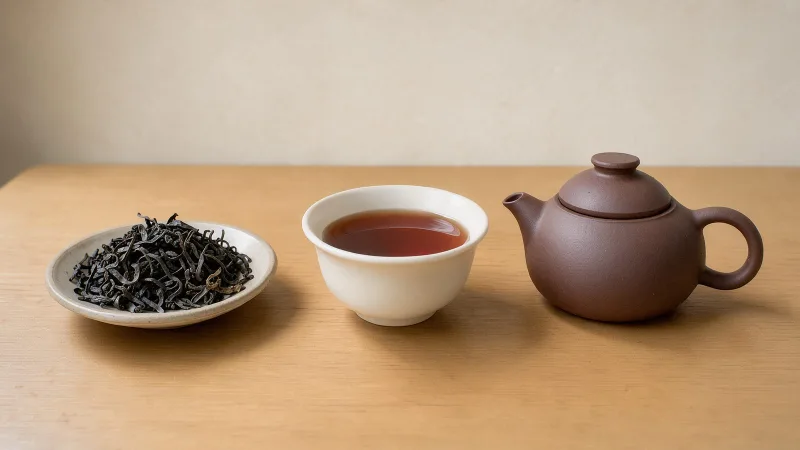
5 g of leaf per 110 ml, water at 95 °C (203 °F). Pour off the first infusion after 5 seconds, then go 10, 15 and 20 seconds, a little longer each time. The leaf lasts 5–7 infusions: the smoke fades first, leaving longan and honey at the end. For a single long steep in a teapot, use 3 g per 250 ml for 3–4 minutes.
Smoked Lapsang stands up to milk, and cooks add it to broths and marinades for the smoke. The unsmoked version is better straight, gongfu cha style.
Store it apart from other teas in a tightly closed jar, because pine smoke passes easily to its neighbors.
Common questions
Are Lapsang Souchong and Zheng Shan Xiao Zhong the same tea?
Lapsang Souchong is the Western name for this tea. In the West, though, the name almost always means a heavily smoked tea, often not from Tongmu. Zheng Shan Xiao Zhong is tea from the historic zone around Tongmu, smoked or unsmoked.
Is there Zheng Shan Xiao Zhong without smoke?
Yes. Since the early 2000s Tongmu has made an unsmoked version, dried without pine smoke. Its liquor is bright red and tastes of honey, flowers and fruit. In China people now drink it more often than the smoked kind.
Why does Lapsang smell of rubber?
Usually the culprit is crude smoking: cheap finished leaf smoked fast and hard. In a good smoked tea the smoke is resinous and sweet, with dried longan underneath.
-
Reply of the Fujian Provincial Forestry Administration to deputy's proposal No. 1351 on buying pine for Tongmu, 2022; report "Pine banned in the birthplace of black tea", West China City Daily, 13 October 2022. ↩