Russian tea drinking: zavarka, glass and sugar in the teeth
Russians drink tea in two steps: a strong concentrate from a small pot, then boiling water from the samovar. Tea arrived from Mongolia in 1616–1638 and became a mass drink in the second half of the 19th century.
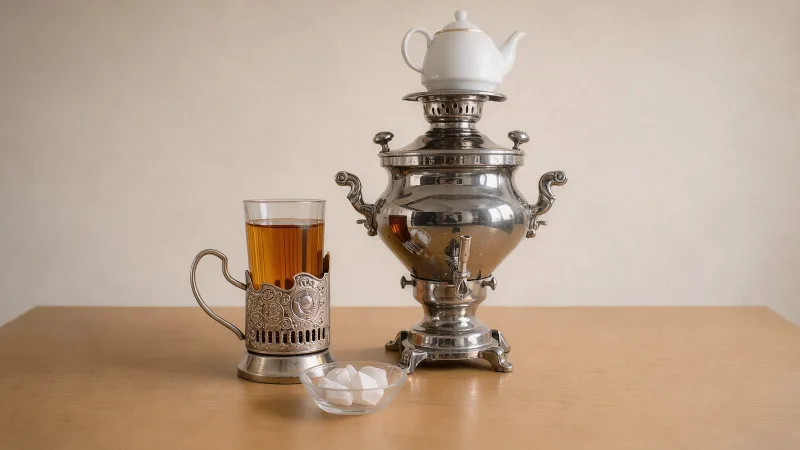
- Arrival:
- from Mongolia, 1616–1638; later via Kyakhta
- Method:
- concentrate in a pot, diluted with boiling water
- Vessels:
- samovar, cup and saucer, glass in a holder
- Sugar:
- in the teeth on weekdays, in the tea on holidays
- Mass drink:
- second half of the 19th century
- Home-grown tea:
- Georgia and Krasnodar, from the 1880s
Russia has its own way with tea, unlike either China's or Britain's. The hostess pours a little dark concentrate into the bottom of a cup and tops it up with boiling water from the samovar, and then come sugar, jam and an hour of talk. The custom grew out of trade, climate and the habit of drinking tea to keep warm.
From Mongolia to Moscow
Audra Yoder names the envoy Vasily Tyumenets as the first Russian to drink tea: in 1616 a Mongol khan served him a drink of “unknown leaves”. In 1638 Altyn Khan sent 200 packets of tea for Tsar Mikhail Fyodorovich with the envoy Vasily Starkov, who tried to decline them as useless in Moscow.1 At three quarters of a pound a packet, that comes to about four poods, a little over 60 kg.
Until the end of the 17th century tea counted as medicine. Samuel Collins, physician to Tsar Alexis, noted in 1671 that tea came from Siberia and that merchants drank it with sugar for lung complaints. Two years later the Swede Kilburger saw it in a Moscow market at 30 kopecks a pound.
Kyakhta and the Great Tea Road
After the treaties of 1689 and 1727, trade moved to the border settlement of Kyakhta, with the Chinese town of Maimachen opposite. Textiles led at first, and tea only took first place after trade resumed in 1792. The market was closed ten times. In 1762–1768, 1778–1780 and 1785–1792, while it was shut, tea came by sea through St. Petersburg, and the poor drank herbal substitutes.
Shanxi merchants ran the Chinese leg, from Wuyishan through Hankou, Kalgan and Urga. The whole route to St. Petersburg is now called the Great Tea Road, some 13,000–14,000 km depending on the source. In Kyakhta, men called savoshniki opened the tea, and teams of stitchers sewed the chests (tsibiki) into raw hide so they would survive the winter road. The trip to Moscow covered about 11,000 km and took half a year, and tea in Russia cost 10 to 12 times the European price.
European Russia drank black loose-leaf tea from Wuyishan, later from Hunan and Hubei, while Siberia drank brick tea. Once the Trans-Siberian opened (1905), tea from Hankou went by sea to Vladivostok and Odesa, and the caravan road withered. In the early 20th century a Briton drank more than 6.5 times as much tea as a Russian.
Zavarka, the samovar and the white key
In the classic 19th-century setup, boiling water came from the samovar and a small teapot sat warming on its top ring. The ring also kept the pot dry and warm, as it has to be before the leaf goes in. The hostess, or the eldest unmarried daughter, poured a little zavarka into each cup and thinned it from the tap.
In his book Tea, Vilyam Pokhlyobkin describes a stricter order. He considered dilution a distortion born of thrift, and the tavern “pair of teapair of teaA tavern order (para chayu): a large pot of boiling water, a small pot of concentrate and two or three lumps of sugar. Hot water refills were free.” struck him as more of the same. In 19th-century homes, though, dilution was the norm, not a flaw.
Rinse a porcelain pot with boiling water 3–4 times or warm it on the samovar ring; never put it empty on a flame. Use water at the “white keywhite keyThe second stage of boiling (belyi klyuch): fine bubbles rise from the bottom, but the water is not yet at a rolling boil. This is the water for zavarka; overboiled water is not used.”, the second stage of boiling. Overboiled water is out. Add the leaf, fill the pot halfway and cover the lid and spout with a linen napkin. Padded cozies are forbidden, since they make the tea “stew”. Steep 3.5–4 minutes in soft water and longer in hard water, where the aroma opens up by minute 7–8. Top up with boiling water, leaving 0.5–1 cm below the lid, and drink within a quarter of an hour.
The “old Russian norm” is about 25 g per 1 L pot. Pokhlyobkin brews green tea differently: a first pour to a quarter of the pot for 5–8 minutes, then a second and a third. The whole scheme is built for black tea, and Pokhlyobkin himself writes of mediocre Indian and Georgian tea from which the zavarka has to be “squeezed out”.
Glass, saucer and sugar
People often mistake these habits for etiquette, but they belong to everyday life. In merchant Moscow men drank from glasses and women from cups and saucers. The saucer was for cooling, since water from the samovar is hotter than water from a pot. The 1881 manual Good Tone calls pouring tea into the saucer “positively indecent” and forbids blowing on it, so “tea from the saucer as Russian etiquette” is a myth. It was a merchant and small-town custom.
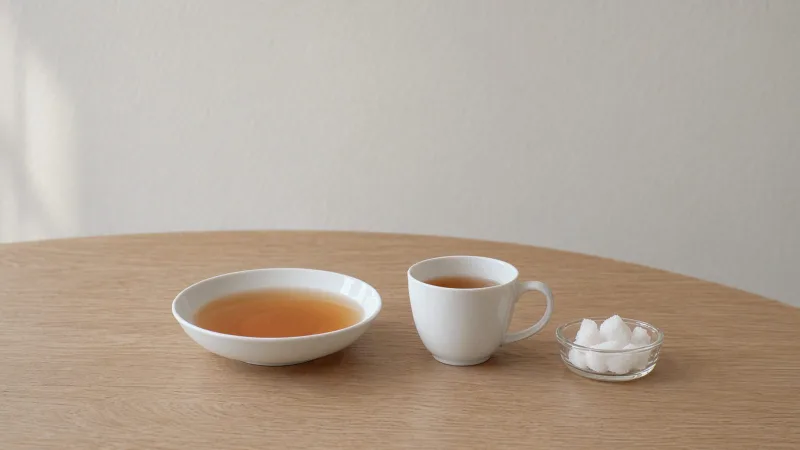
Sugar was sold by the loaf, a bluish cone of about 5–6 pounds, broken up first with a hammer and then with tongs. In a petty-bourgeois family in Yelets people drank tea vprikuskuvprikuskuDrinking tea with sugar held in the teeth: you keep a lump in your mouth or bite one off and leave the tea unsweetened. Sugar stirred into the cup is “vnakladku”. on weekdays and with sugar in the cup on holidays, two or three cups each, sipped from the saucer. A cup turned upside down on its saucer meant “enough”.
The glass holder predates the railways. Brass ones were made at the Tula arms factory, and in the later 19th century the jewelers Khlebnikov, Ovchinnikov, Sazikov and Fabergé took them up. No documents back the story that Witte introduced them on trains in 1892. What is certain is that conductors on the Siberian train served tea in the carriages from 1898. Until 1946 passengers ran to station boilers (kubovye) for hot water.
The Soviet holder was made to a standard: inner diameter 68–69 mm, body 65–85 mm tall, cupronickel or nickel silver. A faceted glass holds 200 ml to the rim and 250 to the top. The legend of Mukhina and of 16 facets for the 16 republics fails a simple check: semi-automatic presses stamped 12- and 20-faceted glasses too, and a museum in Vladimir holds 10-, 12- and 16-faceted ones.
Taverns, merchants and porcelain
An 1822 decree allowed taverns to sell tea from 7 a.m. to midnight. Under Alexander II came alcohol-free tea houses on cheap leases, open from 5 a.m. People ordered a “pair of tea”: two pots and two or three lumps of sugar. That made 5–10 cups, and refills of hot water were free. A copper “side-handle pot” with a long spout let the waiter refill cups over the shoulders of seated guests.
In Moscow tea was a ritual: people sat at the samovar for hours over pies, jam and pickled apples. Alexei Perlov opened a shop in 1787, and his sons won a law requiring tea to be sold in packets with the firm's name and the packing date. By 1913 the largest share capital belonged to Kuznetsov and Co. and V. Vysotsky and Co., 10 million rubles each.
The merchant's tableware came from the Kuznetsovs. Terenty Kuznetsov founded a factory near Dulyovo in 1832, and in 1892 Kuznetsov bought the Gardner factory with its models and designs. Dulyovo's sweeping rose painting got the nickname “agashka”. A Gardner mark on a piece does not prove it predates 1892, because the Kuznetsovs kept using the old mark for years.
“Russian tea” abroad
In Japanese cafés “Russian tea” (ロシアンティー) means tea with jam dropped into the cup. In Russia jam is eaten separately, as a sweet, with tea alongside, so the foreign name describes a Japanese invention more than a Russian custom.
Among the Buryats beyond Lake Baikal, brick tea became so much a part of life that Radishchev wrote in 1792 of households ruined by buying it. They boiled it in a cauldron with milk and butter. Moscow was considered the capital of tea in the 19th century, while St. Petersburg preferred coffee. For a different national habit, compare tea in Britain and Ireland.
Home-grown and Soviet tea
Before the revolution all the tea plantations of the empire covered a little over 900 ha. Solovtsov laid out the first one, at Chakva, in 1885, and the first leaf was picked in 1887. K. S. Popov bought about 300 ha near Batumi in 1892, brought bushes and Chinese tea growers from China in 1893, and in 1900 the tea from his factory won a gold medal in Paris. Yuda Koshman planted tea near Sochi and in 1923 won a medal “for the northernmost tea in the world”.
In the USSR tea became cheap and home-grown. In 1959 “Tea-Georgia” produced 28,142 t of black loose-leaf tea, and green tea was sold by number, from No. 10 to No. 125. By the mid-1980s Georgia was producing up to 150,000 t a year according to the FAO, though Soviet sources give a smaller figure. Then came mechanical harvesting and a race for volume, stalks replaced leaf, and quality fell.
Soviet “elephant” tea was a blend rather than an Indian tea. The Moscow Tea Factory ordered the pack in 1967, and it went on sale in 1972. India supplied no more than a third, and most of the rest was Georgian. Chifir, an ultra-strong boiled tea, has nothing to do with the tea table. It belonged to the prison camps and to drivers in the Far North, and Shalamov writes of 50 grams or more for a small mug.
To try it yourself, brew strong black tea, set a kettle of boiling water beside it, dilute to taste and take your sugar in a lump.
Common questions
What is zavarka, and why is tea diluted with hot water?
Zavarka is a strong concentrate brewed in a small pot kept warm on top of the samovar. You pour a little into the cup or glass and top it up with boiling water to taste. One pot serves the whole table, and everyone sets their own strength. Vilyam Pokhlyobkin called dilution a distortion, but in 19th-century homes it was the norm.
Did Vera Mukhina design the faceted glass?
There is no documentary evidence. The Leningrad art glass workshop was closed during the siege, and Mukhina was evacuated to the Urals. Faceted glasses existed earlier; the Urshel factory, for one, made them.
What was in the Soviet “elephant” tea?
A blend, not a single-origin Indian tea. India supplied no more than a third, and most of the rest came from Georgia. Descriptions of the first grade differ, some listing as many as four countries in the mix.
-
Sources disagree on the year of Starkov's embassy: 1638 in Morinaga, in Moskovsky Zhurnal and in museum texts; 1639 in Yoder's 2016 dissertation; and 1638 again in her 2009 thesis. See Audra Yoder, Tea Time in Romanov Russia, 2016. ↩