Atai: mint green tea of the Maghreb
Atai is brewed from Chinese gunpowder green tea with mint and sugar, then poured from a height to raise foam. It became an everyday drink in Morocco after 1856; in the Sahara and Sahel, one set of leaves makes three glasses.
- Tea:
- Chinese green: gunpowder, less often chunmee
- Additions:
- mint, wormwood in winter; a lot of sugar
- Vessels:
- berrad, siniya tray, handleless glasses
- Rounds:
- three or more
- Mass drink since:
- after the 1856 treaty
- Where:
- Morocco, Mauritania, Sahara, Sahel, Tunisia, Libya
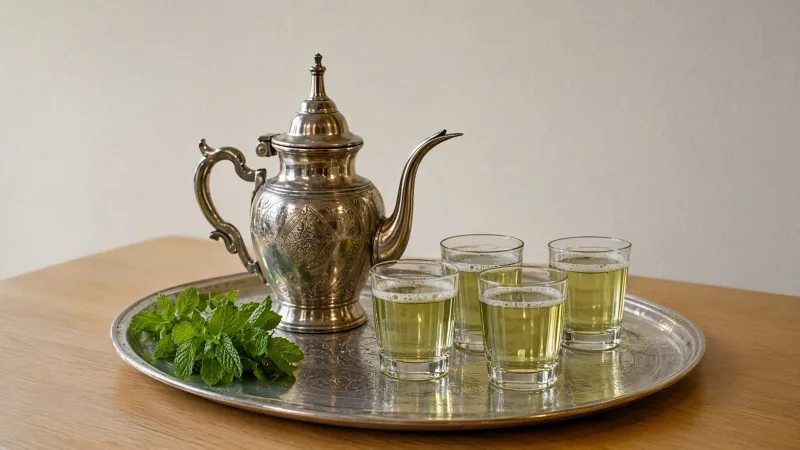
In Morocco, tea is how a guest is welcomed. The pot sits on a tray, the glasses are small, a green bunch of mint pokes out of the spout, and the stream falls from an outstretched arm so high that it looks careless. Yet every part of it is calculated: the foam, the sweetness, the number of rounds.
The word atay (Arabic أتاي) is the Maghrebi name for tea. It has traveled farther than the drink itself: in Senegal the same tea is called attaya. The leaves are almost always the same, too. Nearly all the tea for atay still comes from China, mostly from Zhejiang province.
How tea reached the Maghreb
Morocco's court may have received its first tea as a gift from Queen Anne to Sultan Moulay Ismail. Graham Cornwell calls that story "possible"; Jean-Louis Miège, working from port archives, finds the first documented traces in gifts to European embassies in 1727 and 1767. Only 1,510 pounds of tea reached Mogador in 1804, and in 1851 the minimum of 1,475 kg came in, nearly all of it drunk at court.
The turning point came with the treaty with Britain, signed in Tangier on December 9, 1856. It cut the duty to 10 percent, down from as much as 3.25 francs per kilogram, which had been up to half the price of the tea itself. Imports through Mogador grew from 2,326 kg in 1854 to 31,426 kg in 1862. Over the second half of the 19th century the volume rose 25-fold and the value only 8-fold, so tea got much cheaper.
From there tea traveled with the caravans. Traders carried it from Mogador along trans-Saharan routes to Timbuktu and Agadez, and on to Mauritania, the Tuareg and Senegal. Tunisians first heard of tea in 1761, the bey's household took it up in the early 19th century, and in the first half of that century only a few wealthy townspeople drank it.
The popular story about the Crimean War and British warehouses with nowhere to send their tea is invented. Fighting ended with an armistice in February 1856, and the trade treaty was signed in December. Cornwell points out that none of the writers who repeat it cites a source. There is no "ancient tradition" either: A. Sebti, as quoted by Martin Rose, calls the idea of atay's antiquity an illusion of collective memory.
What goes in the pot and on the tray
Tea is Chinese green. Most often it is gunpowder, known in China as 珠茶 (zhūchá), "pearl tea." The tightly rolled pellets held up better on the long sea voyage. Less often it is chunmee (眉茶), a twisted leaf, which people in Mali prefer to pellets. Buyers go by numeric codes: gunpowder 3505 (with grades AAA, AA, A, B), 9375, 9475, 9575, chunmee 41022. A code tells you the shape and sorting, not the garden or the year.
Mint is na'na', spearmint; Moroccans prize mint from around Meknes. In winter they often swap it for wormwood (shiba), marjoram, lemon verbena or sage.
Sugar used to come as a loaf, a cone of about 2 kg broken up with a hammer (sugar is cut this way in Russian tea drinking too). Later came the factory "ingot," sold in 1 kg boxes. Moroccans consume around 36 to 37 kg of sugar per person a year.
Tea is brewed and served from a berradberradThe metal teapot of the Moroccan set, with a long curved spout and a built-in strainer. It goes straight onto the flame. on a siniya tray. A berrad of silver-plated nickel silver, steel or aluminum goes straight onto the flame, so you hold the handle through a cloth cone. Common sizes are 1½ and 2 pints, about 0.85 and 1.1 L. Rose ties the shape of the berrad to Manchester: Fez cotton merchants ordered silver-plated sets from the ironmonger Richard Wright. In Morocco rayt became the word for good white metal.
Glasses (kas) have no handle and are painted or gilded. The best are Saint-Louis crystal, still part of a bride's trousseau. Cheap ones are made of recycled glass.
How Moroccan atay is made
There is no single recipe, but in towns the order is much the same everywhere. The host or the eldest man makes the tea himself and takes his time.
Rinse the berrad with boiling water. Add two heaped tablespoons of tea, pour in a glass of boiling water, swirl and pour it out: that is the rinse. Pour a second glass, leave it for a minute without stirring and pour it off into a glass. This is the rouh atayrouh atayThe first strong infusion, poured into a glass and then returned to the pot. In Arabic, the "spirit" or "soul" of atay., the "spirit" of the tea, and it goes back into the pot. Some recipes reverse the order: the spirit first, then the rinse. Top up with boiling water (212°F) to two thirds, return the spirit and set the pot on medium-low heat. When bubbles rise, push in a bunch of mint and add sugar: three "ingots" or 7 tablespoons of granulated sugar. Bring it almost to a rolling boil and take it off the heat. Pour a glass and tip it back into the pot, repeating several times. Serve with the arm outstretched over the glass.
This recipe comes from Peace Corps volunteers. Another, for a small 0.5 L pot, calls for one level tablespoon of tea, 4 to 6 tablespoons of sugar and about 3 minutes of steeping. Sources measure in spoons, not grams, so precision is beside the point. Every recipe calls for water at a full boil, while in East Asia green tea is brewed with cooler water.
The pourer fills a glass and tips it back into the pot two or three times, then raises the pot high over the glasses at arm's length. That is what builds the foam.
In southern Morocco water is scarce, so nobody throws away the first pour. The tea there is stronger and more bitter, and dried mint sometimes goes in with the pellets.
Three glasses in the Sahara and Sahel
The farther south you go, the slower the tea. In Mauritania and Western Sahara it is brewed on embers, with up to half an hour between rounds. Three rules apply, the "three jims": jarr (unhurried pace), jamr (embers) and jama'a (company). The tea is made by the al-qayyamal-qayyamThe person who makes tea for the company in the Sahara. A respected figure and a good storyteller, he is not supposed to get up or change seats., a respected member of the group and usually a good storyteller. He is not supposed to get up or move.
All three glasses come from the same leaves. The Sahrawi call the rounds al-kasa (strong), mutawassit (medium) and helu (sweet). Mauritanian glasses hold no more than 70 ml, and each round gets more sugar than the last. The Sahrawi sometimes add gum arabic for foam, and the brewing can take up to two hours.
The proverb about the three glasses has several versions. The usual one goes: "the first is bitter like life; the second strong like love; the third gentle like death." In Senegal and among the Tuareg the order "death, life, love" is recorded too, and popular Moroccan sites flip it, with the first soft and the last bitter. Take it as a saying rather than a rule.
Tea took hold among the Tuareg in the 1940s (by the Quintessences summary), and they use two enameled pots, one for brewing and one for mixing in the sugar. The first glass is made without mint. Bernezat describes it as amber-green and bitter, the second as golden, the third as pale and cloying. A fourth is allowed; a fifth hints that the guest should leave. When a new guest arrives, the ceremony starts over.
Tunisia, Libya, Senegal
In Tunisia pine nuts often go into the glass, sometimes almonds or peanuts. In very sweet tea they float, in unsweetened tea they sink. People like them for the crunch, not the flavor. Tunisians drink both green and "red" (black) tea. According to official figures, a Tunisian drinks about 4 g of tea a day, four times as much as a Frenchman.
In Libya it is shahi al-'alla, "tea of the set": a steel pot and mugs, a tray and three containers for sugar, tea and incense. The tea simmers for a long time on low heat, then gets poured between mugs 20 to 30 times until a thick foam rises, called raghwa or kashkusha. Sugar goes in late, or the foam will not stand. Roasted peanuts or almonds come with the third round.
Senegalese and Gambian attaya follows the Saharan pattern: the rounds are lewel, naarel and nettel, the water boils on embers and the tea is simmered. Usually the youngest makes it for the elders. Glasses there hold 60 to 75 ml, and people drink tea after meals "for digestion." With simmered tea the first glass is the bitterest and the third the sweetest. Moroccan city atay starts out gentler.
Across the Middle East, tea is made differently.
Where the leaves come from
Chinese green tea for the Maghreb is made for export, and the volumes are large. In 2024 China exported 202,644 t of green tea: 80,104 t to Morocco worth $240.7 million, 10,895 t to Algeria, 3,243 t to Tunisia and 955 t to Senegal. The Keqiao district near Pingshui accounts for about three fifths of Chinese gunpowder exports. From January to July 2025 Zhejiang shipped 36,000 t of tea to Morocco, a third of its exports.
Sources disagree on when these shipments began: Chinese references give the 1920s, a Pingshui producer's site gives 1932. No standard covers how atay is prepared: neither ISO nor GB/T touches it, and the only codes are export grades. How much sugar goes into the glass is up to whoever pours.
Common questions
What tea is used for Moroccan atay?
Chinese green tea, most often gunpowder: tightly rolled pellets that unroll in boiling water. In Mali and parts of the Sahara people use chunmee, a twisted leaf. Mint and sugar cover the astringency of an inexpensive tea, so nobody wastes a fine one on atay.
Why is the tea poured from such a height?
The falling stream whips up foam, and in the Maghreb foam is the sign of a well-made tea. In Mauritania people especially value an even pour, with a "turban" of foam standing in every glass.
Is it true that Morocco took up tea because of the Crimean War?
No. Historian Graham Cornwell found no source for that story. The turning point was the 1856 treaty, which cut duties, along with falling tea prices in the later 19th century.