Tea tools: the six gentlemen, pu-erh knife, tea pets 茶道六君子
A scoop, tongs, a needle, a knife for the cake and a clay animal at the edge of the tray. None of them brews tea, but they spare you spilled leaf, burnt fingers and a crumbled cake.
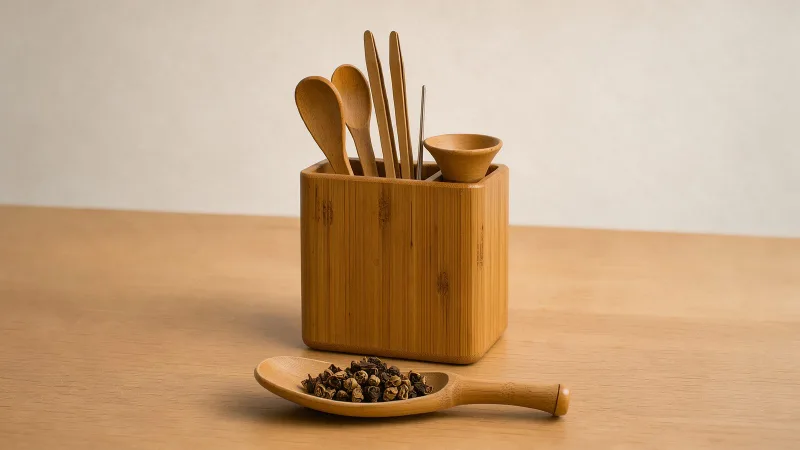
- The set:
- six gentlemen: holder, funnel, scoop, spoon, tongs, needle
- Material:
- bamboo, wood, less often metal or porcelain
- For pu-erh:
- knife, awl, thin needle, pliers
- Tea pets:
- unglazed zisha or chengni clay
- Buy first:
- tongs, spoon, pu-erh knife
A dozen small things lie next to the pot on a tea table, each with its own job. A scoop measures the leaf, a chahechaheA shallow dish with a lip for showing dry leaf: you pour out one portion, look at the leaf and smell it. Not the same as the chahai. shows it to guests, tongs move hot cups, a knife takes a pu-erh cake apart. You can brew without any of them, but with them the table stays cleaner, your fingers safer and the dose more even.
Collect them gradually. Three are enough to start: tongs, a spoon and, if you drink pressed tea, a knife. The rest can wait until the habit sticks.
The six gentlemen
The set is called 茶道六君子, the “six gentlemen of the tea way.” It also goes by the “six helpers of tea art” and the “tea group.” All six stand in one holder and are usually sold as a set, in bamboo or wood.
- Tool holder (茶筒) keeps the other five upright, the way a brush pot holds brushes. It is not a tea caddy, and tea does not go in it. A good one has no burrs, a smooth line and fine carving.
- Funnel (茶漏) sits on the mouth of a teapot so dry leaf does not spill. It has no mesh and is not a strainer: the strainer goes on the fair cup, the funnel on the pot while you load it. It helps when the opening is narrow and the leaf is bulky or tightly rolled.
- Scoop (茶则) takes dry tea from the caddy and measures out a portion.
- Spoon (茶匙) rakes spent leaf out of the pot and nudges dry leaf from the chahe into the vessel.
- Tongs (茶夹) lift hot cups during rinsing, so you neither burn yourself nor touch the rims. Picking out leaf is a secondary use.
- Needle (茶针) clears the built-in strainer inside a teapot and the spout, and levels the leaf so the fines settle and whole leaf stays on top.
People mix up the scoop and the spoon all the time. Some authors measure with the first and rake with the second, others the reverse, so when you buy, go by the shape rather than the label on the box.
Here is the set in use during a gongfu session. The scoop takes tea from the caddy. The funnel goes on the pot, and the spoon tops up the leaf. If the strainer clogs or the leaf settles unevenly, the needle breaks through the “honeycomb” and levels it. Tongs move the rinsed cups, and after the last infusion the spoon rakes out the spent leaf.
The most persistent mistake is about a word. A line by Su Shi about “six gentlemen” is often quoted as the set’s pedigree. In fact the poem, “Seeing Off the Tea Official Zhou to Hanzhou,” uses the name for six officials who broke the tea monopoly in Sichuan.1 The line has nothing to do with tools. When the six took shape, and with which items, remains unclear; it is probably a twentieth-century convention.
Chahe, cloth and brush
The chahe (茶荷) is a shallow dish with a lip. You pour a portion of dry tea onto it to look at the leaf, smell it and pass it around before brewing. Do not confuse it with the chahai: the chahai is a pitcher for the liquor, the chahe a tray for dry leaf. The chahe is not one of the six.
The Taiwanese teacher Xu Yulian asks three things of a chahe: palm size with a notch for the fingers, a smooth curve to the lip and a throat that is not too narrow. Without them, large-leaf oolongs, shou mei and Tai Ping Hou Kui jam or miss the pot. Pick a neutral material. White porcelain is best, since it shows the true color of the leaf, and a sheet of white paper will do in a pinch.
The tea cloth (茶巾) is for drops on the sides and bottom of the pot, the cups and the fair cup, not for wiping the table. A good one is the size of a handkerchief, cotton and linen, and dark, because a light one stains quickly. Pour boiling water over it before first use and let it dry. For a clay Yixing teapot, keep two: a dry one for polishing and a damp one for cleaning. The rest of teapot care is in caring for teaware.
The pot brush (养壶笔) descends directly from the brush 札 in Lu Yu’s Classic of Tea, a bundle of palm fiber set in evodia wood. Today it is also used to sweep tea off tea pets.
Knife, awl and needle for pu-erh
A cake of pu-erh is pressed hard. Break it by hand and the leaf crumbles, the stems snap and the liquor turns cloudy, so you do not cut a cake, you peel it. There are four tools for the job.
- Knife (茶刀): a flat blade with a point and no cutting edge, made of bamboo, bone or stainless steel. For loose cakes and bricks.
- Awl (茶锥): a conical rod on a handle. For dense cakes: punch a line of holes, then lever gently.
- Pu-erh needle (also 茶针, a namesake of the needle in the six): thin and metal. It goes into a tuocha more easily than a wide knife.
- Pliers (茶钳): for the “iron cake” (铁饼), which defeats both knife and needle.
In a 2017 editorial test the knife did best on a loose stone-pressed cake and on a brick. For tuocha, a thin needle worked. A heavy stainless one with a thick end went in poorly and slipped toward the hand, while a 304 steel needle went in more easily. Sources differ on details (an awlawlA conical metal rod with a sharp point, set in a handle. You pierce a dense cake along a line with it, then lever the layer off. for dense cakes, or a needle), but they agree that the pressing decides the tool.
The technique is much the same everywhere:
- Lay the cake on a hard, flat surface. Keep the holding hand behind the point and parallel to the tool, never across its path. The beginner’s rule: the point always faces away from you.
- Go in from the edge along a layer, or from the dimple on the back, holding the tool almost flat against the cake.
- Peel rather than cut: rock the tool up and down, pull it out, insert it next to the first spot, rock again.
- Keep punctures few. To free 8 g, three entries beat four and leave less crumb.
- If the leaf starts to shatter, pull the tool out and start somewhere else.
A knife without an edge does not cut, but the point can still stab. Keep your free hand out of the blade’s path. Choose a pu-erh knife with a thin blade and a point but no cutting edge: a thick one will not go into the cake, and a sharpened one will cut your hand.
One tip from the sources comes with a caveat. The Daoge blog suggests steaming dense tuocha or warming them in a microwave first. None of the other sources checked mention this, so try it on your own tea before you heat a cake. For keeping and aging cakes, see storing tea.
Tea pets
A tea pet (茶宠, also 茶玩) is a small sculpture at the edge of the tea tray. You pour tea over it until a patina builds up and the smell soaks in. Pets are made of unglazed Yixing zisha or chengni clay.
Care is simple. Pour fresh tea over the pet, spread it with a brush and wipe it, so that it goes from damp to dry and back. Stick to one kind of tea, or the color comes out patchy. Shu pu-erh darkens a pet fastest; black tea, Wuyi rock oolongs and old white tea also work well, and green tea stains slowly. Do not boil a new pet the way you season a teapot, because the fine modeling will crack against the walls. Wash it in plain water, no soap.
Some pets are hollow. A “pee-pee boy” (尿童) is first filled with cold water through a hole, and when boiling water is poured over his head, he shoots out a jet. In 2016 Lee and Attinger showed that the reach of the jet depends on water temperature and suggested such figures may have been early thermometers.2 They could not date the invention.
People choose a figure for what it symbolizes. A pig stands for wealth, a pixiupixiuA mythical beast with a horn, wings and the body of a lion. Folk belief has it guarding the owner’s wealth. (貔貅) for protection. A pixiu belongs in the living room, not the bedroom. A three-legged toad with a coin in its mouth faces the owner, while one without a coin faces outward to draw wealth in. A Maitreya Buddha faces the guests.
Where the custom began is unclear, and only Tang figures are documented. Li Zhao’s Supplement to the History of the State says that potters in Gongxian county modeled little porcelain men called “Lu Hongjian” (a courtesy name of Lu Yu), and merchants poured liquid over the figure when their tea did not sell.3 The story of Yuan-dynasty Yixing potters making animals from zisha scraps has no support in primary sources. Nor is the line “茶宠手能煎” any proof: in the Siku quanshu text it reads “茶灶手能煎,” “at the tea stove I can brew myself.”
Travel sets and what to buy
On the road you get by with less. The kuaike bei (快客杯, literally “quick guest cup”) is built as “cup on top, pot below”: an upturned cup serves as the lid, and a filter sits in the spout. Sets come with one or two cups. The Taiwanese teacher Cai Rongzhang suggests something simpler still: a teapot, two cups and a thermos. Put the leaf in the pot at home, brew three times and wash up at the hotel.
For home, buy in this order. Tongs and a spoon come first, because they save your fingers and the table. If you drink pu-erh, add a knife or an awl. Then a chahe and a cloth, then the full six gentlemen if you like your things in order. A tea pet comes last, since you do not need one to brew.
Choose bamboo and wood free of cracks and burrs, in a tone that matches the rest of your teaware. A gaiwan is a good place to start, and a scoop and tongs are all it needs.
Common questions
What are the six gentlemen of tea?
A tool holder, funnel, scoop, spoon, tongs and needle. There is no single canon: authors swap the names of the scoop and spoon, and the chahe is not among the six. The term itself appears to be modern.
Knife or needle for breaking up pu-erh?
Use a knife for a loose cake or brick, an awl for a dense cake and a thin needle for a tuocha. An “iron cake” that defeats knife and needle needs pliers. The blade should be thin, with no cutting edge.
Do you need a tea pet?
Not for brewing. It decorates the tray and darkens with tea over time. Stick to one kind of tea and pour it over the pet regularly, and the patina will come in evenly.
-
Su Shi, “Seeing Off the Tea Official Zhou to Hanzhou” (送周朝議守漢州), Wikisource. The “two Lis” in the poem are Li Qi and Li Ji, who guided the officials. ↩
-
V. Lee and D. Attinger, “Thermodynamics and historical relevance of a jetting thermometer made of Chinese zisha ceramic,” Scientific Reports 6, 28609 (2016), nature.com. ↩
-
Li Zhao, Supplement to the History of the State, quoted in Taiping guangji, juan 83, ctext.org. The dating of the book is disputed: 820s. ↩