White tea 白茶
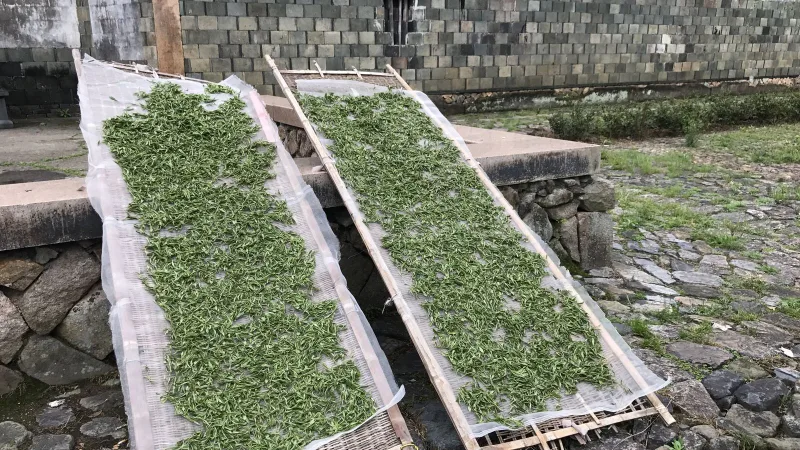
Of the six types, white tea has the shortest processing: the leaf is only withered and dried. The name comes from the white down on the buds.

- Oxidation:
- light, happens on its own during withering
- Key step:
- long withering, no fixation or rolling
- Main province:
- Fujian: Fuding and Zhenghe counties
- Raw material:
- downy buds and young leaves of Da Bai cultivars
- Liquor color:
- pale straw to amber
White tea takes two steps, withering and then drying. There is no fixing or rolling, so leaves and buds keep their natural shape, and oxidation runs on its own, slowly and lightly. The liquor is pale and sweet, with a scent of hay, honey and dried flowers.
Withering
Nearly everything depends on withering, wei diaowei diaoWithering: the leaf lies in the open air, loses water and turns soft. For white tea it lasts two to three days. (萎凋). Producers spread fresh leaf on bamboo trays, in the shade or in a well-ventilated room, and leave it for two to three days. It loses most of its water, turns soft and darkens slightly at the edges. In damp weather they warm it with hot air to keep mold away. A final drying over a low fire finishes the tea.
Fujian and the four types
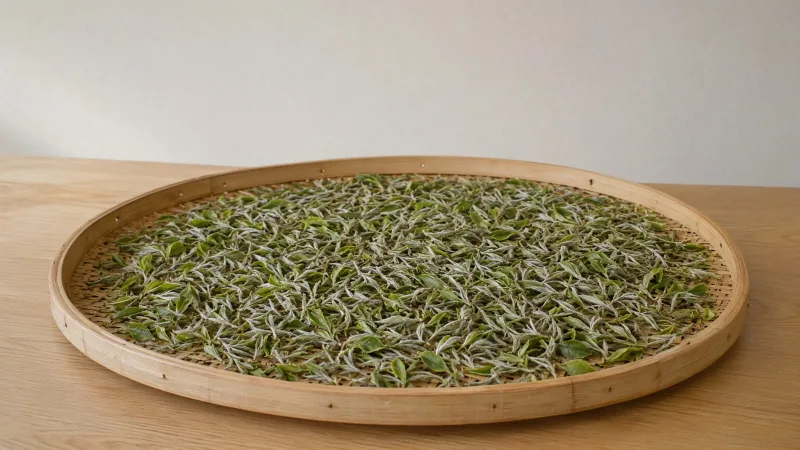
Classic white tea comes from northeastern Fujian, from the counties of Fuding and Zhenghe. The local cultivars Fuding Da Bai and Zhenghe Da Bai have large buds thickly covered in silvery down, bai hao (白毫). The Chinese national standard divides white tea into four types by raw material1:
| Type | Raw material |
|---|---|
| Bai Hao Yin Zhen | buds only |
| Bai Mu Dan | a bud with one or two leaves |
| Gong Mei | buds and leaves of local small-leaf bushes |
| Shou Mei | leaves from later pickings, few buds |
The more buds a tea has, the paler and more delicate it is. Shou Mei brews fuller and darker and is the type most often pressed into cakes.
Aging
Green tea goes flat with time. White tea kept in dry storage changes instead: the liquor darkens to amber, the grassy notes fade, and dates, prunes and medicinal herbs appear. Sellers love quoting Fuding sayings about the virtues of age, but aged Shou Mei really is noticeably different from fresh.
How to brew
White tea is hard to ruin: it has little bitterness, and a long steep only makes the liquor denser. Brew Bai Hao Yin Zhen at 80–85 °C in a glass or a gaiwan. Shou Mei and aged cakes take water straight off the boil.
After five or six infusions, aged leaf can be simmered: put it in a pot of water and keep it over a low flame for 5 minutes. The result is thick and sweet.
-
 Bai Hao Yin Zhen
白毫银针
Bai Hao Yin Zhen is a white tea made only from buds, grown in Fuding and Zhenghe in Fujian. How it is withered and dried, how it ages, how to brew it.
-
 Bai Mu Dan
白牡丹
Bai Mu Dan is a white tea made from a bud with one or two leaves. Where it comes from, how it is withered, its grades and Mu Dan Wang, how to brew it.
-
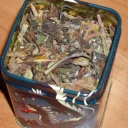 Shou Mei
寿眉
Shou Mei is a leafy white tea from later pickings in Fujian. How it differs from Gong Mei, why it is pressed into cakes, how it ages and how to simmer it.
-
GB/T 22291-2017 "White tea" (白茶). ↩