Chawan: Bowls for Matcha 茶碗
The chawan is a wide bowl in which the host whisks matcha and from which the guest drinks. Its shape, clay and kiln are chosen as carefully as the tea itself.
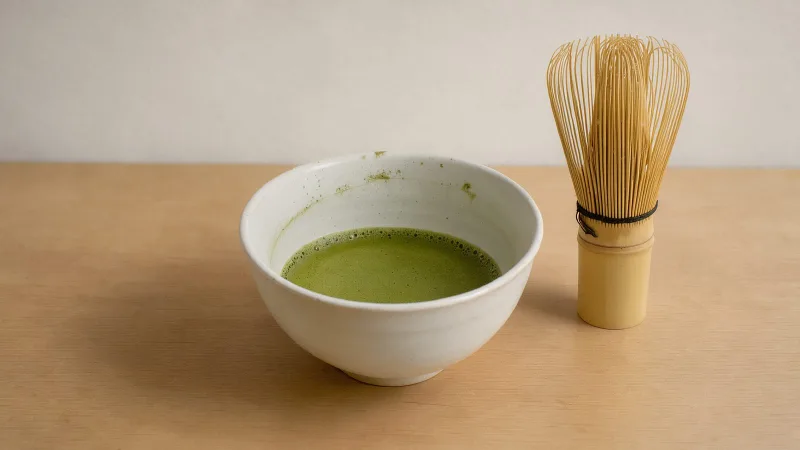
- Meaning:
- "tea bowl"
- Kyoto craft norm:
- rim about 12 cm, height about 8 cm
- For which tea:
- matcha: usucha and koicha
- Three groups:
- Chinese, Korean, Japanese
- Main kilns:
- Raku, Hagi, Karatsu, Mino
- National Treasures:
- 8 of 14 ceramic ones
Chawan (茶碗) means "tea bowl," not "rice bowl." Rice bowls inherited the name from tea bowls.1 Of everything used in the tea ceremony, it is the one object both host and guest hold in their hands. Matcha is whisked in it and drunk from it, so the bowl has three jobs: leave room for the whisk, sit well in the palms, and look good from every side.
How the bowl is built
The Japanese compare the size of a chawan to two cupped palms. Kyoto potters work to a craft norm: a rim of 4 sun (about 12 cm) and a height of 2.6 sun (about 8 cm). A bowl of 11.5 × 7.5 cm already counts as small.2 Most chawan are glazed ceramic; a few are metal, glass or lacquered wood.
Every part of the bowl has a name, which helps when you talk to a collector:
- kuchi-zukuri: the rim, the part your lips judge first;
- chakin-zuri: the band inside the rim that the chakin cloth wipes;
- chasen-zuri: the area the whisk moves through;
- chadamarichadamariThe hollow in the center of the bowl floor, where the last of the tea collects for the final sip.: the hollow in the center of the floor;
- do: the body; koshi: the transition to the foot; kodai: the ring foot; kodai-waki: the area just above it, where trimming cuts and bare clay show.
The rim can be straight (ichimonji) or wavy (yamamichi-guchi, "mountain path"). A bowl has a "face," the side with the painting or the finest firing effect. The host sets the face toward the guest, who turns the bowl to drink from the "back." Fire patterns are called keshikikeshikiLiterally "landscape": the pattern fire left on glaze and clay, viewed like a painting., "landscape." The bowl is judged by hand too: weight, balance, how much heat comes through the wall.
Shapes and seasons
Shape decides how fast the tea cools, so bowls change with the calendar.
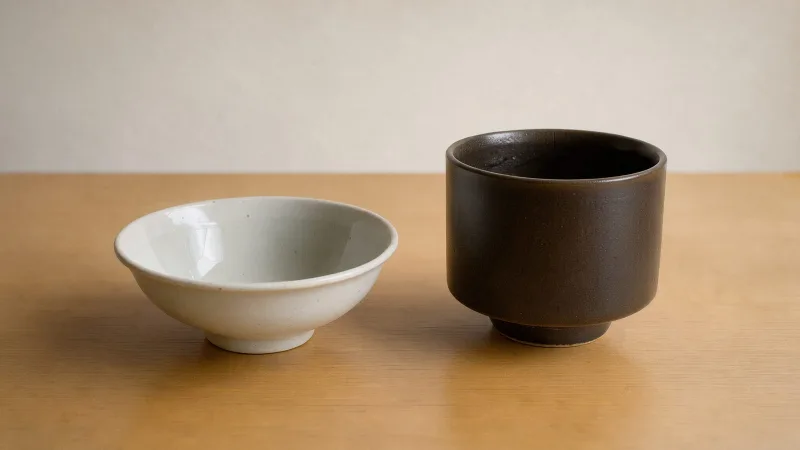
| Shape | Trait | When |
|---|---|---|
| Wan-nari | the basic bowl | year round |
| Hira-chawan | low, wide rim, tea cools faster | summer |
| Tsutsu-chawan | tall, straight walls, holds heat | December to February |
| Han-zutsu | shortened cylinder | all but summer |
| Kutsu-gata | deliberately squashed "like a shoe," typical of Oribe | as the occasion suits |
Spring and autumn call for the deeper "winter" form. Decoration runs a little ahead of the season: in hot weather, hosts bring out bowls with autumn or snow motifs to make the heat feel milder.2
Where Japanese bowls came from
The first bowls were Chinese. Zen monks brought the custom of whisking powdered tea to Japan along with the bowls; some sources date this to the Heian period, others to Kamakura (1185–1333). Chinese tenmoku bowls, the Song dynasty jian zhan, sat on a stand called tenmoku-dai and belonged to the most formal tea, shoin-no-cha. Masters sort bowls into three groups: Chinese (karamono), Korean (korai-chawan) and Japanese (wamono). Chinese bowls suit formal tea, Korean and Japanese ones a less formal gathering.
Japanese kilns working specifically for tea took shape in the Momoyama period (1573–1603), when tea practice turned toward wabi: simplicity, irregularity, muted color. Korean bowls came from provincial kilns that made everyday wares. Japanese masters prized their plainness, and in the Tensho era (1573–1592) such bowls grew expensive. Ordinary pots became treasures. Today 8 of the 14 ceramic National Treasures of Japan are tea bowls.
Kilns and schools
Tea people have a saying, "ichi Raku, ni Hagi, san Karatsu": first Raku, second Hagi, third Karatsu. It dates to the Taisho era (1912–1926) and is more a label than a ranking.
Raku. The Raku family of Kyoto makes bowls without a wheel, shaping them by hand and trimming them with a knife. By the Raku Museum's estimate, the founder Chojiro made his first bowl around 1579. Black Raku is fired at about 1200 °C, red Raku at 800–900 °C (sources disagree).3 The bowl comes out light, soft and warm in the hand. The black glaze is ground from Kamo River stone, and the finished bowl is pulled from the kiln with tongs. Smoking pots in sawdust is a 20th-century American technique and has nothing to do with Japanese Raku.
Mino. Fleeing war, potters from Owari moved to eastern Mino and built a kiln there. It produced Seto-guro (black, with nearly vertical walls, snatched from the kiln and cooled fast), Ki-Seto (yellow ash glaze with spots of copper green), Shino (thick white glaze that blushes pink where it runs thin) and Oribe, asymmetrical and glazed in copper green. All of these were credited to Seto until 1930, when Arakawa Toyozo found Shino shards in Mino.
Hagi. Hagi became the seat of the Mori clan in 1604, and the Korean master Ri Shakko ran the domain kiln. Potters use three clays and a glaze of ash and feldspar at 5 : 5. Tea seeps through the fine crackle into the body, so a bowl's color shifts year by year. This is known as the "seven changes" of Hagi.
Karatsu. The kilns near Mount Kishidake in Saga Prefecture were the first in Japan to make glazed ceramics. The wars of 1592 and 1597 are called the "ceramic wars": Korean potters were carried off to Japan and brought the kick wheel and the stepped noborigama kiln with them. Karatsu clay is sandy, beige to gray-brown with flecks of iron, and the decoration varies widely.
Ido. Ido are Korean bowls that tea masters hold dear. The Fujita Museum lists seven marks: the biwa color, fine crackle, wheel marks, a foot like a bamboo joint, bubbled glaze near the foot, a point in the center of the foot, and spur marks from stacked firing.
Bizen, Shigaraki and Iga fire their clay unglazed. These kilns turn out vases and jars more often, though bowls in the Mino manner have been made there since the 17th century.
How to choose
Price depends on the maker or kiln, the era, the keshiki and the tomobakotomobakoThe maker's paulownia box, with the artist and the bowl named in brush on the lid. For an expensive bowl it matters almost as much as the bowl. box. The box is light paulownia, with the names of the artist and the bowl brushed on the lid. Famous bowls carry poetic names and a documented chain of owners.
Telling the three main kilns apart is simple:
- wheel marks inside rule out Raku;
- the clay on the foot of Hagi is pale and smooth, on Karatsu sandy;
- a notch cut in the foot points to Hagi;
- the 楽 seal is easy to fake, clay and forming are not;
- a white bowl with crackle is not necessarily Hagi, many kilns make those.
You do not need any of this for a first bowl. What matters is a rim of about 12 cm, a bowl that sits well in your palms, and a weight you can manage. Pick it up, pour in water and bring it to your lips: the rim should feel pleasant, and the filled bowl should not drag at your wrist. A heavy bowl tires you while you whisk, and a light, thin one loses its heat too fast.
How to drink and care for it
The major schools share the same sequence: bow to the host, set the bowl on your left palm and steady it with your right, turn it half a turn, raise it slightly in thanks, drink, turn the face back toward you and set the bowl on the tatami. Then guests look the bowl over and talk about it. For koicha one bowl passes from guest to guest, while usucha is served to each guest separately.
Usucha: 2 g of matcha, about 60 ml of water at 80 °C (176 °F), 15 seconds of brisk whisking. Koicha: 4 g in 30 ml, the same temperature, 15 seconds of slow whisking. There are no repeat infusions; the tea is whisked and drunk in a single serving. For the full method, see how to make matcha.
Before first use, soak a porous bowl in warm or cold water for about an hour (ten minutes in a hurry). It then absorbs less tea and copes better with sudden temperature changes. Raku used to be soaked overnight.
After washing, give the bowl a long time to dry. Unglazed Bizen and Shigaraki, along with Hagi, Karatsu and Shino, need about a week; dense Kyo-yaki, Satsuma, Oribe and Seto at least three to four days; Raku a week or more. Mold on Raku means it was not dried long enough. Chlorine bleach can change the color and leave a smell, so a weak solution or baking soda is gentler. Take a broken bowl to a specialist rather than gluing it yourself.
Store the bowl in its box, with thin paper packed into the gaps so it does not rattle, and wrap it in turmeric-colored cloth or a silk bag. Everything else falls under general teaware care.
Common questions
How is a chawan different from an ordinary cup?
In size and shape: it is a wide bowl with room for the chasen whisk, and you hold it in both hands. Rice bowls took their name from tea bowls, not the other way around: "chawan" means "tea bowl."
Which chawan should a beginner buy?
A plain bowl with a wide rim about 12 cm across, glazed inside. A low, wide one suits summer, a tall straight-walled one suits winter. Expensive boxed bowls can wait.
Should a chawan be soaked before first use?
If it is unglazed or porous, yes. An hour in water means it absorbs less tea, and ten minutes will do in a hurry. Afterward, dry the bowl longer than usual, a week or more for Raku, or mold will appear.
-
Ono Y., Kyoto National Museum. Tenmoku Teabowls, 1996. ↩
-
Jogaku, 抹茶碗の季節の違い (in Japanese): sizes by the Kyoto norm and shapes by season. ↩ ↩
-
Nagel C., Raku Ceramics: process: red Raku about 820 °C; J-STAGE (Kwon, Lee, 2014) gives up to 900 °C, Yoshien about 800 °C. ↩