How to make matcha: usucha and koicha 抹茶
A bowl of usucha takes 1.5–2 g of powder and 60–70 ml of water; koicha takes twice the powder and half the water. The rest comes down to water temperature and how you use the whisk.
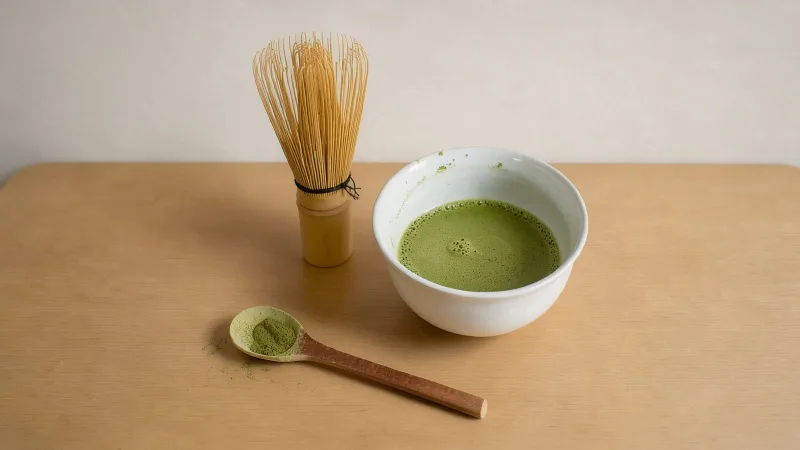
- Usucha:
- 1.5–2 g in 60–70 ml
- Koicha:
- 3.75–4 g in 30 ml
- Water:
- 70–85 °C, koicha around 80 °C
- Tools:
- bowl, chasen, chashaku, sifter
- Infusions:
- one, the powder is drunk whole
- Storage:
- refrigerated, 180 days unopened
Green tea is usually steeped and strained, and the leaf is thrown away. Matcha is different: the powder is ground from tenchatenchaLeaf shaded for 2–3 weeks, steamed and dried without rolling. Tencha ground to powder is matcha., so the whole leaf goes into the bowl along with the water. You do not brew it; you whisk or knead it. There are two styles: usucha ("thin tea", 薄茶) and koicha ("thick tea", 濃茶).
These names refer to preparations, not grades. Both use powder made the same way. The difference lies in the dose and in what you do with the whisk.
What is in the tin
Under the Japanese labeling standard, matcha is tencha ground on stone mills. Tencha comes from bushes shaded for 2–3 weeks; the leaf is steamed and dried without rolling. The same standard puts powder from ordinary green tea in a separate category, "powdered tea" (funmatsucha).
Particle size governs how smooth the tea feels on the tongue. Stone-ground matcha has a median particle size by volume of about 18 microns. The popular claim that matcha is "1 micron" refers to the median by particle count, but what your mouth senses is volume. The finer the grind, the more foam.
The real choice is between blends. The top ones go to koicha, since bitterness and astringency show through in a concentrate. Any powder good enough for koicha can be drunk as usucha, but not the other way round. "Ceremonial grade" on export tins is marketing: the term has no definition in Japan or anywhere else. Fresh, good powder is bright green. A rusty tint means it has aged.
What you need
- Chawan. A wide bowl with room for the whisk to move. Kobe University trials used a bowl 10.5 cm across.
- Chasen. The bamboo whisk. Rinse a new one in water, then in hot water, to wash off the factory glue.
- Chashaku. The bamboo scoop. One scoop holds roughly 0.75–1.3 g, depending on its shape and how you fill it.
- A sifter (furui or chakoshi). For breaking up lumps.
- A yuzamashi or any vessel for cooling boiled water. Each pour from one vessel to another lowers the temperature by about 5–10 °C.
- A scale. Useful until your hand learns the dose.
Usucha
Both styles start the same way. Warm the bowl with hot water, pour it out and wipe the bowl dry. Dip the tips of the chasenchasenA bamboo whisk carved from a single piece, with 16 to 120 fine tines (64 is common). Softened tips spring back, dry ones snap. in warm water; in chanoyu this step is called chasen-toshi. Boil soft water and pour it between vessels until it cools to the temperature you want.
- Sift 2 g of matcha straight into the bowl.
- Add a little water and work the powder into a smooth paste.
- Top up to 60–70 ml.
- Hold the whisk just off the bottom and move it quickly back and forth from the wrist in a zigzag, an "M" or a "W". Not in circles. 15–20 seconds is enough.
- Once the foam rises, bring the tips up to the surface and break the bubbles down with slow strokes; pop large ones with a tip.
- Lift the whisk out from the center so the foam stands in a slight mound.
Urasenke masters keep the elbow almost still as they whisk; it serves as a pivot while the wrist and fingers move together. Beginners let the elbow wander, and the foam comes out coarse.
Warm the bowl, soften the chasen. Sift 2 g of powder, make a paste with a splash of water, then add 60–70 ml of water at 70–85 °C (158–185 °F). Whisk in a zigzag for 15–20 seconds, finish by slowing down to refine the foam, and lift the whisk from the center.
Sources differ on the details. The usucha dose runs from 1.5 g (Marukyu Koyamaen) through about 1.8 g (Urasenke) to 2 g (Ippodo and the Kyoto tea research institute), with 60–70 ml of water.1 These are house habits, not errors. Start with 2 g and 70 ml, then adjust to taste.
Where foam comes from
Foam takes more than air and technique. Tea saponins form the bubble film, pectin modifies it, and fine powder particles line up along the film and keep it from tearing. That is why finer grinds foam more, even though bubble size hardly depends on the grind. The rest is down to the water and your hand.
Tea schools see foam differently. Urasenke aims for an unbroken cover of small bubbles; Omotesenke and Mushakojisenke leave part of the surface open. At home it is a matter of taste. No school holds that more foam means better powder: how much foam you aim for follows the school's rules, not the grade.
Koicha
Koicha is not whisked. You use twice the powder and half the water, and the result is closer to a sauce than a drink.
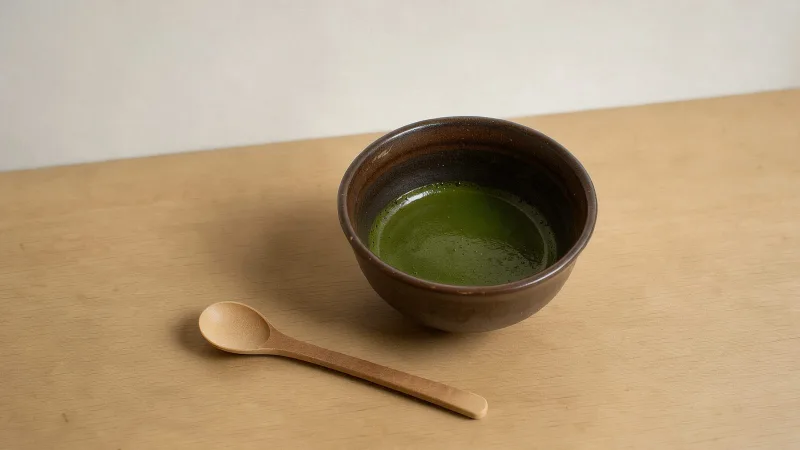
- Sift 3.75–4 g of matcha. Omotesenke measures three scoops per guest; Urasenke uses about 3.75 g (1 momme) per person.
- Take 30 ml of water at 80 °C, pour in about half and knead a thick paste.
- Add the rest and knead slowly for about 15 seconds, without raising foam.
Omotesenke likens the consistency to thick kudzu starch broth: a glossy mass.
Koicha goes back further in chanoyu than you might expect. The word "koicha" is recorded in 1575, and an entry for 1586 in the Matsuya diary describes the custom of several guests sharing one bowl. At a tea ceremony, koicha is served according to the procedure of chanoyu; this section covers only the preparation.
Water and temperature
Use soft water. Marukyu Koyamaen suggests boiling tap water for 5 minutes with the lid off, and checking imported mineral water for hardness. How the makeup of the water affects taste is covered in water for tea.
For usucha, Japanese sources give 70–85 °C, higher in winter and lower in summer. The Kyoto institute recommends 70–80 °C, Marukyu Koyamaen 70–85 °C, Ippodo 80 °C. For koicha, nobody offers a convincing reason for any particular temperature; Ippodo uses 80 °C. Russian barista cheat sheets give 65–70 °C for both styles, and Western shops 66 °C, without explaining why.
Hotter water pulls out more, tannins included. Foam is more complicated. In laboratory trials its volume grew up to 60–70 °C and dropped above that, while the bubbles got larger. In practice, if the foam comes out coarse, the water may be too hot.
Iced matcha and lattes
Even for cold drinks, mix the powder with a little water first. Dry powder dropped into cold milk clumps.
- Mizudate. 2 g of powder, 60 ml of cold water, whisk for 15 seconds.
- On ice. Make usucha a bit stronger and add ice.
- Shaka-shaka. 1 g of powder and 100 ml of ice-cold water in a shaker.
- Latte. Ippodo: 3 g of powder, 100 ml of water at 80 °C and 100 ml of milk. For a layered latte, pour milk over ice first and add the concentrate last.
For milk drinks, producers sell separate cafe powders with a flavor strong enough to cut through milk and sugar. Each maker draws the line between drinking and culinary matcha in a different place.
Common mistakes
Nearly every failure comes down to six causes, and you can fix all of them without changing the powder.
- Lumps. Sift every portion. Lumps do not mean bad powder; static and shaking cause them.
- Boiling water. The tea turns bitter and the foam coarse. Cool the water.
- Circular motion. Whisk in a zigzag, or the bubbles come out large.
- A dry whisk. Dry tines snap. Dip the tips in warm water.
- Chasing foam. How much foam you want depends on the school, not on the quality of the powder.
- Washing the whisk with soap. Rinse it in warm water and clear any residue with your fingers. A chasen will not survive detergent or a dishwasher.
After use, stand the chasen handle up in a ventilated spot and let it dry for about a day; a damp whisk grows mold. It is a consumable, and broken tines are not repaired.
Keeping the powder
Matcha is sensitive to heat, moisture, light and stray odors. Keep a sealed tin in the refrigerator, and an opened one there too, tightly closed. For long storage, use the freezer. Before opening, let the tin come almost to room temperature, or condensation will form on the powder. Ippodo gives a shelf life of 180 days unopened.
You can see age in the color: the bright green dulls, a rusty tint appears, and the fresh "shade aroma" fades.
Since you drink the powder whole, how much caffeine and theanine you get is a question of its own. For Japanese green tea without a whisk, there are sencha, gyokuro and hojicha.
Common questions
How much matcha goes into one bowl?
For usucha, 1.5–2 g (about one and a half to two chashaku scoops) in 60–70 ml of water. For koicha, 3.75–4 g in 30 ml. Scoop weight is not standardized: two scoops come to 1.5 g with one maker and 2 g with another, so a scale is more reliable.
Why is my matcha lumpy and how do I fix it?
Lumps come from static electricity, settling and shaking in transit, and have nothing to do with quality. Sift each portion into the bowl, and keep a wet spoon away from the powder: one drop makes a hard lump the sifter cannot break.
Can I whisk matcha with a spoon or in a shaker?
You can, but you get a different foam. Ippodo has a shaker recipe: 1 g of powder with 100 ml of ice-cold water. For hot usucha you want a chasen: the foam depends on saponins from the leaf and fine particles of powder, and the whisk whips them up.
-
Kyoto tea research institute: 2 g, 70 ml, 70–80 °C. Urasenke: usucha about 1.8 g, koicha about 3.75 g. Marukyu Koyamaen: about 1.5 g, 70 ml. ↩