Bai Mu Dan 白牡丹
A bud with one or two leaves, simply withered and dried. Bai Mu Dan brews a fuller, fruitier cup than Yin Zhen and costs noticeably less.

- Province:
- Fujian: Zhenghe, Fuding, Jianyang, Songxi
- Oxidation:
- light, happens on its own during withering
- Raw material:
- a bud with one or two leaves
- Leaf shape:
- two leaves around the bud, downy undersides
- Harvest:
- spring, late March to late April
- Flavor:
- hay, melon, apricot; with age, honey and dates
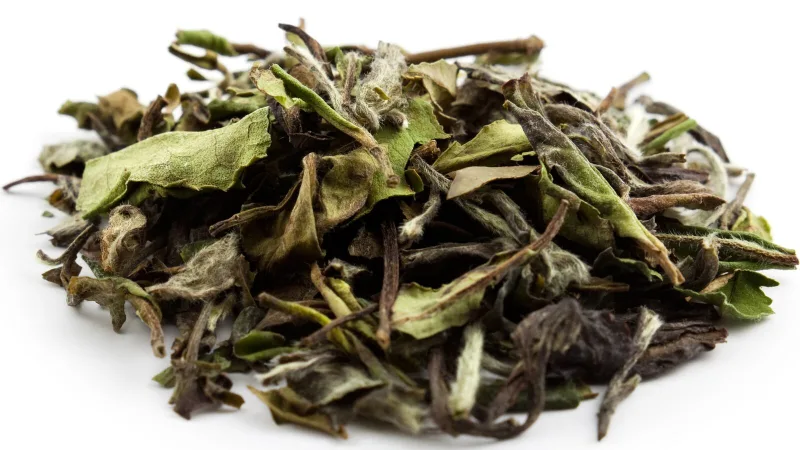
Bai Mu Dan (白牡丹, "white peony") is made from a bud with one or two leaves. The dry tea looks like a handful of crumpled flowers: dark green leaves with downy white undersides lie around a silvery bud. In water the leaves open out and cradle the bud the way petals hold a flower bud, hence the name. Among white teas it sits in the middle, between Bai Hao Yin Zhen, made only from buds, and leafy Shou Mei.
Shuiji and Zhenghe
Reference books name Shuiji township in Jianyang county, northern Fujian, as the birthplace of Bai Mu Dan, and 1922 as the year. Local chronicles push the first batches back to the late 19th century, when white tea passed through Shuiji on its way to Guangzhou and Hong Kong. In the 1920s production began in neighboring Zhenghe, a mountain county that long remained the main supplier. As late as the 1980s and 1990s, most export Bai Mu Dan went from there to Hong Kong, Macau and Southeast Asia. Today it also comes from coastal Fuding and from Songxi county.
Under the standard, Bai Mu Dan is a bud with one or two leaves from large-bud Da Bai or Shui Xian cultivars1. In Fuding these are Fuding Da Bai and Fuding Da Hao, in Zhenghe the local Zhenghe Da Bai. Yin Zhen comes from the same bushes; only the timing and the part picked differ.
Picking and withering
Bai Mu Dan is picked in spring, in the first flush, from late March through April. A bud that misses the Yin Zhen picking puts out leaves within a few days, and the shoot goes into Bai Mu Dan instead. A classic shoot follows the rule of the "three whites": the bud and both leaves are covered in white down, and the leaves are roughly as long as the bud. Summer and autumn shoots are thinner and less downy, so they are not used for classic Bai Mu Dan.
Producers spread the leaf thinly on bamboo trays and wither it, usually for two to three days. Unlike oolong, it is never tossed or bruised by hand; it oxidizes slowly on its own. Once the leaf has visibly wilted, the contents of two trays go into one. In the thicker layer the leaf edges curl toward the underside, so the leaf does not stick to the tray as a flat sheet. Meanwhile the veins turn red. Chinese tea people describe a good Bai Mu Dan with two phrases. The first is "green leaf, red veins". The second is qing tian bai diqing tian bai di"Blue sky, white earth": the top of the leaf is dark green, the underside white with down. Chinese tea people use it to describe a good Bai Mu Dan., "blue sky, white earth": a dark top side and a white underside.
Lower grades are briefly piled 10–15 cm high before drying, which lets the leaf oxidize a little more and darken. Finally the tea is dried over a low fire, in baskets above the heat or in a dryer, then sorted to remove stems and debris.
Grades and Mu Dan Wang
The Chinese standard divides Bai Mu Dan into four grades: special, first, second and third1. The higher the grade, the more buds the tea contains, the larger and downier they are, and the younger the leaves. Third grade has thin, sparse buds, larger and darker leaves and a thicker liquor. It makes a solid everyday white tea that also ages fairly well.
Sellers place Mu Dan WangMu Dan Wang"King of peonies": a trade name for the most bud-rich batches of Bai Mu Dan. The standard has no such grade., "king of peonies", above the special grade. The name usually goes to batches with so many buds that the tea almost resembles Yin Zhen, with small leaves on each bud. The standard has no Mu Dan Wang, so only the leaf tells you what a given shop means by it.
Flavor and aging
Fresh Bai Mu Dan brews an apricot-colored liquor, paler than Shou Mei but darker than Yin Zhen. The aroma is hay and apricot. The leaf adds body and a light herbaceous astringency to the sweetness of the bud, so the taste is more focused and brighter than a bud tea's, if less delicate.
It ages well. Over the first years the fresh-leaf aroma fades, the liquor darkens to amber, and the taste picks up honey, dried apricot and herbs, later dates. Some Bai Mu Dan is pressed into cakes for this, like Shou Mei and pu-erh. Leaf in a cake changes more slowly and evenly, but as a fresh tea a cake falls short of loose leaf, since steaming and pressing dull the aroma. Buy a fresh harvest loose and drink it within a year; store tea for aging in a dry, dark place away from foreign odors.
How to brew
Bai Mu Dan forgives an extra minute: it has little bitterness, and a long steep only thickens the liquor. A gaiwan and short gongfu cha infusions work best. For fresh tea, keep the water off the boil, or the floral notes go first and the astringency of the leaf comes forward.
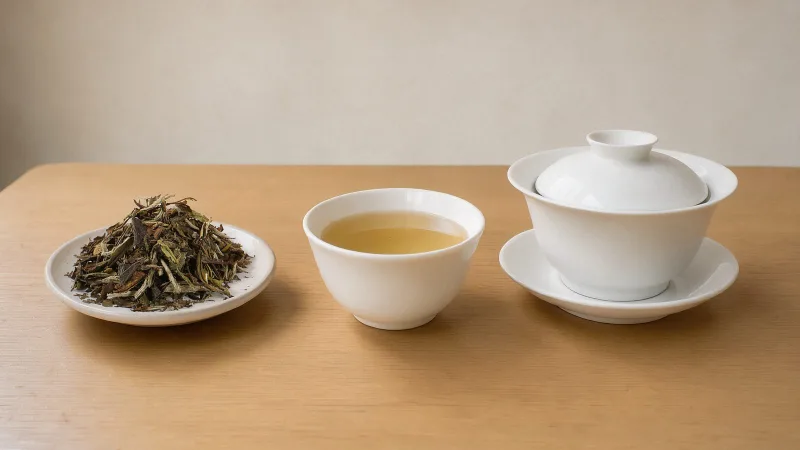
5 g of leaf per 100 ml, water at 85–90 °C (185–194 °F). First infusion 30 seconds, then 10–15 seconds longer each time. Good leaf holds up for 6–8 infusions. Aged tea and cakes take water at 95–100 °C, and you can rinse a piece of cake once before the first infusion.
For a large teapot, use 3 g per 250 ml and steep for 3–5 minutes at the same temperature. Hard water mutes the delicate aroma of white tea, so filtered or soft bottled water is better.
The easiest way to compare the three teas is in one tasting, in order: Yin Zhen, Bai Mu Dan, Shou Mei. With each step there are fewer buds and more leaf, and the liquor turns darker and thicker.
Common questions
How is Bai Mu Dan different from Shou Mei?
In raw material and picking time. Bai Mu Dan is picked in spring: a bud with one or two young leaves. Shou Mei comes from leaves of later pickings and has few buds. Its liquor is darker and thicker, while Bai Mu Dan brews paler, with a floral aroma.
Can I brew Bai Mu Dan with boiling water?
Fresh tea does better at 85–90 °C: boiling water drives off the floral aroma first and brings out the astringency of the leaf. Tea older than three years and pressed cakes need water at 95–100 °C.
Why are there brown leaves in Bai Mu Dan?
The leaf oxidizes slightly during withering: the veins turn red and the edges darken, so some brown is normal. If brown leaves outnumber gray-green ones and there are almost no buds, you have a low grade or leaf that withered in damp weather.