Teaware by region
Every country drinks tea its own way and makes its own teaware to match. The Japanese kyusu, the Korean dagwan and the Russian samovar grew out of very different habits.
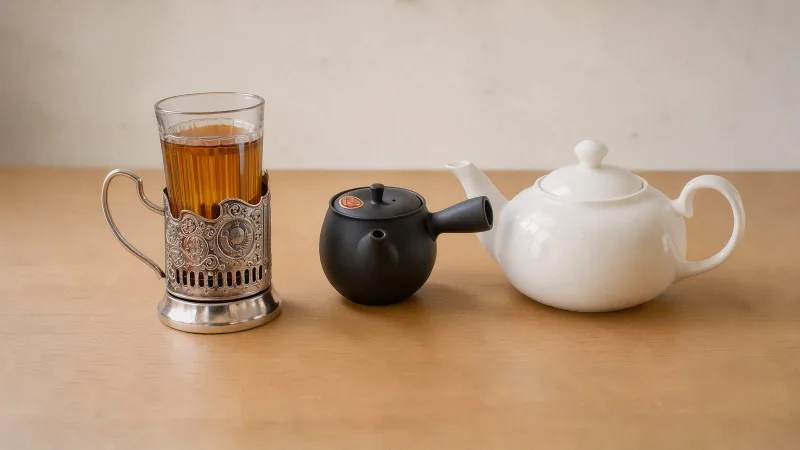
In Japan and Korea people drink mostly green tea, and the teaware is built around it. Loose leaf goes into a kyusu, a small teapot with a side handle and a strainer inside. Clay kyusu come from Tokoname and Banko, both made of iron-rich clay fired without glaze, which turns red in Tokoname and a purplish brown in Banko. Matcha is whisked in a wide chawan bowl, and chanoyu needs about ten more pieces beside it, from the bamboo chasen whisk to the kama kettle. In Korea the leaf is brewed in a dagwan teapot, the water is cooled in a sukwu bowl, and the cups are celadon, buncheong or Joseon white porcelain.
Europe and Russia started with imports: ships brought Jingdezhen porcelain and red Yixing teapots with the tea. Around 1678–1680 Delft potters began copying the Yixing pots. Saxony produced its own hard-paste porcelain in 1708, the Meissen factory opened two years later, and Spode had bone china by about 1800. A British table put a big Brown Betty teapot of Staffordshire clay next to a jug of hot water, a caddy and a strainer. In Russia the water was heated in a samovar. The first record of one dates to 1740, at the Irginsky works in the Urals, and Tula has made samovars since 1778.
-
 Japan and Korea
茶器
Japanese and Korean teaware: the kyusu, Tokoname and Banko teapots, chawan bowls and chanoyu utensils, the Korean dagwan teapot, sukwu, celadon.
Kyusu, houhin and shiboridashi · Tokoname and Banko: Japanese clay teapots · Chawan: Bowls for Matcha · Chanoyu utensils: chasen, chashaku, natsume, kama · Korean teaware: dagwan, sukwu, celadon and buncheong
-
 Europe and Russia
The first European teapots modeled on Yixing ware, Meissen porcelain, the British tea table and the Tula samovar.
The samovar · European teapots: from Delft to Meissen · The British tea table: Brown Betty, urn and strainer