Meng Ding Huang Ya 蒙顶黄芽
A yellow bud tea from Mount Mengding near Ya'an, one of the oldest tea-growing places in China. The buds are yellowed hot, straight from the wok, in short rounds between firings, and then kept under paper for another 24–36 hours.
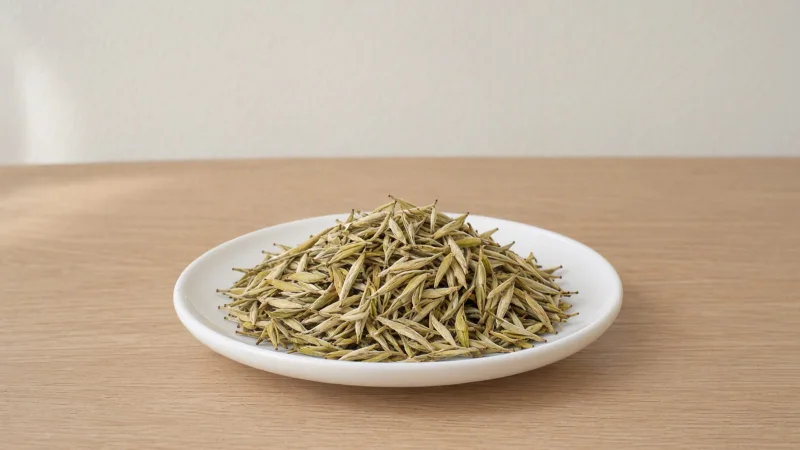
- Province:
- Sichuan, Mingshan District of Ya'an
- Altitude:
- gardens from 800 m, Shangqing peak 1456 m
- Raw leaf:
- bud, sometimes with a barely opened leaf
- Harvest:
- from the spring equinox, best before Qingming
- Leaf shape:
- flat, straight, downy buds
- Flavor:
- sweet, soft: corn, chestnut
Meng Ding Huang Ya (蒙顶黄芽, "Yellow Buds from the Summit of Meng") is made on Mount Mengding in Sichuan, on the western edge of the Sichuan Basin. The dry tea consists of flat, straight buds covered in pale down, a little like a small Longjing. But Longjing is a green tea, and Meng Ding Huang Ya is a yellow tea: its buds are yellowed while still hot from the wok, and more than once.
Mount Mengding
The mountain rises above the Mingshan District of Ya'an. Its five main peaks spread out like petals; the highest, Shangqing, reaches 1456 m. In China Ya'an is known as "the city of rain", and mist clings to the slopes for most of the year. Since 2021 the core of the tea zone has been defined as 300 hectares of gardens above 800 m.
Local legend says that under the Western Han a farmer named Wu Lizhen domesticated wild tea trees here and planted seven bushes on the summit. A walled garden on that spot is called the Imperial Tea Garden and shown to visitors. The records tell a different story: from 742 Mengding tea went to the court as tribute, and the tribute lasted until the fall of the Qing in 1911, 1169 years in all1. Under the Song it was also traded for Tibetan horses through the state tea and horse office. An old saying pairs "water from the middle of the Yangtze and tea from the summit of Meng".
Buds before Qingming
Picking starts at the spring equinox, when about a tenth of the buds in the garden have opened. The best lots are picked before Qingming (April 4–5). Pickers take a plump bud about 1.5 cm long, in some lots with a barely opened leaf. It takes 40,000–50,000 buds to make 500 g of finished tea, and a picker gathers 200–250 g of fresh leaf a day.
Three firings, three yellowings
In Mingshan the process is called san chao san baosan chao san bao"Three firings, three wrappings": the Mingshan name for how Meng Ding Huang Ya is made, with wok firings alternating with yellowing in paper., "three firings, three wrappings". There are more steps than that, but these set the rhythm: the wok dries and shapes the bud, paper and warmth turn it yellow. The figures below follow a description of the classic handmade method.
- Fixation. A flat wok about 50 cm across is rubbed with wax and heated to 130 °C. 120–150 g of buds go in and are stirred for 4–5 minutes until they darken and smell of tea.
- First wrapping. The hot buds are wrapped straight away in straw paper. Inside the packet the temperature sits around 55 °C, and men huangmen huangSealed yellowing: after fixation the warm, damp leaf is covered and left until it turns yellow., sealed yellowing, begins. After 60–80 minutes, when the packet has cooled to 35 °C and the buds have turned yellowish green, they go back into the wok.
- Second firing. The wok is now at 70–80 °C. The buds are straightened and pressed, which gives them their flat shape. They come off still warm, at 50–55 °C, and are wrapped again for 50–60 minutes.
- Third firing and resting. One more round in the wok at 70 °C almost completes the shape. Then the hot buds are poured into a bamboo basket in a layer 5–7 cm deep, covered with paper and left for 24–36 hours. This third yellowing is the longest: moisture spreads evenly through the bud, and leaf and liquor turn yellow.
- Final drying. A fourth firing at 60–70 °C drives the stale smell of yellowing out of the bud. If the buds are not yellow enough, they are yellowed again. The last drying is slow, at 40–50 °C, down to about 5% moisture.
Jun Shan Yin Zhen is yellowed cool and slow, its buds lying in boxes for two days. Here yellowing is hot and short: the tea maker handles each packet while it is still warm and keeps an eye on the temperature of the leaf. The whole job takes from three days to a week and depends on the weather, since buds picked on a sunny day and on a cloudy one yellow differently. Mingshan tea makers say that under-yellowed tea comes out "neither green nor yellow", and over-yellowed tea "neither red nor yellow".
Yellow and green from one mountain
Mengding produces several teas, and the best known of them is green: Meng Ding Gan Lu, curly and downy. The two use similar leaf picked in the same season. Green tea is quicker and simpler to make, and local farms turn out very little Huang Ya; some of the tea sold under this name is made the green way, without yellowing.
In China good Meng Ding Huang Ya is described by its "three yellows": yellow dry leaf, yellow liquor, yellow wet buds. The dry buds are yellowish green with visible down. The liquor is clear and pale yellow with a sweet aroma; it tastes of sweet corn and roasted chestnut, with almost no bitterness. Bright green buds, a greenish liquor and astringency mean the tea was never yellowed.
How to brew
Flat buds suit a gaiwan: you can watch them unfold, and it is easy to pour off the liquor at the right moment. Use soft water at 80–85 °C. Boiling water scalds the bud and turns its sweetness bitter.
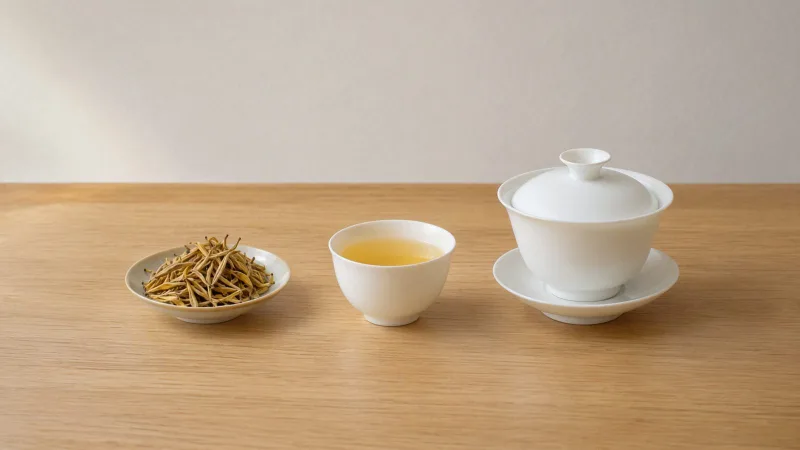
4 g of buds to 100 ml of water at 80–85 °C (176–185 °F). No rinse needed. Steep the first infusion for 30 seconds and add 10 seconds for each one after. Between infusions keep the lid ajar so the buds do not stew. You get 4–5 infusions; the second and third are usually the best.
Store Meng Ding Huang Ya like green tea, in the fridge, and drink it in the year it was picked. To see what three wrappings do to a bud, brew it side by side with the lightly yellowed Huo Shan Huang Ya from Anhui.
Common questions
How does Meng Ding Huang Ya differ from Meng Ding Gan Lu?
By type. Both grow on the same mountain and are picked in early spring, but Gan Lu is a green tea: the leaf is pan-fired and rolled with no yellowing and comes out small, curly and grassy-fresh. Huang Ya is yellowed: its buds are flat, the liquor is yellow, the taste softer and sweeter.
Why does my Meng Ding Huang Ya brew green?
Most likely it was made as a green tea, which is quicker and simpler, and plenty of tea under this name is made that way. Properly yellowed Huang Ya brews a clear yellow liquor, and the wet buds are yellowish too.
Can I brew it in a glass?
Yes: 3 g to 150 ml of water at 80 °C. Drink after 3 minutes and top up, leaving a third. The flat buds slowly sink to the bottom. The taste comes out lighter than in a gaiwan.
-
Mengding tea became tribute in the first year of the Tianbao era (742). Baidu Baike article on Meng Ding Huang Ya. ↩