History of Yixing teapots and their masters 宜兴紫砂壶史
Yixing teapots have been made for almost five centuries, long enough for a few masters to make history, for the pots to reach Europe and Japan, and for the name on the base to stop being proof of who made it.
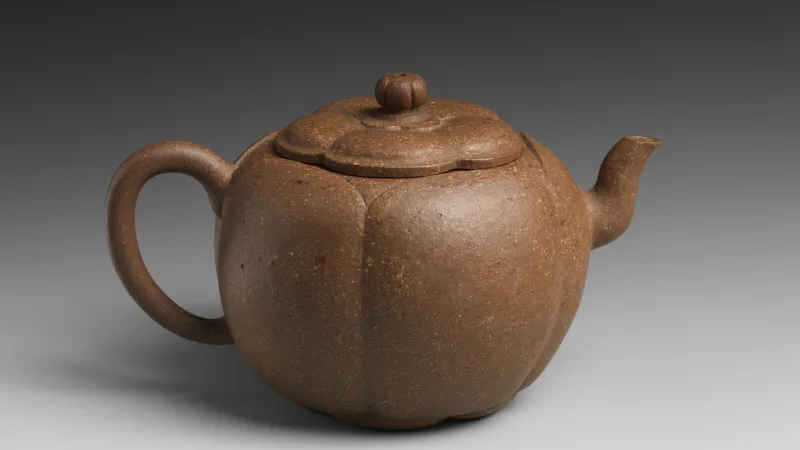
- Earliest dated find:
- tomb of Wu Jing, Nanjing: 1533 or 1544
- First treatise:
- Yangxian Ming Hu Xi, around 1640
- Great master of the Ming:
- Shi Dabin
- Qing:
- Chen Mingyuan, Chen Mansheng, Yang Pengnian, Shao Daheng
- 20th century:
- Gu Jingzhou, 1915–1996
- China’s intangible heritage:
- listed in 2006, no. Ⅷ-1
The Yixing teapot was not invented in a day. Its shape, its clay and the habit of signing a piece came together over centuries, from kettle-like pots in Ming tombs to the factory workshops of the 1950s, and at nearly every step there is a name, sometimes two disputed ones. Some of it is known for sure, some remains legend, and you need a handful of masters’ names to read a catalog or a seller’s tag.
Yixing clays and how a Yixing teapot is made have pages of their own; this one sticks to history.
Where it began
The earliest dated teapot comes from Nanjing, from the tomb of the eunuch Wu Jing. The tomb’s land deed is marked 1533, while the epitaph gives 1544 as the year of his death and burial.1 The museum and most authors take the first date, so “the first half of the 16th century” is the safer wording.
It is a plain object: 17.7 cm tall, mouth 7.0 cm across (7.7 by the epitaph), the body coarse and porous, with drops of glaze on its sides. The pot was fired unprotected in the same kiln as large jars. It is closer to a kettle for heating water than to a vessel for steeping tea.
Here the arguments start. In 1976, building a factory on Yangjiaoshan hill, workers found a small “dragon” kiln with a dump of spoiled ware: spouts, bodies, handles, lids. Gu Jingzhou, who inspected the site, placed most of it in the Southern Song. Song Boyin and Li Guangning objected: the dig was unscientific, the dating relied on similar shapes, and among thousands of opened Song tombs there is not one zisha teapot. So a Song beginning remains a hypothesis, and only Ming pieces stand on firm ground.
The shift came with tea itself. Zhou Gaoqi, author of the first treatise on Yixing teapots (Yangxian Ming Hu Xi, around 1640), explains that under the Ming people stopped grinding tea to powder and pressing it into cakes, and pots of silver, tin and porcelain gave way to Yixing ones. From the Wanli era makers began setting teapots in saggarssaggarsClay boxes a teapot sits in during firing. They shield it from soot and from glaze running off neighboring jars., and glaze from neighboring jars stopped dripping onto their sides. A famous maker’s piece weighed “no more than a few liang” and cost ten to twenty jin of silver. In Zhou’s words, clay rivaled gold in price.
Gongchun, Shi Dabin and the Ming “greats”
Zhou Gaoqi lays out a lineage. The “beginning” is an anonymous monk of Jinsha Temple, who fired pots in the kilns of jar makers. The “proper beginning” is Gongchun (供春), a servant of the scholar Wu Yishan: while his master read in the temple, he copied the monk’s methods and shaped the clay with his fingers, so that fingerprints stayed on the body.
It is a good story that cannot be checked. Gao Xuyang and Anke Hein, in a 2024 paper, consider it probably invented.2 The people who tell it are tied to the Wu family, Wu Shi (1481–1545) himself never mentions a servant or teapots, and the two “Gongchun” pots in museums have no provenance and look too smooth for an early piece.
Alongside Gongchun, the treatise lists four masters of the Wanli era: Dong Han, Zhao Liang, Yuan Xi and Shi Peng, the father of Shi Dabin. Dong is “elegant,” the other three “simple and archaic.”
Shi Dabin (時大彬, about 1573–1648; sources also give 1578) is considered the first great master. He began with large pots, but after meeting tea connoisseurs in Loudong he switched to small ones, “one to a table.” At first a calligrapher wrote his inscriptions, then he began carving them himself. Zhou ranks him above every master of the Ming. A potters’ saying names three greats: Shi Dabin, Li Zhongfang and Xu Youquan. Li, his best pupil, made pieces that Shi signed with his own name: “Li is the great master, Shi the great name.”
Forgeries of Shi Dabin appeared in his lifetime. Of eight teapots bearing his signature found in 1968–1987, the three most securely dated come from tombs in Zhangpu (1610), Jiangdu (1616) and Wuxi (1629). The lid of the Zhangpu pot can be turned over onto three feet and drunk from, and tea leaf was found inside: a vessel for one person.
The Qing: scholars and plain ware
At the end of the Ming, Chen Yongqing moved the inscription from the base to the body, and Chen Zhongmei came from Jingdezhen and shaped flowers, fruit and insects. Two streams formed: sculptural ware (hua huo) and plain ware, guang huoguang huo“Plain ware” (光货): a pot built from geometric shapes with no sculpted decoration. The opposite of hua huo, sculptural ware, where the body is a gourd, a branch or a nut.. Under the Qing the two coexisted.
Chen Mingyuan, son of the potter Chen Ziqi, worked in the second half of the 17th century and the early 18th. He made teapots, desk objects and naturalistic pieces: gourds, plum branches, nuts. Wu Qian writes that scholars competed to invite him to their houses. The sources give no firm dates for his life.
The court ordered Yixing pieces too. The Palace Museum holds about 400 of them. Under Kangxi, Yixing bodies were painted in enamels in palace workshops, and under Qianlong teapots with the emperor’s poems were commissioned.
Chen Hongshou (1768–1822), art name Mansheng, a calligrapher and seal carver, served as magistrate of Liyang. He drew eighteen teapot shapes and commissioned them from Yang Pengnian and Shao Erquan, then added poems and a seal to the pieces. The marks of a “Mansheng pot” are the seal “Pengnian” under the handle, the studio seal on the base and poems on the body. Yang Pengnian, according to Xu Kang, “shaped the spout by hand, without a mold.”3 His brother Yang Baonian and sister Yang Fengnian worked with him. “Eighteen” is a convention: some sources list about twenty shapes, others nearly thirty.
Shao Daheng of Shangyuan village (about 1796–1850/1860) made plain ware: the “stacked spheres,” the “bundle of bamboo with eight trigrams,” the “fish turned dragon.” Gao Si writes that his lid fits tightly and the steam hole is “small outside and large inside, like a horn.” Gu Jingzhou held that Shao Daheng “swept away the affectation of a whole era.” Late Qing makers include Huang Yulin (1842–1914) and Cheng Shouzhen (1857–1939). Late in life Cheng made only three shapes, the stacked spheres among them, and won an award at the 1915 Panama-Pacific Exposition.
The pots go out into the world
Yixing teapots traveled south and west. Chinese emigrants carried them to Thailand for gongfu cha, and in 1907 King Rama V ordered a batch marked with Thai characters. The junk Tek Sing sank in 1822 on the way from Xiamen to Batavia, and her cargo included hundreds of Yixing teapots: small ones for gongfu cha and large ones over 30 cm across.
Red ware reached Europe with tea. In Delft, Cleffius, van Eenhoorn and de Milde made wheel-thrown imitations, and de Milde’s workshop ran from about 1680 to January 1724. The Elers brothers in Staffordshire made “red porcelain” from Bradwell Wood clay in the 1690s and were bankrupt by 1700. Böttger at Meissen produced a red stoneware “in the Yixing manner” in 1710–1713, until he mastered white porcelain. By 1776 Wedgwood complained that the public was glutted with red teapots.
In Japan, Yixing teapots were prized by sencha masters in the Bunka–Bunsei era (1804–1830). The first monograph, Okuranden’s Meiko Zuroku, appeared in 1876: 32 teapots and 14 chapters on shapes, clays, marks and forgeries.
The 20th century: from cooperative to “Old No. 1”
In the 1910s–1930s Shanghai shops ordered teapots in Yixing with their own marks. Sets themed after “Night Mooring at Maple Bridge” went to Japan, one-knob pots to Thailand, and “Mengchen” pots to Southeast Asia.
In 1954–1955 seven masters set up a workshop within a pottery cooperative, and in 1956 the authorities named the “seven elders” as instructors: Ren Ganting, Wu Yungen, Pei Shimin, Wang Yinchun, Zhu Kexin, Gu Jingzhou and Jiang Rong. In April 1958 the cooperative, the Hexin factory and 28 craft yards were merged into the Yixing Zisha Art Ceramics Factory: 2,067 workers, 299 of them apprentices. During the Cultural Revolution teapots were labeled one of the “Four Olds,” and they returned to the factory floor only in 1970. A second, third and fourth factory followed, and the first came to be called “Old No. 1.” It ceased to be state-owned in 1997.
Of this generation, Gu Jingzhou (顾景舟, 1915–1996) is the best known. He studied with his grandmother, who came from the Shao family, and with the master Chu Ming, became an instructor in the 1950s and taught Xu Hantang, Li Changhong and Zhou Guizhen. From 1956 to 1978 he kept refining his Tibi teapot. In April 1988 he became the first potter to receive the title “Master of Arts and Crafts of China.” And in 2006 the making of Yixing zisha ceramics entered China’s first national list of intangible cultural heritage.
How to read a name on a teapot
A mark does not prove authorship. The mark “Mengchen” appears on pieces from 1627 (a teapot in the Victoria and Albert Museum is signed so) through the 18th century and later, and it long ago came to denote a type, not a person. In 19th-century Chaoshan, small Yixing teapots were copied: thrown on the wheel, coated in red slip and stamped “Hui Mengchen” or “Siting.” Shoula teapots, the local ware of the Chaozhou tradition, are made there too.
Famous masters were being copied as early as the late Ming, and the copies are most numerous at the end of the 19th and start of the 20th century. Many are of high quality. Zhou Gaoqi says outright that some “Shi Dabins” were made by Li Zhongfang. Gu Jingzhou said that the real thing gives itself away through clay, manner, familiar colors and the maker’s seals, and that you learn to tell only by looking at a great many pieces.
Judge the object as a whole. Does the lid fit well, does the spout pour cleanly, how does the handle sit in the hand, what does the clay smell and sound like? If you are buying a pot for gongfu cha, those qualities matter more than the characters on the base.
Common questions
Who made the first Yixing teapot?
Nobody knows for certain. Tradition names a servant, Gongchun, who copied a monk’s methods, but there is no archaeological proof, and some researchers think the story was invented by the Wu family. The earliest dated piece is a pot from the Nanjing tomb of the eunuch Wu Jing, 1533 or 1544.
Why do so many teapots carry the mark Mengchen?
Mengchen became the name of a type: a small gongfu pot, especially the pear-shaped kind. The mark appears on pieces from 1627 on, in Chaoshan and in Europe as well, so it tells you about the shape, not the maker.
Is it true that tea does not spoil overnight in a Yixing teapot?
No. Zhou Gaoqi disproved it back in the 17th century: tea goes off in the pot within a short time. Pour out the brew right away, then wash the pot and let it dry.
-
The tomb’s land deed says 1533, the epitaph 1544. Source: “Some studies of the artifacts from the tomb of the eunuch Wu Jing”, 2024 (in Chinese). ↩
-
Gao Xuyang, Anke Hein. Building Fame Through Tea: The Wu Family and the Manufacture of Zisha Teapots. Ming Studies, 2024. ↩
-
Li Minxing. “An inquiry into when Mansheng teapots were made”, Palace Museum (in Chinese). Wikipedia broadens this to a return to hand shaping instead of molds. ↩