Steppe milk tea: cauldron, brick, salt and butter
On the steppe tea is not steeped but simmered: brick, water, milk, salt and butter, about 15 minutes. The first pour goes to the spirits, the brick once served as money, and coarse brick tea comes at a price in fluoride.
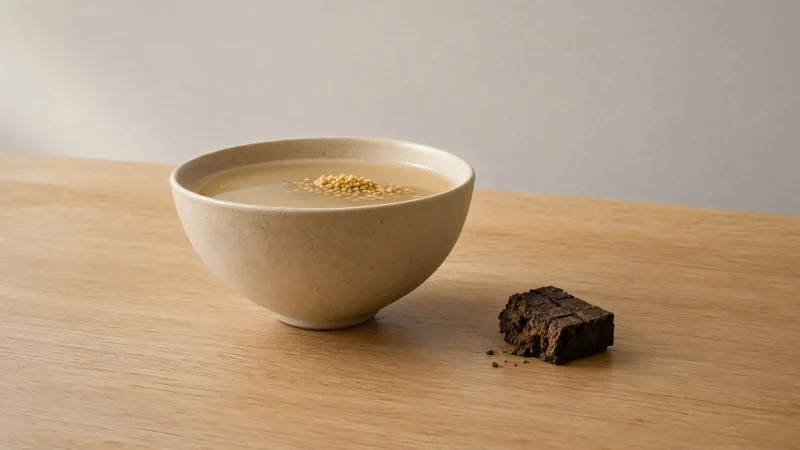
- Where:
- Mongolia, Buryatia, Kalmykia, Kazakhs of Bayan-Ölgii
- Tea:
- pressed brick tea, green or dark
- Method:
- simmered in a cauldron with milk and salt
- Additions:
- butter, roasted millet, flour, meat
- Cooking time:
- about 15 minutes (Mongolia)
- Fluoride limit:
- 300 mg/kg of brick tea (GB 19965-2005)
You step into a ger and the hostess is already at the cauldron. There is no teapot, just a cauldron, a ladle and a palm-sized piece of pressed tea. She simmers the tea together with the milk, salts it, then ladles it up and pours it back for a long time until tea and milk blend into one. Mongols, Buryats and Kalmyks drink it this way. Their neighbors on the steppe, the Kazakhs, Kyrgyz, Uyghurs and Tatars, kept some of the habits and changed the rest.
Brick instead of leaf
Tea does not grow in Mongolia, so it always came from far away and had to survive the trip. A pressed brick does not crumble on the road, keeps for years and can be divided with a knife. In Inner Mongolia people cook with several kinds of brick tea: qing zhuan, hei zhuan, fu zhuan, mi zhuan. Hubei qing zhuan is the best seller. Under the standard GB/T 9833.9-2013 it is made from "old green tea": the leaf is steamed, pressed and dried. Coarse, mature leaf stands up to a long simmer, though there is a catch.
Kalmyks once bought the "lowest grade of Chinese brick tea", glued into tiles. Buryats cut the brick with a tea cutter and pounded it in a mortar. Kalmyks sliced it with a knife, never an axe, and kept the pieces in a leather bag. Today the brick often goes into a gauze bag so nobody has to strain the tea, and in cities tea bags are common.
Pressed green tea is still the classic at Kalmyk and Buryat tables. Among Buryats, black tea with milk is a newer and less sacred habit: it is made with boiling water rather than simmered.
How it is made
Mongols make salty milk tea from what they call "the five best foods" (tavan tansag idee): tea, water, milk, salt and butter. The milk can be cow's, sheep's, camel's or yak's, less often goat's. Beyond that, cooks add what they like: milk skin, dried curd, roasted millet, meat, dumplings, flour browned in fat.
Here is the order.
- Break off a piece of brick and bring water to a boil in the cauldron (togoo). Set the cauldron level, tilted slightly north, never south toward the door.
- Add the tea and cook it, lifting it with the ladle and watching the color. This is the longest stage.
- Pour in the milk, then salt. Guests get less salt.
- Keep ladling until tea and milk "come together": the more you ladle, the better it tastes.
- Add butter, set aside the first pour, and strain the tea into a dombodomboA jug for finished tea: a truncated cone with a closed top pierced by small holes, made of brass or copper. Kalmyks call it donbo. In a ger it stands in a pair. or a thermos.
The whole thing takes about 15 minutes. In western Mongolia cooks do it in two stages: they set a water infusion aside in another vessel for 5 minutes, wipe the cauldron dry, boil milk in it with a pinch of tea, and pour the infusion back in. There milk counts as "white" and has to go into the cauldron first.
Every family has its own proportions, and the sources show it. The Kalmyk cook Olzeeva takes 1 L of water to 0.5 L of milk and leaves the tea another 10 minutes under a lid. A Russia Beyond recipe for four servings calls for 100 g of pressed green tea, 1 L each of water and milk, 2 tsp salt, 50 g butter, pepper, nutmeg and bay leaf. Kalmyks did not throw out the grounds, called shar: they squeezed them in a wooden vise and added them to the next batch for softness. Poor families cooked the same leaves up to three times.
For the general technique, see boiling tea. The numbers above are only a guide: a hostess in the ger judges by color and smell, not by grams.
Vessels: dombo, ayaga, ladle
Mongolian tea has its own tableware. The tea in the cauldron is "lifted and poured" with a copper ladle. Finished tea goes into the dombo, and people drink it from an ayaga, a wooden bowl with silver trim. A brass dombo with copper hoops in a Warsaw museum stands 33 cm tall. A monastery dombo from Khovd holds 16 L and weighs 20 kg. In the ger the dombo stands in a pair, and pouring from it toward the door is forbidden.
A Buryat ayaga is sometimes carved from birch burl and counts as a personal possession. Kalmyks have their own set: a horsehair sieve, a wooden vise for the grounds, a leather bag for the brick. Kazakhs of Kazakhstan use a kese, a bowl of the Turkestan type, and carry it in a felt case. Tatars and Kazakhs both know the samovar well.
Customs: who gets the first bowl
These rules are taken seriously, and each people has its own.
In Mongolia the hostess makes the tea. The first portion, taken while the cauldron is still on the fire, goes to the sky, the earth, the spirits and the altar. In the west she also flicks drops onto the four corners of the stove with a wooden spoon tied with a blue ribbon. The next bowl goes to the husband, even if he is away: his bowl is filled and set aside. Guests are served before the household. Tea without milk is not called "black", because the color is taboo. When tasting, you pour half a ladle back into the cauldron.
Buryats fill the bowl two thirds full and pour from the ladle toward themselves, since water for washing the dead is poured away from oneself. Buryats and Tuvans count milk tea as "white food" (sagaan edeen), the best offering to the spirits.
Kalmyks lifted and poured the tea with a spoon 108 times "so that it would not sour". People connect the number with the saying "sorrow has 108 songs". The first part is flicked out as tsatsltsatslThe Kalmyk libation: the first of the tea is flicked upward with the right hand through the open door. At funerals it goes downward, in silence., and the first cup of tea, deezh, is not left overnight: it goes to the children.
Buryat zutaranzutaranBuryat tea with flour: the flour is browned in fat, stirred into strained milk tea, salted and brought to a boil. It should not turn thick., and Kalmyk tea with flour, mutton or tail fat, are closer to a meal than a drink. The Transbaikal Cossacks adopted the Buryat way: they ladled crushed tea "from the height of a raised hand" and added salt, butter, milk and sometimes zutaran. They called it "Karym tea".
Kazakhs, Kyrgyz, Uyghurs, Tatars: milk without the cauldron
Further west the milk stays and the simmering goes. Kazakhs of Kazakhstan drink brewed black tea they call "red" (qyzyl shai). It has to keep its color once the milk goes in, so they brew it strong. A spoon of milk goes into the kese first, then the brew through a strainer, then boiling water from the samovar. Kazakhs of Bayan-Ölgii and Xinjiang simmer tea the Mongol way, with yak or cow milk, salt and butter in the bowl. Kazakhs moved from tile and brick tea to loose leaf in the 1950s and 1960s.
In northern Kyrgyzstan people drink black tea with milk, in the south green tea without it. Atkan chai takes 4 tsp of tea, 500 ml each of water and milk, a pinch of salt, 20 g butter and 30 g sour cream, steeped 4–5 minutes. The sour cream is first loosened with a ladle of hot tea, or it curdles. Uyghur etken chay is made with milk and water at 1:1 and served in large bowls with flatbread.
Everyday Tatar tea is the tile kind, takta chäy, brewed in a metal pot on the samovar chimney. Festive loose tea, börtek chäy, is brewed in a porcelain pot on the burner. Karl Fuchs wrote in 1844 that a guest should drink at least four cups, and a guest who has had enough turns the cup over on the saucer and lays a spoon and a lump of sugar on top. For a Kazakh the same gesture also means "enough".
Brick as money and as burden
Brick tea was legal tender in Mongolia until about 1925. People split it into halves (tal tsai), quarters and eighths. Chinese merchants counted debts and interest in bricks, and Mongols paid in livestock. Sources disagree on the rate: by one, a brick bought a sheep, by another, a sheep cost 12–15 bricks. They probably describe different bricks in different years.
The trade ran along the Great Tea Road: the treaties of Nerchinsk (1689) and Kyakhta (1727) opened caravan trade across Mongolia. In 1848, 369,995 poods of tea passed through Kyakhta, 116,249 of them brick. The same roads carried tea on to Russia.
The downside is fluoride. Old leaf holds more of it than young leaf, and a long simmer pulls it into the liquor. The mandatory standard GB 19965-2005 caps brick tea at 300 mg/kg. In 2020 Inner Mongolia tested 24,282 samples of household brick tea: 74.77 % exceeded the limit, and only "red brick" came in under it. Consumption in the same survey was 1.00 kg per person a year. China's health ministry advises people in risk areas not to drink strong tea or tea that has boiled for a long time, not to add soda to the pot, and to pour off the first one or two infusions. For the numbers and limits in detail, see tea safety.
What to know before you try it
Three common myths.
"Mongols have drunk tea since Genghis Khan." The word "tea" does not appear in The Secret History of the Mongols. It first turns up in a Mongol chronicle, the Altan Tobchi, where Queen Mandukhai splashes tea on a minister in anger. Tea was first sold to Mongols at Kalgan in 1577.
"It is Tibetan tea." Opinion is divided, and a resemblance does not prove a shared recipe.
"The salt makes up for a lack of iodine." That is a hypothesis, not an established fact.
At home, buy tea with labeling and a license and do not over-boil it. In cafes, ask what went in: "national" tea often contains sour cream, cream, flour, tail fat or sugar. Hand over the bowl the Kazakh way, with the right hand while the left supports the elbow.
Common questions
Why is steppe tea salty?
There is no settled answer. The ethnographer Beknazarov suggested an iodine shortage, but he writes himself that the idea "requires scientific study". Bamana links the salty tea of western Mongolia to the region's saline water. What is certain is that salt always goes in, and guests get less of it than the household.
What tea do I need to make süütei tsai at home?
Brick tea or pressed green tea, which holds up to a long simmer. Buy it with labeling and a production license: China's health ministry advises against unlabeled brick. A guide from Ordos: 50–80 g of brick for 2–3 L of water, with milk at about a fifth of the water volume. People use tea bags too, especially in cities.
Did Mongolian milk tea come from Tibet?
Sources disagree. Zhao Fangren and coauthors reject a Tibetan origin on field and textual evidence, while Beknazarov traces "tea as food" to Tibet. Similar salted buttered teas do not prove a shared recipe.