Tea in South and Southeast Asia
Across the region tea is rarely drunk plain. People boil it with milk and spices, churn it with butter, pour it over ice, or ferment it and eat it. Masala chai, trà đá and bubble tea all took shape in the 20th century.
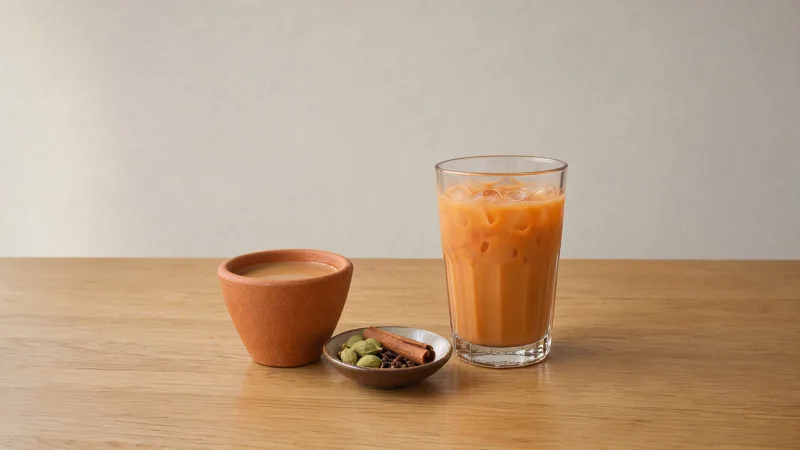
In India and Pakistan people boil the leaf in a pan with milk, sugar and spices instead of steeping it. Street masala chai took shape only between World War I and the 1930s; before 1930, over 90% of India's crop went abroad. Kashmir has its own noon chai, salty and pink, made from green leaf with baking soda. The milk teas of Hong Kong, Malaysia, Thailand, Myanmar and Taiwan also descend from British tea with milk and sugar, but they are made with cheap fine-cut leaf and canned milk and strained through a cloth sock. Bubble tea appeared in Taiwan in the 1980s.
In Tibet people simmer a brick of dark tea from Ya'an in Sichuan for anywhere from half an hour to half a day, churn the brew with butter and salt in a dongmo, and knead tsampa with it. Vietnam drinks tea three ways: fresh leaf in the villages, green Thai Nguyen brewed in a small pot for chuyên trà, and iced trà đá on the sidewalk. West Lake lotus tea from Hanoi is prized above all. In Myanmar and northern Thailand the leaf is steamed, then fermented away from air for a week to a year. Laphet and miang are chewed or tossed into salads, not steeped.
-
 South Asia
Tea in India, Pakistan, Bangladesh and Kashmir: masala chai, cutting chai, the kulhad, salty pink noon chai, kahwa, seven-layer tea and street chai.
-
 Asian milk teas
Milk tea in Hong Kong, Malaysia, Thailand, Myanmar and Taiwan: cloth tea sock, condensed milk, tea dust, ice and tapioca, and how each is made.
-
 Tibetan butter tea
酥油茶
Tibetan butter tea, po cha: Ya'an brick tea, dri butter and salt, the dongmo churn, tsampa, monastery tea rounds, Ladakh, Bhutan and the fluoride question.
-
 Vietnam
Tea in Vietnam: chuyên trà with a small clay pot and three cups, Tây Hồ lotus tea, green Thai Nguyen, iced sidewalk trà đá and ancient Shan tuyet.
-
 Laphet and miang
Laphet in Myanmar, miang in northern Thailand, sour tea in Yunnan: how the leaf ferments in pits and bamboo, and why it ends up in salads and at weddings.