Chaxi: the art of the tea table 茶席
The runner, teaware, flowers and scroll on a tea table are chosen for one tea and one idea. That is how Chinese and Taiwanese masters understand chaxi, and since 2019 the idea has been written into an association standard.
- What it is:
- a place for brewing and drinking tea, arranged with intent
- Modern form:
- Taiwan, from the late 1970s
- Nine elements:
- Qiao Musen, Chaxi Design, 2005
- Standard:
- T/CTSS 3-2019 and T/CTSS 3-2024
- Competition table:
- 1200 × 600 × 700 mm
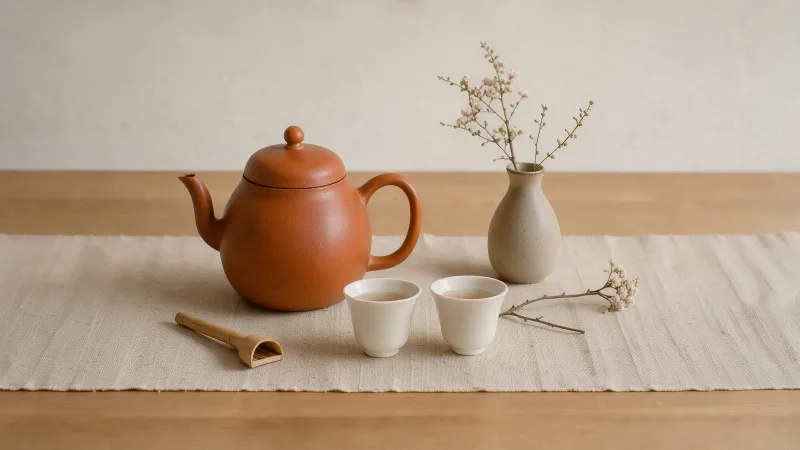
Chaxi (茶席) is a deliberately arranged place for brewing and drinking tea: a table or the floor, a runner, teaware, and, if you like, flowers, incense, a scroll and small objects chosen for the mood. The Chinese Tea Society defines it as a “spatial art” made of tea, utensils and other elements that serves brewing and conveys the thought and feeling of its author.1
Nearly every school agrees on one thing: the tea comes first. If guests remember the vase and not the liquor, the table was set badly.
What counts as chaxi
The Taiwanese theorist Cai Rongzhang distinguishes two meanings. The narrow one is the “brewing table” (泡茶席). The broad one also takes in the tea room, a tea house with an entrance hall and a washing area, and a tea garden. For him, chaxi is only a space planned to show the beauty or spirit of the way of tea, not just any place where someone made tea.
The word itself is old. In Japanese, 茶席 (chaseki) means a tea gathering or the room where it is held, and the earliest dictionary example dates to 1806. But chaxi as we know it, with deliberate composition and rules, took shape only in recent decades. Old tea gatherings are known from texts and paintings, yet they had no notion of “chaxi design”, writes the anthropologist Zhang Jinghong.
Nine elements
In 2005 Qiao Musen published Chaxi Design (茶席设计), the first monograph on the subject on the mainland. He named nine components:
- Tea, the “soul” of the chaxi and the starting point of the idea.
- A teaware set: ancient, new or “folk”.
- The base layer: fabric or bamboo, its color and how it is laid.
- Flowers.
- Incense and burners.
- A scroll or painting as backdrop.
- Art objects: tea pets, stones, figurines.
- Sweets and snacks.
- Background: a screen, a wall, nature.
Qiao stresses that the author may use only some of the nine. Cai Rongzhang goes the other way and would leave nothing but teaware on the table; in his view, music, flowers and incense scatter attention.
Cai sorts the teaware itself by function. The main group is the pot or bowl, the pitcher (gongdaobei), cups and stands. The auxiliary group is the fair cup (chahai), a towel, a leaf scoop and a timer. The water group is the kettle and the waste-water bowl. Storage jars he puts in a group of their own.
Composition
Qiao Musen describes a “central” structure that balances large and small, high and low, near and far. There are also “multiple” structures: linear, scattered, table combined with floor, sunken center.
Xie Zhizhang advises a rhythm of “front and back, high and low, dense and sparse”, and insists that every object stay within reach. Ouyang Feng builds the table outward from the teapot. He matches a stand, a pitcher, a waste-water bowl and cups to it, and only then turns to the textiles.
On the mainland the runner is called 桌旗, a “table flag”. Runners are made of cotton-linen, linen, ramie or bamboo. Linen creases after washing, and tea stains are hard to get out of light linen. Bamboo and ramie do not crease and absorb less, but they can only be rolled from the short side, or they break. Ouyang Feng suggests three layers: a plain cloth reaching the bottom of the legs, a “transition” layer, and a waterproof patterned mat. Two thirds of the mat go toward the guest and one third toward the host, with the center left empty for the teaware.
Keep to three or four colors. Coffee, light beige, light gray and navy are safe choices for a runner. Avoid dark ware on a dark runner; it looks heavy.
History from the Song to Taiwan
Burning incense, whisking tea, hanging paintings and arranging flowers: Southern Song writers called these four pastimes of an educated person the four leisurely artsfour leisurely artsA Southern Song list of the pastimes of an educated person: burning incense, whisking tea, hanging paintings, arranging flowers. (四般閑事). The phrase appears in Naidewen's Records of the Capital and in Wu Zimu's Dreams of Rice in the Millet Pot, in juan 19.2 It is a list of what was laid on for banquets, not a guide to setting a table.
The painting Literary Gathering (Northern Song, National Palace Museum, Taipei) shows a separate side table next to the big one, and a servant scooping powder with a long spoon, as in Song diancha. The museum considers the signature of Emperor Huizong doubtful.
In 1518 Wen Zhengming painted Tea Gathering at Mount Huishan: friends by a well in a pine grove, a servant boiling water. In the Ming, Xu Cishu's Cha Shu describes a separate tea hut with two stoves, a small table for pot and cups, a second for other ware, a rack for towels, and charcoal kept away from the fire. By then tea was already steeped as loose leaf, the way it was done in the Ming and Qing.
The modern chaxi came out of Taiwan. The 茶藝 (“tea art”) movement took shape there from the late 1970s, and through the 1980s and 1990s tea houses opened across the island. In 1988 Xie Zhizhang founded the Qingxiangzhai tea house in Taipei. Tall scent cups and the gongdaobei appeared in the same years. For the movement itself and Cai Rongzhang's Sans Self Tea Gathering (1990, or 1989 in one of his own tables), see Taiwanese tea arts.
Chaxi reached the mainland through courses, gatherings and competitions. In 2012 Li Shuyun moved from Taiwan to Beijing and opened the Wanxiangshi space. Zhang Jinghong notes that some masters regard the Japanese traits of Taiwanese chaxi (baskets and pouches for ware, low tables, silence) as Chinese in origin.
The T/CTSS 3 standard
In 2019 the Chinese Tea Society made the chaxi contest part of the standard T/CTSS 3-2019. The standard also specifies the equipment for the compulsory program:
| Item | Size or volume |
|---|---|
| Table for tea art | 1200 × 600 × 700 mm |
| Stool | 400 × 300 × 450 mm |
| Tea tray (chapan) | 500 × 300 mm |
| Tea towel | 300 × 300 mm |
| Yixing pot for oolong | 110 ml |
| Oolong cups | 25 ml each |
| Gaiwan for black tea | 150 ml |
| Glass for green tea | 200 ml |
These sizes serve the contest and are not meant as a canon of style. Still, the pairings in the standard show how pieces are matched: green tea in a glass, black tea in a gaiwan, oolong in a Yixing pot with two cups.
Theme and idea are worth 35 points, choice of teaware 30, color 15, background, flowers, scroll and objects 10, and the text with a title and a note another 10. In the 2024 edition, T/CTSS 3-2024, the “chaxi creation” module takes place inside a 2 × 2 × 2 m booth. Contestants get 120–180 minutes for setup, and the note is limited to 500 characters.
What to use with which tea
Start from the tea and choose the teaware to match. For oolongs, pu-erh and dark teas, Ouyang Feng takes a Yixing or wood-fired pot, with a stand, pitcher and cups of the same material. Glass, porcelain or a gaiwan suit green, yellow and black teas. Students at a Taipei academy ask themselves simple questions. Will the cup hold the aroma? Does its size suit the strength of the tea (strong tea goes into small cups)? Should the pot be doused on the outside so tightly rolled leaves open? Gongfu cha and Chaozhou gongfu show how tea is brewed at such a table.
How to set a table
The order below follows Xie Zhizhang, Cai Rongzhang and Global Tea Hut.
- Clean the space. In the Global Tea Hut tradition, cleaning is where chaxi begins.
- Decide where the table stands. Give the guests the best view, leave walkways, and do not set the table against the light.
- Count the guests and think about the season and the brewing method.
- Pick the tea and the teaware for it. Flowers come last, chosen for the finished table.
- Choose the runner. For dark tea and a large group, skip white: you will be pouring fast, and stains are certain.
- Place the teaware. The waste-water bowl goes on the side of the free hand, on the left for a right-handed host, so you can empty the tea boat (chachuan, the dish under the pot) without crossing your arms.
- Run a dry brew and move things around until every movement feels comfortable.
- Place the flowers so the guest sees them from the best angle.
If you use incense, light it before guests arrive and put it out once the scent becomes noticeable. Cai Rongzhang holds that the “olfactory atmosphere” should take up no more than a third of the gathering. A smoke displaysmoke displayThe pattern incense smoke draws: from heavy agarwood it creeps sideways, from light sandalwood it rises straight up. is better watched at a separate table, before the tea or during a pause.
Flowers are simpler: seasonal, without a strong scent, and without a kenzan pin holder, since sharp needles beside the cups jar the eye. The flower should not draw attention away from the teapot.
The commonest mistake is overloading the table. Global Tea Hut observes that at many events all attention goes to showy details while the “guest of honor”, the tea, gets lost. Li Shuyun puts it this way: “it is easy to make a show, hard to create a state.” The contest score sheet explicitly docks points for missing or extra teaware and for mismatched materials and shapes.
The Sans Self gathering, with its four cups per participant, its circle and its silence, is a form of its own within Taiwanese tea arts.
Common questions
How is chaxi different from an ordinary tea table?
By intent. A chaxi is built around a particular tea, season and set of guests, and the host runs through the brewing once with no tea in the pot to check that everything sits within reach. The Chinese Tea Society standard T/CTSS 3-2019 calls it a “spatial art” that serves brewing and conveys the author’s thought.
Does a chaxi need flowers and incense?
No. Qiao Musen treats the flower as a full element, while Cai Rongzhang advises keeping only teaware on the table and skipping music and incense altogether. If you do use flowers, pick ones without a strong scent that would compete with the aroma of the tea.
How many elements should a chaxi have?
As many as the idea needs. Qiao Musen lists nine but lets the author choose only some. The minimum is the tea and the teaware to brew it.
-
Chinese Tea Society, T/CTSS 3-2019, Technical Rules for Tea Art Skills Competitions: https://www.ttbz.org.cn/Home/PdfFileStreamGet/c3QsMjk1Mzk(eq) ↩
-
National Palace Museum (Taipei), “The Four Leisure Pursuits”: https://theme.npm.edu.tw/Academic/ChineseArtDownload.ashx?bid=9961&eid=219. Records of the Capital reads 不許戾家 and Dreams of Rice in the Millet Pot reads 不宜戾家; online editions of the Menglianglu print 累家, so the variants differ between editions as well. ↩